A quantum clock is a timekeeping device that exploits the discrete energy levels of quantum systems — atoms, ions, or even single photons — to mark time with extraordinary precision. Unlike classical clocks that count mechanical or electronic oscillations, quantum clocks use the frequency of light absorbed or emitted when a quantum system transitions between energy states. This frequency is an intrinsic property of the system, making the clock highly stable and reproducible. The most advanced examples are optical lattice clocks and nuclear clocks, which can detect minute changes in the flow of time caused by gravity, as predicted by general relativity.
History
The concept emerged from the development of atomic clocks in the mid-20th century, with the first cesium atomic clock built by Louis Essen in 1955. Quantum optical clocks using laser-cooled atoms were developed in the 1990s and 2000s, and thorium nuclear clocks are a recent proposal still under development.
How it works
The clock works by locking a laser to a specific quantumtransition — for instance, the energy difference between two electron orbitals in an atom. The laser frequency is tuned until it resonantly drives the transition, and the clock counts the laser's oscillations as 'ticks'. Because the transition frequency is fixed by quantum mechanics, any drift in the laser is corrected by feedback, keeping the clock accurate. For gravitational time dilation tests, two such clocks at different heights tick at slightly different rates; the higher clock runs faster, and the difference can be measured with quantum-limited sensitivity.
In practice
Quantum clocks underpin GPS navigation, synchronize telecommunications networks, and are used in fundamental physics experiments to test relativity and search for variations in fundamental constants.
Fun fact
A quantum clock based on a single trapped ion is so precise that if it had been running since the Big Bang, it would have lost or gained less than one second over the entire age of the universe.
The orchestra plays without a conductor. Each instrument follows its own schedule: the violin on Monday, the flute on Wednesday, the timpani on Saturday. Astronomers hear not music but isolated notes scattered across the calendar. A telescope sees a star only when it is above the horizon and when the schedule has allotted time for it.
The pendulum in these clocks doesn't swing from a spring or a weight, but from a tiny kick inside the atomic nucleus. Ordinary atomic clocks keep time by the oscillations of electrons, but here the pendulum is the nucleus itself — a dense ball of protons and neutrons.
A quantum particle moves in a circle, passing through several stations. At each station, something happens to it — for example, its properties change slightly. After completing a full circle, the particle returns, but its state is no longer exactly what it was at the start.
Imagine a quantum phase transition as an intricate dance. Electrons whirl in strict order, each step representing their spatial arrangement, and the rhythm their dynamics. For decades, physicists could only see a blur of motion, unable to tell if the figures were changing or the music speeding up.
An orchestra of billions of cesium atoms struck a single note, and it sounded for 17 hours without fading. That’s no exaggeration: Chinese physicists created a continuous time crystal with a record-breaking lifespan. A time crystal is a system that breaks time symmetry, spontaneously pulsating in an unchanging rhythm.
A pendulum that swings almost half a quadrillion times per second. This isn't mechanics: it's the pulse of light trapped by ytterbium atoms. Instead of gears, there's an optical lattice — a standing wave that holds atoms at its nodes like peas in a pod.
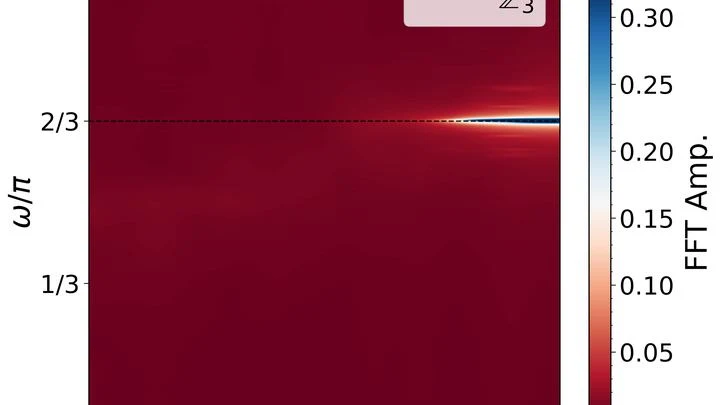
An ordinary pendulum swings at the same frequency as the push it receives. But in the quantum world, you can create a system that responds to a push two, three, or more times slower, as if it has its own rhythm. Such systems are called discrete time crystals.
A stone falls into a well, and the splash reaches your ears with a delay. Something similar happens to light as it leaves Earth: its oscillations become less frequent, the beam seems to 'tire.' This is gravitational redshift — a phenomenon Einstein spoke of a century ago.
Drop a stone into a pond, and ripples spread across the water. As the stone sinks, the waves radiate outward and gradually fade. But if you look at the very fabric of spacetime, it turns out things work a bit differently.
A film of a shattered cup played backward looks absurd: shards don't spontaneously reassemble. This intuitive sense of irreversibility is tied to the increase of entropy — a measure of disorder in a system. The second law of thermodynamics states that the entropy of an isolated system never decreases, setting time's direction from past to future.
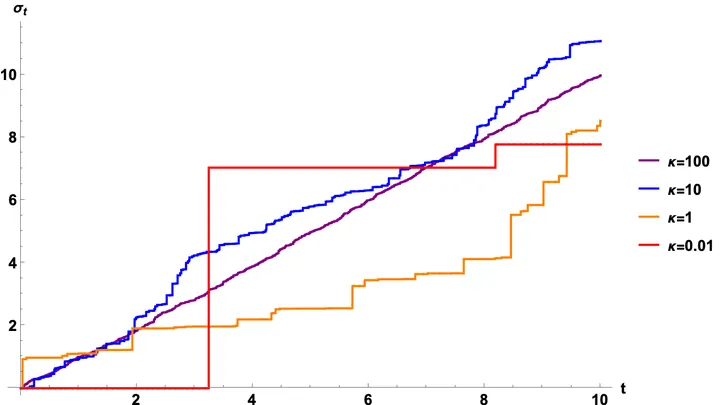
A regular wall clock runs smoothly, but quantum clocks are a different story. They tick at random moments, and each tick can have a different duration. On average, if you watch such a clock for a long time, it will show the correct time. But at any given moment, its hand might jump forward by an unexpected amount.
Since Vera Rubin first convincingly showed that galaxies are surrounded by invisible matter, the quest to understand the nature of dark matter has remained one of physics' greatest challenges.
Time flows slower near the ground than on the roof: this was predicted by Einstein in his theory of relativity. To spot the tiny difference, physicists propose using a pair of photons, linked like voices in a duet.
Heat an ordinary quartz watch by ten degrees, and it will start losing seconds each day. Atomic clocks are more precise, but they take up an entire cabinet. Diamond with a tiny defect, a nitrogen vacancy, promises atomic-clock accuracy in the volume of a grain of sand.
Time is like a highway: from afar it looks flawlessly paved, but zoom in and every pothole appears. These bumps are the quantum fluctuations of the vacuum, making it impossible to measure the journey exactly. Physicists built a clock model whose operation relies on spontaneous particle creation from the void.
We’re used to time flowing only forward. But quantum laws let it become like a coin showing heads and tails at once.
Take a particle with its own spin — its intrinsic rotation. In a magnetic field, it spins like a top. Send this particle through a device where two opposing magnetic flows fight each other — and it will start moving into the future and the past at the same time.
In the lab, time usually ticks on the wall: hands, digits, a frequency standard. But for the Universe, there are no external clocks. The Wheeler–DeWitt equation, the main law of quantum gravity, contains no time at all, and all fundamental theories lack an inbuilt arrow of time.