Vacuum Controls Magnetism
In a pot of boiling water, steam bubbles appear and disappear — a similar struggle takes place in two-dimensional materials. Here, electrons both create magnetism and try to extinguish it.
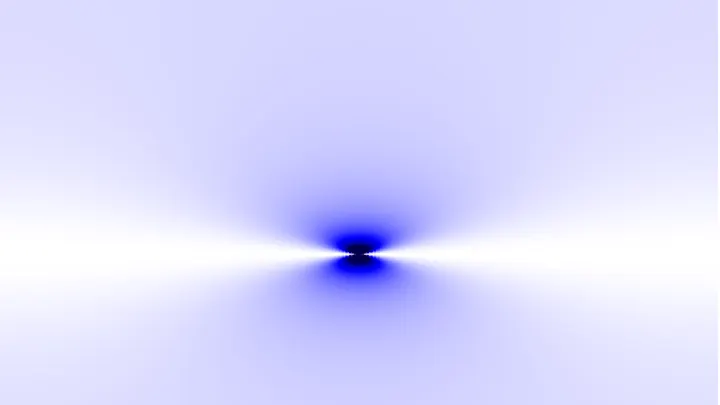
Thin layers in space where the vacuum properties change abruptly, forming during a phase transition.Domain walls are hypothetical, sheet-like structures that could form in the early universe when a symmetry-breaking phase transition occurs. In particle physics, such a transition would cause different regions of space to settle into different vacuum states — the lowest-energy configurations of a field. Where two regions with different vacuum states meet, a boundary layer forms, and that boundary is a domain wall. These walls would carry enormous energy density and, if they existed today, would dominate the universe's expansion, which observations rule out. This is why their absence is a puzzle: either the phase transition never happened, or some mechanism (like inflation) diluted or destroyed the walls.
The concept emerged in the late 1970s and early 1980s from work on spontaneous symmetry breaking in grand unified theories, notably by Tom Kibble and others, who studied topological defects like cosmic strings and monopoles.
Imagine a field that, at high temperature, has a single symmetric minimum (like a bowl). As the universe cools, the field develops two or more equivalent minima (like a double well). Different patches of space randomly choose different minima. Where two patches meet, the field must interpolate smoothly from one minimum to the other, creating a thin region of high energy — the domain wall. The wall's tension and energy density depend on the field's potential and coupling, but in simple models they are enormous, far exceeding the critical density of the universe.
Domain walls are primarily of theoretical interest in cosmology and high-energy physics, but similar topological defects appear in condensed matter systems, such as ferromagnets and liquid crystals, where they are studied experimentally.
If domain walls existed today, they would create a gravitational pull so strong that the universe would have collapsed long ago, which is why their absence is a strong constraint on particle physics models.