Quantum Clocks with Three Ticks express
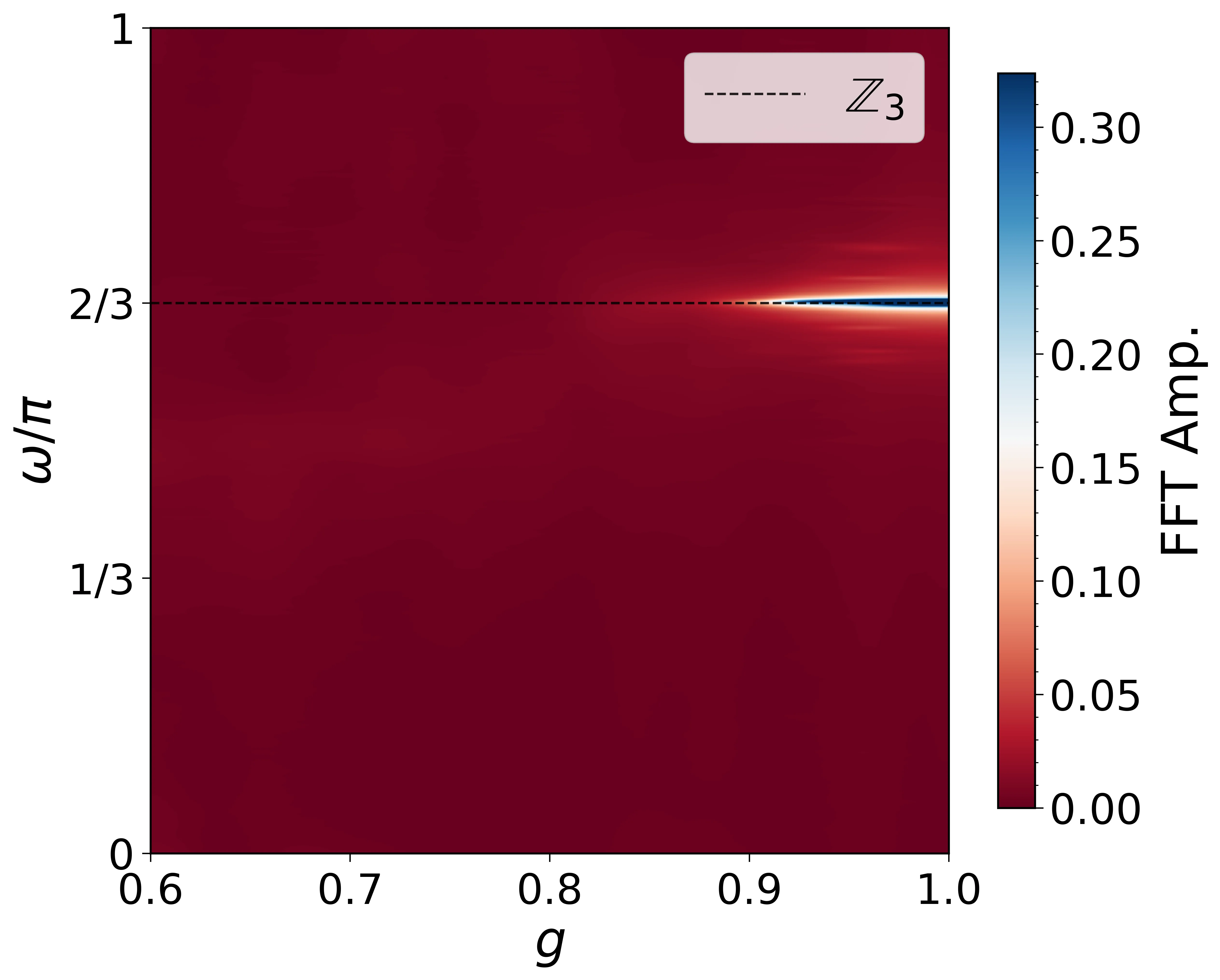
An ordinary pendulum swings at the same frequency as the push it receives. But in the quantum world, you can create a system that responds to a push two, three, or more times slower, as if it has its own rhythm. Such systems are called discrete time crystals. Until now, almost all experiments were limited to period doubling on the simplest elements — qubits (quantum analogs of bits with two states).
In the new work, physicists assembled a chain of 15 superconducting qudits — elements that can exist in three states, like a switch with three positions. The chain was periodically shaken with microwave pulses, and in response it began to pulse with a period three times longer than the external drive. This is a time crystal with $\mathbb{Z}_3$ symmetry.
Chirality acts as a conductor that makes all domain walls, boundaries between regions with different oscillation phases, move coherently. Thanks to this, the period tripling persists even with slight disorder in the coupling strengths and does not depend on how the system was initialized. The experiment with qudits opens the door to exploring a richer set of nonequilibrium phases of matter that were previously inaccessible with ordinary qubits.
Qudits with three states are called qutrits. If a qubit is a coin (heads or tails), a qutrit is a die that can show 1, 2, or 3 pips.