A discrete time crystal is a phase of matter that breaks time-translationsymmetry in a very particular way: it oscillates with a period that is an integer multiple of the period of the external force driving it. While a standard system driven periodically will respond with the same period, a time crystal 'locks' into a subharmonic response, like a pendulum that takes two pushes to complete one full swing. This happens without any energy input beyond the drive, and it persists indefinitely, defying the usual expectation that a many-body system will eventually thermalize and lose all memory of its initial state.
History
The concept was proposed by Frank Wilczek in 2012, but his original idea of a spontaneously oscillating ground state was shown to be impossible. The discrete time crystal, driven by an external periodic force, was first realized experimentally in 2016 by groups at Princeton and the University of Maryland, following a theoretical proposal by Dominic Else and colleagues.
How it works
The key is a combination of many-body localization (which prevents the system from absorbing energy and heating up) and a carefully engineered drive that flips the system's state each time. The system's quantum state is arranged so that after one period of the drive, it returns to itself only up to a symmetry operation (like flipping all spins), so it takes two periods to truly repeat. This 'time-crystalline' order is protected by the localization, making it stable against perturbations.
In practice
Time crystals are being explored as ultra-stable oscillators for precision timekeeping and as sensitive sensors for magnetic fields and other perturbations, potentially outperforming conventional atomic clocks in certain regimes.
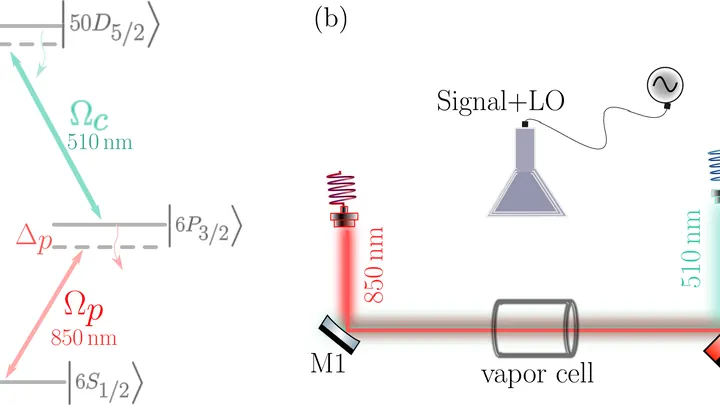
Moiré patterns are familiar to everyone. Two combs with different spacing, placed on top of each other, show dark fringes. Something similar has emerged in time. Physicists took a cloud of Rydberg atoms, particles with unusually large electron orbits, and illuminated it with two lasers.
An orchestra of billions of cesium atoms struck a single note, and it sounded for 17 hours without fading. That’s no exaggeration: Chinese physicists created a continuous time crystal with a record-breaking lifespan. A time crystal is a system that breaks time symmetry, spontaneously pulsating in an unchanging rhythm.
Diamond is a symbol of perfection, but its true magic is revealed through flaws. Perfect lattice purity gives transparency and hardness, while defects, such as color centers, open a portal to the quantum world, becoming the foundation for quantum computers and quantum sensors.
The river of time may not be a smooth flow but a sequence of minuscule steps, like a stop-motion film shot with an unimaginably fast camera. In 1964, Yu. A. Golfand suggested that time moves not continuously but in tiny jumps, and derived an equation that predicted an inevitable increase in disorder (entropy).
A pendulum that swings on its own, without any winding — in the quantum world, such 'pendulums' are called time crystals. In them, rhythmic motion arises spontaneously and does not decay. But until now, controlling this rhythm was nearly impossible: any intervention threatened to destroy the fragile order.
The universe is expanding faster and faster thanks to dark energy. But measurements of the rate give contradictory results. A new explanation: in the past, dark energy acted as a brake, slowing the galaxies' recession, and then switched to acceleration. Like a car that first rolls backward and then lunges forward.
Time crystals are quantum phases of matter that spontaneously oscillate, like a tuning fork with an infinitely decaying echo. If an ordinary spatial crystal repeats an atomic pattern in space, breaking translational symmetry, a time crystal exhibits periodicity in time, breaking time translation symmetry.
Two quantum particles are linked by an invisible thread: one loses energy, the other gains it, but the total remains unchanged. If you watch only the first, its oscillations don't fade — the rhythm is steady, like that of a cosmic pulsar, even though it seems that entropy and chaos are increasing.
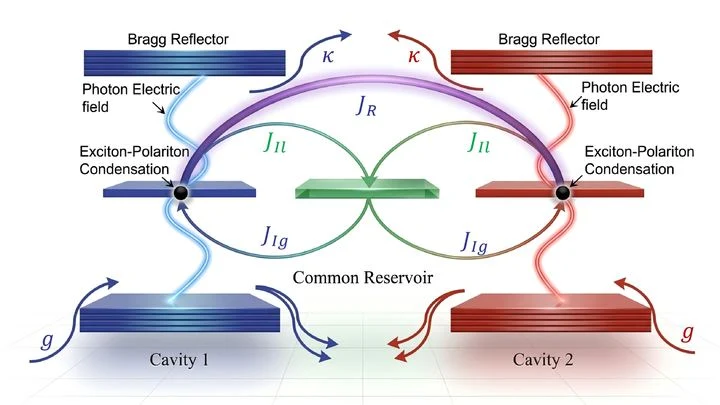
The pendulum of an old clock swings because a spring mechanism gives it a regular nudge. Now imagine a pendulum that decides on its own when to swing, and does so with a steady rhythm, just because the room is warm and there's a slight draft. That's exactly how time crystals behave, born in clumps of light and matter inside a semiconductor chip.
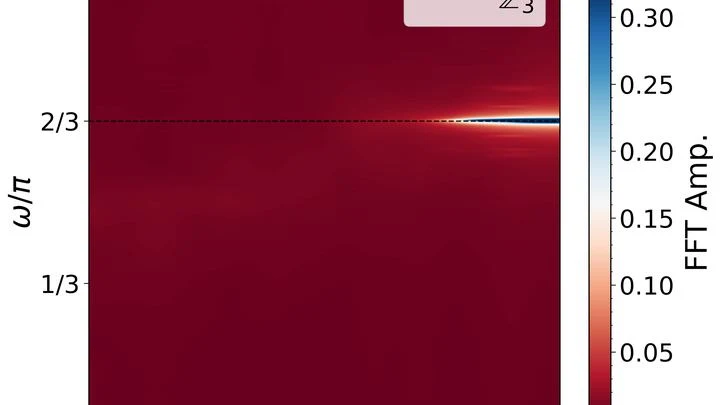
An ordinary pendulum swings at the same frequency as the push it receives. But in the quantum world, you can create a system that responds to a push two, three, or more times slower, as if it has its own rhythm. Such systems are called discrete time crystals.
When hot soup cools, clumps form on the surface — similarly, as the early universe cooled, it gave birth to threadlike clumps of energy: cosmic strings. Some of them are like a stretched rubber band: as long as it's intact, it's stable. But if you nick the band, it snaps.
A time crystal is a system pulsing with a steady rhythm, like a metronome. A row of swings, pushed rhythmically, usually rocks in sync. But with a clever setup, they start a full cycle every two pushes. That is a discrete time crystal. The main obstacle is heating: continuous kicks destroy order, breeding chaos.
A coin spinning on a table is a familiar sight. At first it rotates quickly, then it tilts, and its rattling becomes faster and faster. In the last seconds it seems to hover: the rotation slows, but the coin just won't finally lie flat. This final moment is a real puzzle for physicists.
A cloud of cesium atoms was made to behave like a single quantum string. By shining a laser and letting the particles interact, scientists launched self-sustaining oscillations — a rhythm emerged without an external conductor.
Radio waves acted like frets on a fingerboard: it was possible to smoothly vary the sounding frequency.
An ordinary superconductor works like a perfect conductor: electrons pair up and flow without resistance. In the new material TaPtSi, the pairs are arranged differently: their internal symmetry is skewed, and when cooled below the critical temperature, tiny magnetic fields spontaneously emerge inside the crystal.
Time crystals are an exotic phase of matter that exhibits periodic motion not in space but in time, even while in its ground, unexcited state. This idea, reminiscent of a perpetual clock that never needs winding, was first proposed by Frank Wilczek.
Water in a glass settles down once you stop stirring it. Oil in an engine dampens vibrations. It seems viscosity is always about damping. But in some flows, it's the opposite: add friction, and waves start to grow as if from nowhere.
Physicists have found a simple explanation.
Heat an ordinary quartz watch by ten degrees, and it will start losing seconds each day. Atomic clocks are more precise, but they take up an entire cabinet. Diamond with a tiny defect, a nitrogen vacancy, promises atomic-clock accuracy in the volume of a grain of sand.
Time crystals pulse in time, like a perpetual metronome that never needs winding. The idea was proposed by Frank Wilczek almost ten years ago. Previously, to keep such a metronome from losing its beat, disorder was deliberately introduced into the system — a paradox, but chaos helped the rhythm.
In the quantum world, noise usually destroys orderly behavior, like random jolts damping a pendulum. But on IBM quantum processors, physicists discovered the opposite: structured noise can prolong and even create rhythmic oscillations. It's like a pendulum that swings harder from seemingly chaotic yet internally synchronized pushes.
A pendulum receives a kick but returns to its starting position not after one period, but after two. That is how a discrete time crystal behaves: a phase of matter that spontaneously breaks discrete time-translation symmetry and oscillates with a period that is a multiple of the driving period.
In a chain of cold spins stretched along a single line, order and disorder can intertwine into a pattern that defies the usual rules. Two states of matter, two kinds of "order," are separated by a crossroads where the roads do not converge but diverge.