Aging as Losing the Wheel express
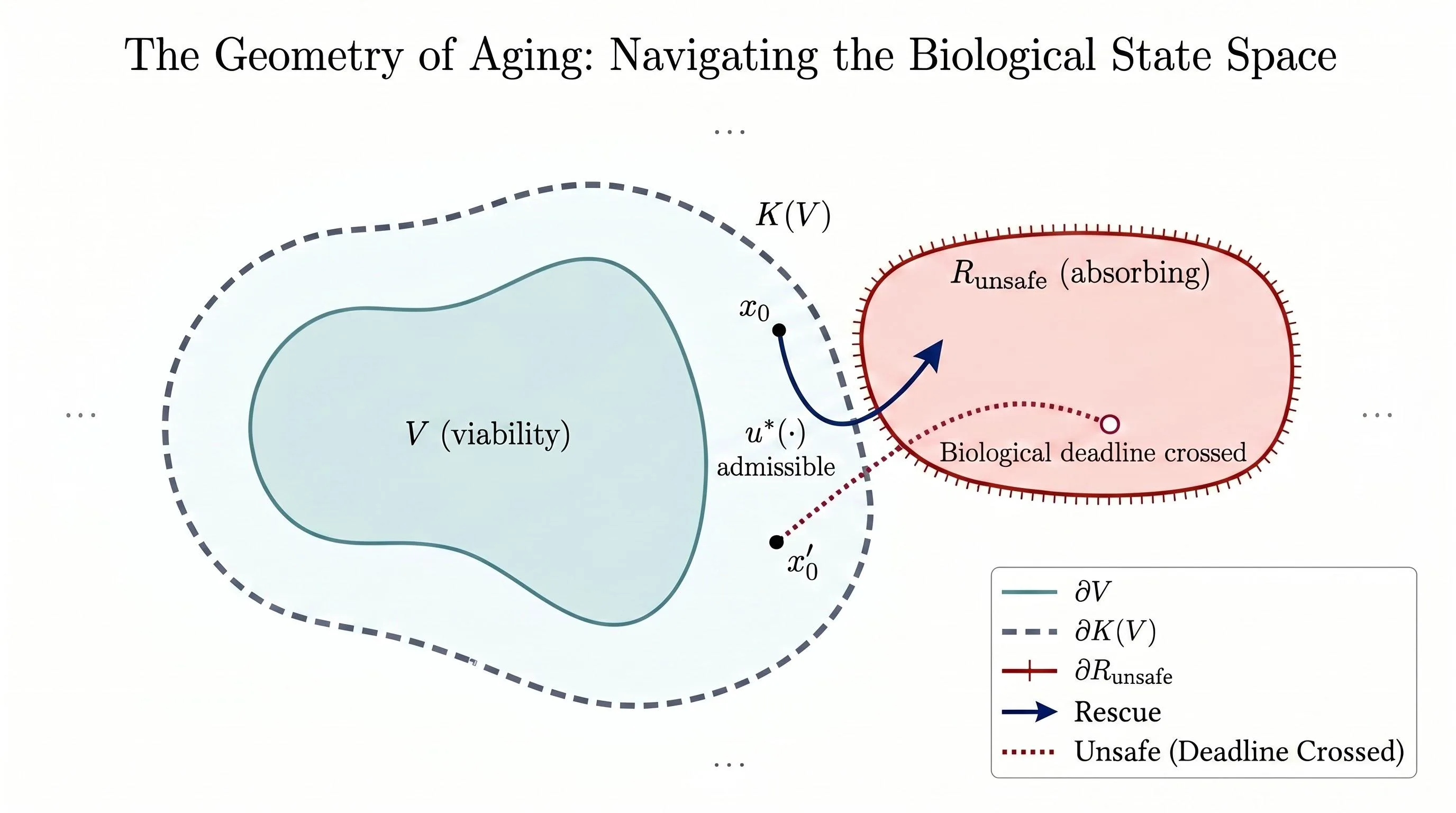
In a car, the steering, brakes, and accelerator gradually fail. At first, you can still swerve around a pothole, but each year the maneuver takes more effort. At some point, even a perfect road becomes impassable — the car no longer obeys the driver.
That's exactly how the authors describe aging: not as the accumulation of rust or wear and tear, but as the loss of "controllability" of the body. In this picture, biological age is not the number of years lived, but the minimum price you have to pay (in drugs, procedures, time) to bring the body back into a safe, working zone. The older the system, the more expensive and complex it is to "repair" it to normal.
The most surprising conclusion concerns the order of actions. Two drugs taken in different sequences can lead to opposite results, just as in a car you must first press the clutch and then shift gears, not the other way around. Mathematically, this is described by the concept of "non-commutativity" (when the result depends on the order of operations): for two interventions A and B, the effect of A followed by B is not equal to the effect of B followed by A. The authors built a model of five equations that computes the optimal sequence and dosage, and then tested it on real data on age-related changes.
The practical goal is not just to find another "anti-aging drug," but to give pharmacologists a tool to calculate which intervention, at what time, and in what combination will truly rejuvenate cells, rather than just shift lab values. The authors formulated twenty testable predictions — if they hold, the search for therapy will become not a blind trial-and-error, but a precise engineering calculation.
In mathematics, the "Lie bracket" is a way to measure how much two actions interfere with each other when performed in different orders. The same apparatus is used in quantum mechanics and robot control theory.
In Isaac Asimov's novel "Foundation," mathematician Seldon predicts the future of civilization using equations — here, equations predict how to restore youth to an individual organism.