q-bio.MN q-bio.MN

24 articles

articles

q-bio.MN2026-01-273 minarXiv:2601.90004
Skin as a City: How to Rejuvenate an Entire Organ
Every morning the city wakes up and starts repairing itself: workers replace asphalt, painters coat facades, street sweepers haul away trash. You can picture skin as just such a city, where worker cells constantly renew the streets and buildings.

q-bio.MN2026-01-311 minarXiv:2602.00586express
Teaching a Neural Network to Read Textbooks
Proteins in a cell communicate like people in a bustling city: some pass signals, others put on the brakes, and still others just hang around. A graph neural network sees the map of these connections, who's linked to whom, but to it, they're just lines.
q-bio.MN2026-02-282 minarXiv:2602.90001
How Yeast Hit the Reset Button on Life: Cellular Rejuvenation in a Microchannel
The yeast that bakes our bread knows how to cheat time. Its sex cells are born with a full supply of divisions, even if the parent cell has already grown old. But exactly how a cell clears out accumulated damage long remained a mystery: measuring the age of hundreds of gametes by hand was far too labor-intensive. Now scientists have built a microfluidic assembly line.
Statistical Mech2026-03-041 minarXiv:2603.03866express
The Secret of Muscle Contraction: The Physics of Tiny Magnets at the Protein Level
Muscle contraction is driven by two types of protein filaments: thin carbon actin filaments and thick myosin filaments that act as molecular motors. At rest, a special protein safety catch, tropomyosin, blocks the myosin-binding sites on actin.
q-bio.MN2026-04-051 minarXiv:2604.04285express
Amplify Without Spending a Drop of Fuel
A molecular amplifier is like a door latch: a weak signal opens the way for a strong one. In living cells, such amplifiers work constantly, but they almost always burn fuel. Can you amplify a signal without expending energy?
q-bio.MN2026-05-162 minarXiv:2605.16781express
Aging as Losing the Wheel
In a car, the steering, brakes, and accelerator gradually fail. At first, you can still swerve around a pothole, but each year the maneuver takes more effort. At some point, even a perfect road becomes impassable — the car no longer obeys the driver. That's exactly how the authors describe aging: not as the accumulation of rust or wear and tear, but as the loss of "controllability" of the body.
q-bio.BM2026-05-191 minarXiv:2605.19252express
The Chemical Signature of Life: How to Find It by Its Elements
From carbon, nitrogen, oxygen, and sulfur, you can assemble 10⁶⁰ different small molecules: that's a 1 with 60 zeros, more than the stars in the visible universe. Life uses only a tiny fraction of this menu, but not randomly.
A Genetic Anchor for Health
You buy a new kitchen scale, but instead of exact weight, it only shows deviations from some "norm." To find out how much an apple weighs, you first have to weigh dozens of other apples and calculate the average.
q-bio.MN2026-06-143 minarXiv:2606.15905
Six Strings of a Living Orchestra
In 1943, Erwin Schrödinger gave a lecture in Dublin that later became the book What Is Life? A physicist who had fled the Nazis, he asked a question that seemed almost indecent at the time: can living things be explained by the laws of physics? He proposed that heredity is stored in an "aperiodic crystal," ten years before the discovery of the DNA double helix.
q-bio.MN2026-06-151 minarXiv:2606.16803express
How Cell Division Rewrites a Cell's Fate
Inside every cell, a complex network of genes determines what it will become — a nerve cell, a muscle cell, or part of the skin. This choice often resembles flipping a toggle switch: two stable positions, and the cell decides which way to tip. But cells have a feature rarely considered in such models: they divide.
q-bio.MN2026-07-033 minarXiv:2607.03545
The Cellular Orchestra: How Genes Learn to Play in Tune with Chaos
In embryonic development, a cell resembles a musician in a vast orchestra: it must play its part, following a conductor — the gradient of signaling molecules. But the conductor is unreliable: morphogen concentrations constantly fluctuate. How then does a cellist not veer into a violin melody?
q-bio.MN2026-08-051 minarXiv:2608.04635express
A Recipe for a Cell: Why Chemistry Can't Be Programmed in a Hurry
A cookbook without a shopping list: that's what a scientist faces when looking at a scheme of chemical reactions. The arrows and formulas on paper look neat, but once you start hunting in the lab for molecules that will actually behave that way, a real quest begins.
q-bio.GN2026-08-082 minarXiv:2608.07865express
Why the Tumor Doesn't Glow for Everyone
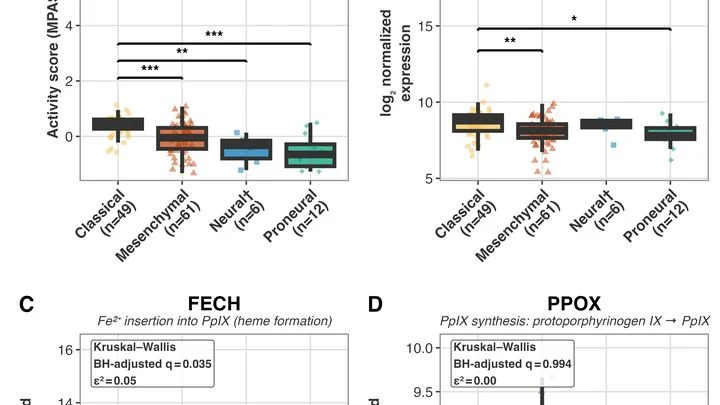
Imagine a workshop where glowing paint is assembled. A worker takes a precursor, adds the right pigment, and the paint is ready. Nearby, a supervisor redirects some of the paint to another warehouse and dumps the rest as waste. Similarly, brain tumor cells themselves produce the substance that makes them glow under the surgeon's blue lamp.
Biological Physics2026-08-092 minarXiv:2608.08571express
Why biological recognition doesn't snap but smoothly switches
When an antibody meets a virus, it doesn't latch on with a single death grip. Rather, it's like two bunches of grapes tumbling in water, catching each other with dozens of short tendrils. Each tendril is weak on its own, easily torn by the thermal jitter of water molecules, but together they hold tight.
q-bio.QM2026-08-092 minarXiv:2608.08916express
A Protein Orchestra Without a Conductor
As you slowly turn the tuning knob of an old radio, the sound doesn't fade in gradually from the static: it bursts forth in a sudden jump, the moment the antenna hits resonance with the wave. Genes in a living cell behave much the same way.
q-bio.MN2026-08-283 minarXiv:2608.90060
NOTCH3 as the conductor of the vascular wall
Inside the wall of every artery, a concert plays without pause. Smooth muscle cells, which line the vessel from within, simultaneously build a supporting scaffold of collagen, remodel their own internal skeleton and extract energy from glucose. Conducting this orchestra is the NOTCH3 protein, which sits on the cell surface and catches signals from its neighbors.
q-bio.MN2026-09-013 minarXiv:2609.90017
PIF1: the guard that untangles knots and fans the flames
Every time a cell divides, the protective caps on the ends of its chromosomes, known as telomeres, get shorter. Once those caps become too short, the cell stops dividing.
q-bio.MN2026-09-073 minarXiv:2609.90007
MicroRNA-128: A Master Switch for Muscle Aging
An old mouse hangs on a wire two-thirds longer than a mouse its own age, and after running on a treadmill it doesn't collapse from exhaustion. The difference isn't training or diet: the mice had a single molecule suppressed, and their muscles worked like they did in youth. That molecule is microRNA-128-3p, a short chain of nucleotides that silences entire groups of genes.
q-bio.MN2026-09-072 minarXiv:2609.90021
The Cell as Orchestra: Getting Blood Vessels Back in Tune in Progeria
In the orchestra of the cell, there is a tuner that muffles one important note far too aggressively. That note is a chemical mark on the protein that packages DNA, and once it disappears, the cell starts to play out of tune: it repairs its genes less accurately and ages faster. In Hutchinson-Gilford progeria syndrome, a rare disease of accelerated aging, blood vessel cells lose exactly this mark.
q-bio.MN2026-09-073 minarXiv:2609.90031
Precision That Doesn't Get in the Way of Change
An architect reinforces the foundation but leaves a door open for remodeling: that's how living systems balance reliability against renewal. A cell copies hereditary information with a fidelity any scribe would envy, yet it can also allow changes that help it survive under new conditions.
q-bio.MN2026-09-112 minarXiv:2609.90025
Two Axes of Life: How a Blood Test of 11,124 People Drew a Map of Growing Up and Growing Old
Picture every blood test as a dot on a large map. Plot thousands of those dots and they won't scatter at random: they line up along two main roads. One road separates men from women, the other stretches from youth to old age. Follow these roads and you can see how a person grows up, lives and grows old.
q-bio.MN2026-09-132 minarXiv:2609.90064
The cellular atlas of aging: how 3.5 billion cells reveal the architectural remodeling of organs
Human tissue is like a city: dense neighborhoods of specialized cells, streets of blood vessels, plazas of functional units. As we age, this city gets remodeled. Researchers from the GTEx project examined 14,788 tissue sections from 980 donors and segmented 3.5 billion cells across 16 organs to see how this architecture changes.
q-bio.MN2026-08-072 minarXiv:2608.90078
The Sleeping Enzyme You Can Wake Up
An old house often has a locked cabinet full of tools: everything is there, but nobody fixes anything. Aging cells work much the same way. They accumulate the enzyme NAMPT, which kicks off production of the molecule NAD+, a sort of fuel for cellular processes. But in old cells that fuel is burned slowly, and the enzyme sits idle. NAMPT is the key that opens the door to NAD+.
q-bio.MN2026-06-252 minarXiv:2606.90005
Seven Witnesses to One Longevity: How Metabolites Reveal a Shared Signature
Five different roads lead to a single destination: a long life. Some mice received drugs, others ate 40% less than usual. After eight months, seven tissues were collected from all of them: brain, liver, muscle, kidney, fat, blood. Each tissue is a separate witness, seeing what happens from its own angle.