Neurons as Conductors: Why the Brain Can't Learn Without Them express
An orchestra at its first rehearsal without a conductor. Violins come in at the wrong time, brass is late, and instead of a symphony, you get cacophony. That's roughly how a computer model of the brain behaves when you remove special cells — von Economo neurons. These are large, spindle-shaped cells (about the size of two or three regular neurons), found in areas responsible for communication and understanding others, and they mysteriously disappear in certain diseases.
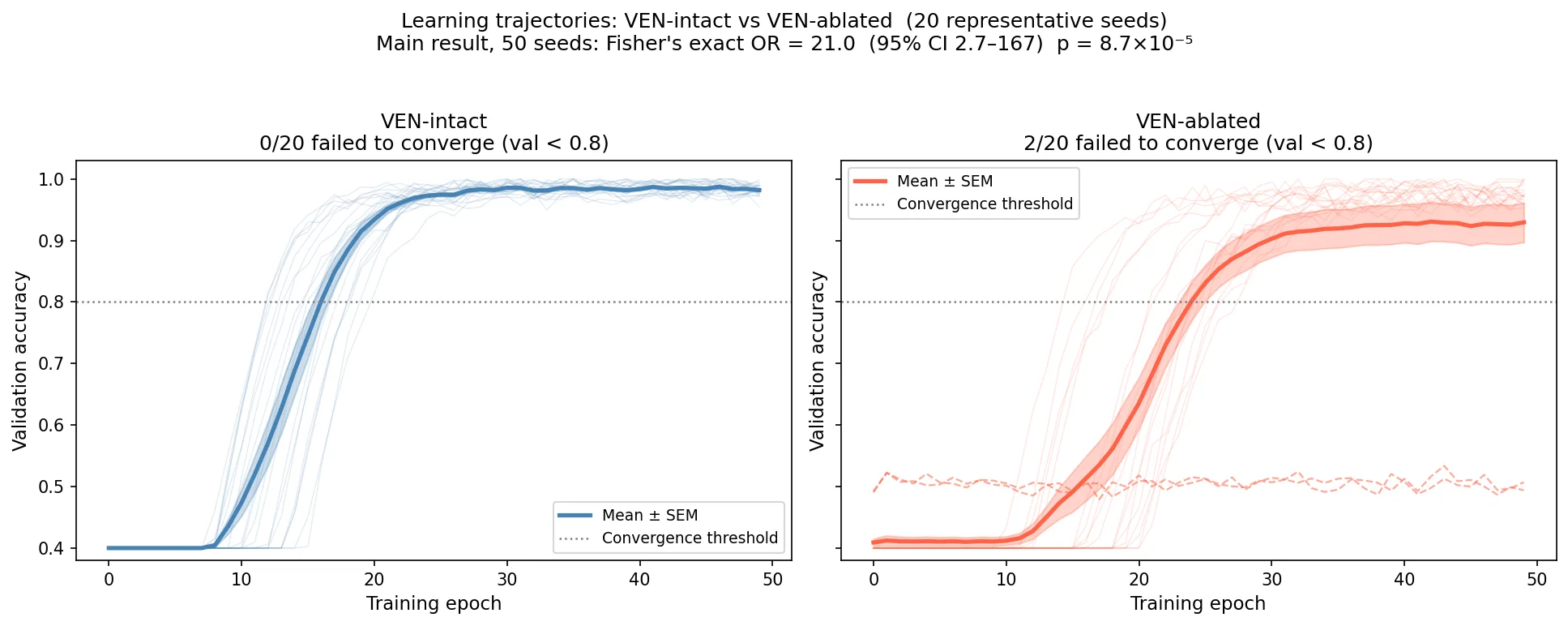
In the new study, neuroscientists built a simplified neural network of 2000 cells, of which only 40 were such "conductors." The network was trained to distinguish between two types of signals — roughly like telling a cat from a dog. With the conductors, learning succeeded in 49 out of 50 cases. Remove them, and the network stalled in 15 out of 50 cases: every third "brain" failed to learn at all.
Why is that? Regular neurons in the network communicate through feedback loops, and the signal can fade or blow up — mathematicians call this "Jacobian instability." Von Economo neurons create a direct bypass route, allowing the learning signal to travel without distortion. Like a courier with an important package on a dedicated lane, avoiding traffic jams.
Once learning is complete, the conductors are no longer needed: the network works without them. However, in 4 out of 20 networks, performance dropped sharply — apparently, they became "dependent" on the bypass. This is reminiscent of scaffolding: while the building is going up, it's essential, but the finished house stands on its own.
This fragility of learning explains why people with autism, who have fewer of these cells, develop social skills very unevenly — from nearly normal to severely impaired. The mathematical model predicts that in lab-grown mini-brains with von Economo neurons removed, learning will fail stochastically, and this can be tested in the lab.
Von Economo neurons are found only in humans, great apes, elephants, whales, and dolphins — animals with complex social behavior.
In the novel "Flowers for Algernon," the protagonist gains and loses intelligence through brain intervention — new data hint that losing just 2% of special cells could cripple the ability to learn.