How Young Galaxies Ignite Gas express
If you turn on a lamp in a room, it illuminates the walls. But if you place the same lamp in a vast hall, the light barely reaches the corners. Similarly, radiation from young stars affects gas in a galaxy: it knocks electrons out of hydrogen atoms, making the gas glow. Astronomers call this 'ionization' and the strength of this effect the ionization parameter.
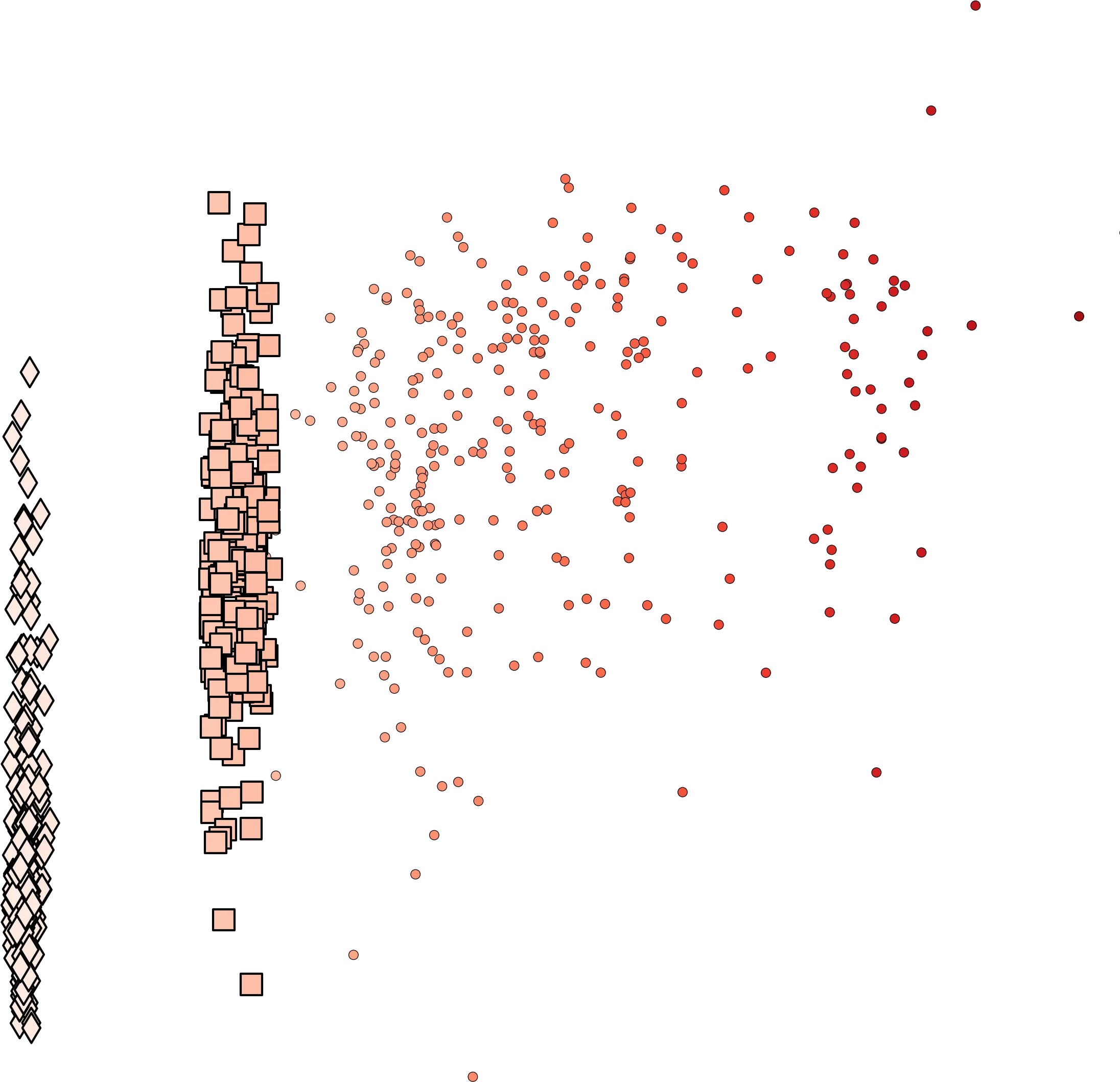
Before the launch of JWST, this parameter could not be measured in very distant galaxies: those we see as they were a few hundred million years after the big bang. Now, thanks to spectra of 434 galaxies with redshifts from 3 to 9, scientists have for the first time traced how the ionization parameter changed over 13 billion years. They compared distant objects with closer ones studied earlier and found a clear trend: the higher the redshift (i.e., the further back in time), the more strongly stellar radiation stirs up the gas.
But the most interesting part is that this dependence is stronger than simple models predicted. Even accounting for galaxy mass and star formation rate, the ionization parameter is still higher at large redshifts. The authors propose an elegant explanation: early galaxies were smaller in size. If the volume of the gas region is roughly proportional to the galaxy's total volume, then in a compact system, light from stars reaches the boundaries faster and ionizes gas more efficiently. It's like the same lamp in a small room: it illuminates everything much brighter than in a spacious hall.
The ionization parameter is denoted by the letter U, and it is dimensionless — simply the ratio of two quantities: the flux of ionizing photons to the hydrogen density. But even with perfect measurements, the uncertainty in its value can reach 0.3 dex (i.e., a factor of two) because different nebular models produce the same oxygen line ratios.
In Carl Sagan's novel 'Contact', an alien signal contains blueprints for a machine capable of warping space. To understand the physics of distant galaxies, astronomers also have to decipher 'blueprints'—spectra where oxygen lines tell us how starlight interacts with gas.