Stellar radiation encompasses the entire electromagnetic spectrum and particle flux emitted by a star, from radio waves to gamma rays, along with charged particles like the solar wind. This radiation is the primary means by which a star influences its surroundings, shaping planetary atmospheres, driving space weather, and even triggering phenomena like auroras. The balance between a star's radiation pressure and gravitational pull determines the structure of its outer layers, and the radiation itself carries energy that can heat, ionize, and strip material from nearby objects. Understanding stellar radiation is crucial for interpreting observations of stars and for assessing the habitability of exoplanets.
History
The study of stellar radiation began with the development of spectroscopy in the 19th century, when scientists like Joseph Fraunhofer and Gustav Kirchhoff analyzed the Sun's spectrum. The concept of the solar wind was proposed in the 1950s by Ludwig Biermann and later modeled by Eugene Parker in 1958.
How it works
Stellar radiation originates from nuclear fusion in the star's core, which produces energy that gradually works its way outward through radiative and convective zones before escaping from the photosphere. The spectrum of this radiation is approximately a blackbody curve, with the peak wavelength determined by the star's surface temperature. In addition to photons, stars emit a stream of charged particles (the stellar wind) that can interact with planetarymagnetic fields and atmospheres. The corpus titles touch on related phenomena: stellar prominences triggering radio bursts, cosmic rays accelerated by black holes, and the role of radiation in shaping planetary atmospheres.
In practice
Stellar radiation is a key factor in designing spacecraft and satellites, which must withstand radiation damage, and in assessing the potential for life on exoplanets by studying how their host stars' radiation affects their atmospheres.
Fun fact
The Sun's radiation pressure is strong enough to push dust particles away, creating the anti-tail of a comet — a phenomenon where the dust tail points toward the Sun, not away from it.
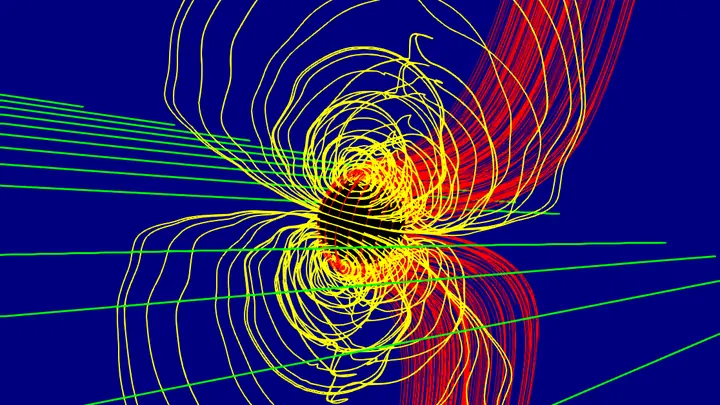
The orchestra plays, though no one sees the conductor. The musicians are charged particles in the pulsar's magnetosphere, and the score is the electric and magnetic fields generated by the spinning superdense star.
Twelve stars have received X-ray passports. Now, for each of them, we know the exact radiation dose received by a planet in the habitable zone, the region where liquid water is possible.
Twelve stars have received X-ray passports. Now, for each of them, we know the exact radiation dose received by a planet in the habitable zone, the region where liquid water is possible.
The night sky looks calm, but in reality, invisible particles, cosmic rays, are constantly flying through us. Among them are electrons and their antimatter counterparts, positrons. When they collide with detectors on satellites or balloons, the instruments record their energy.
An electron is not just a point. It is a probability cloud, smeared out in space. When such a cloud collides with a powerful laser pulse, it can emit a high-energy photon — a gamma quantum. And this photon can be not just ordinary but twisted, like a corkscrew, carrying orbital angular momentum.
A planet in the habitable zone is no guarantee of life. Like a conductor leading an orchestra, a star dictates the tempo and character of planetary atmosphere evolution over billions of years.
Neutron stars are the final chord in the evolution of massive suns. Born in the cataclysm of a supernova, they pack a mass comparable to the Sun's into a sphere the size of an earthly metropolis.
In the orchestra of interstellar life search, every note counts. And the score here is dictated not by man, but by a distant star. For the planet TRAPPIST-1 e, one of seven in the system of an ultracool red dwarf, the conductor's baton is harsh ultraviolet light.
The first exoplanet was discovered around an unusual cosmic lighthouse — a neutron star known as a pulsar. These ultra-dense remnants of dead stars spin at tremendous speeds and emit precise radio pulses.
A stone falls into a pond — near the shore, the ripples are barely visible, while the water churns at the point of impact. The electric field around a charge behaves similarly: close in, it's sharp and tangled, but at a distance it stretches into a smooth wave that carries energy away. Physicists call this distant region the radiation zone.
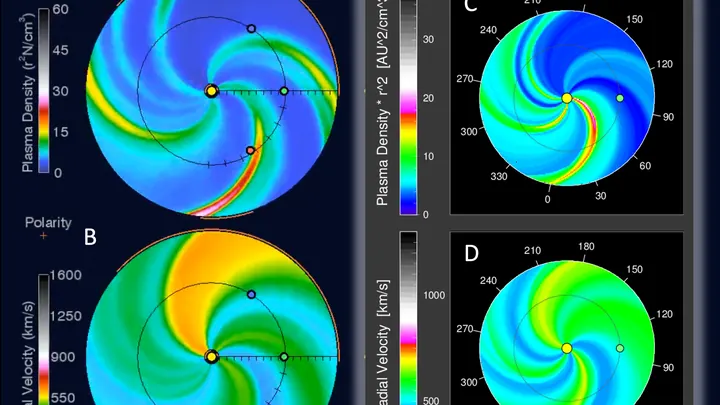
The solar wind, a stream of charged particles from the Sun, slams into the tenuous gas that fills the space between the stars. The collision produces a faint X-ray glow. For astronomers, this is like fog in front of headlights: it obscures distant objects.
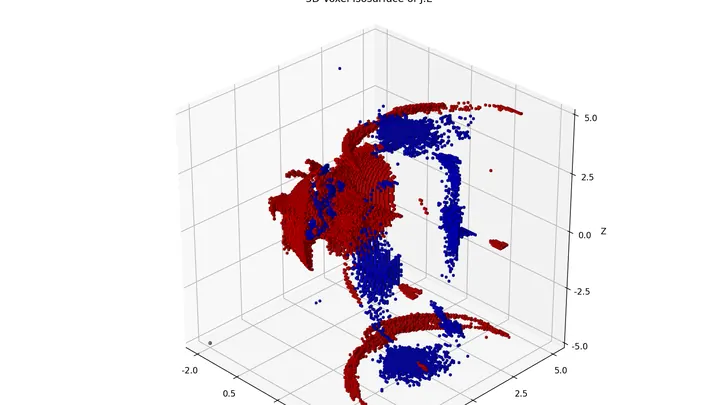
Two neutron stars spiral closer together, about to merge in an instant. Their dance lasts fractions of a second, but just before the finale, one star plows into the other's magnetic envelope, like a swimmer cutting through water, kicking up waves. At that moment, a complex system of currents is born, carrying energy away.
A galaxy is like a glowing pancake studded with stars. If you look at it face-on, you see everything at once — both the bright spiral arms and the dark dust lanes. But tilt the pancake, and the picture changes: layers overlap, light blends together. This very effect, it turns out, creates the illusion of a tight link between radio and gamma-ray emission in distant star systems.
A balloon in your hand springs back equally in all directions. But a bottle of soda behaves differently: along the neck it is stiff, while across it is easily squeezed. This is roughly how pressure works inside some stars: it can be unequal in different directions. Such stars are called anisotropic, and their behavior has so far been described by disparate methods.
The center of our galaxy is a crowded kitchen where several dishes are simmering at once, and their steam blends into a single cloud. X-rays from the exploded star's remnant, from the stellar wind around the supermassive black hole, and from hot gas between stars all overlap.
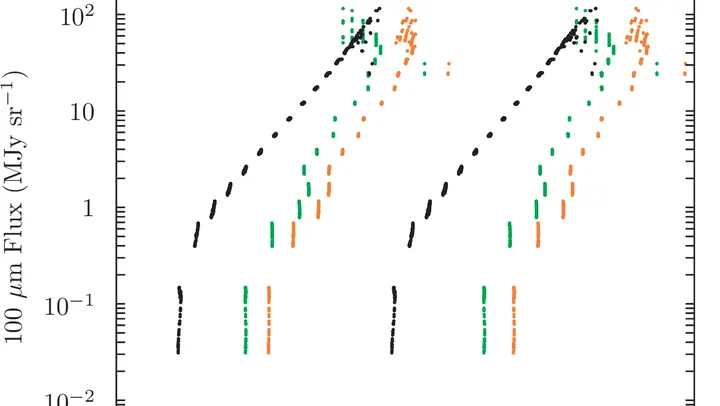
In the dark cloud L43, where stars are born, dust grains twirl like tiny compasses. Light from a young star pushes them, while the magnetic field lines them up in a specific direction. When a grain is turned sideways to us, its heat reaches us polarized, like light passing through a narrow slit.
When an X-ray burst erupts on a neutron star, its atmosphere heats up to millions of degrees. The light we catch with telescopes passes through this dense layer of gas, and gets dramatically altered along the way. The spectrum no longer looks like that of an ideal radiator: some colors get amplified, others dim.
A quasar is a supermassive black hole at the center of a galaxy that devours matter and shines brighter than all the stars around it. Some of that energy goes into radio emission, which, it was thought, could heat or expel cold gas — the raw material for new stars.
A spinning black hole acts like a cosmic generator: its rotation pumps energy into an invisible scalar cloud — a prime candidate for dark matter. A scalar field is like temperature: at every point in space it's just a single number, with no arrows or vectors. The cloud grows until it overflows.
At night, invisible bullets streak across the sky — cosmic rays. These are atomic nuclei accelerated to near-light speeds. The Galaxy's magnetic fields tangle their paths, making it hard to pinpoint where they were born.
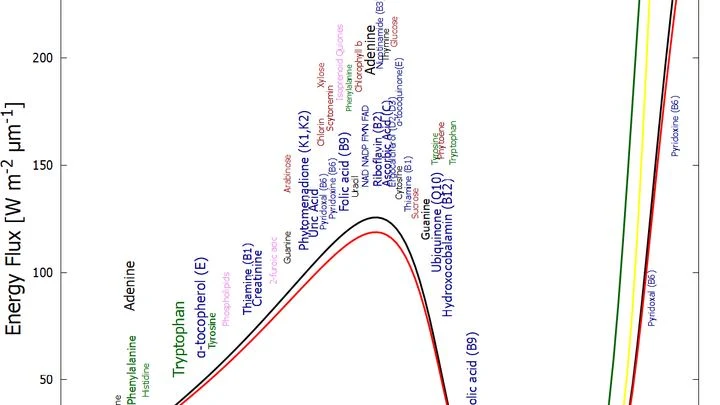
Life began with molecules akin to natural sunscreen — based on carbon, they soaked up the mild ultraviolet of the young Sun and turned it into heat. This way of dissipating energy wasn’t just heating: it made molecules self-organize, like chefs kneading structured dough out of a chaos of ingredients. But ultraviolet is a finicky tool.