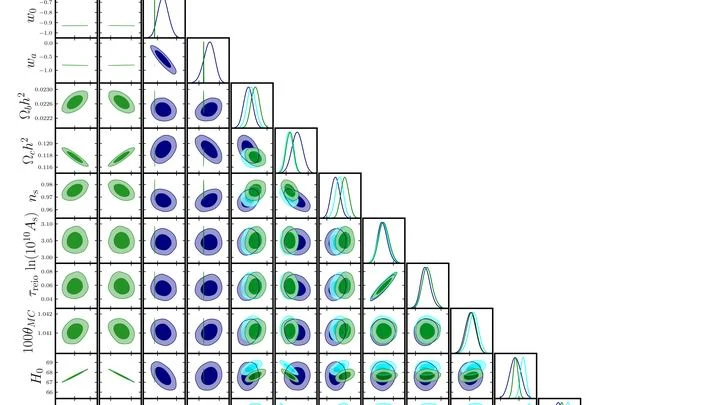
The equation of state parameter, denoted w, is a dimensionless number that relates the pressure of a substance to its energy density. In cosmology, it is most famously used to characterizedark energy, the mysterious force driving the accelerated expansion of the universe. A value of w = -1 corresponds to a cosmological constant, where the energy density remains constant as space expands, leading to exponential growth. Other values, such as w > -1 (quintessence) or w < -1 (phantom energy), imply that the dark energy density changes over time, with profound implications for the universe's fate.
History
The concept of the equation of state parameter was introduced in the context of cosmology in the 1980s, particularly through work on inflation and dark energy models. The term 'quintessence' was coined by Robert Caldwell, Rahul Dave, and Paul Steinhardt in 1998, shortly after the discovery of cosmic acceleration.
How it works
The parameter is defined by the equation p = wρc², where p is pressure, ρ is energy density, and c is the speed of light. For ordinary matter, w = 0 (pressureless dust); for radiation, w = 1/3. Dark energy has a negative pressure, so w is negative. The value of w is inferred from observations of supernovae, cosmic microwave background, and large-scale structure, which probe how the expansion rate changes over cosmic time. If w is not exactly -1, it suggests dark energy is a dynamic field rather than a constant.
In practice
It is the primary target of next-generation dark energy surveys like DESI and Euclid, which aim to measure w with high precision to determine whether dark energy is truly constant or evolving.
Fun fact
If w is less than -1, the universe would end in a 'Big Rip,' where all matter is torn apart in a finite time, a scenario that some observations have not yet ruled out.
An invisible scaffold holds galaxies together, keeping them from flying apart. This is dark matter — matter that doesn't shine and barely interacts with ordinary stuff. Astrophysicists have long debated what it's made of.
The cosmological standard model is like a recipe for a cake where everything is strictly measured: dark matter is like flour without a single lump (zero pressure), and dark energy is like the perfect leavening agent (equation of state exactly minus one). But what if the flour is a bit damp and the leavening agent has lost its oomph?
The universe sometimes resembles an old fabric: after rapid cooling, wrinkles could have remained — thin, almost invisible threads of monstrous density. They are called cosmic strings. Usually, at the center of such a string hides a singularity — a point where the laws of physics lose their meaning.
Cosmic ripples begin with tiny clumps. 380,000 years after the Big Bang, the universe was nearly homogeneous — density fluctuations were only one part in 100,000. But gravity turned these weak ripples into galaxies, clusters, and giant voids.
A cold, black mirror — that's what the sea of dark energy, the invisible substance driving the expansion of the universe, looked like for billions of years. But the DESI spectrograph has caught a faint ripple.
Ever since Fritz Zwicky noticed that galaxy clusters were moving too fast, and Vera Rubin measured the rotation of spiral arms, dark matter has remained cosmology's greatest mystery.
In the ordinary world without dark energy, the mass of any object is always positive. That seems obvious: positive mass attracts, creating gravity. But the real universe has dark energy — a mysterious force making the cosmos expand faster and faster.
A runner on the middle of a track suddenly switches to a walk — not speeding up or slowing down, but maintaining a constant pace. Something similar may have happened to the universe itself shortly after the Big Bang.
The cosmological kitchen is full of invisible ingredients. Dark matter, like an invisible scaffold, keeps galaxies from flying apart, while dark energy, like yeast in dough, makes space expand ever faster.
The universe is expanding at an accelerating rate, like dough that keeps rising faster even though the yeast ran out long ago. For twenty years, astronomers have been searching for the cause and call it dark energy. But what it is remains a mystery.
New work proposes an unexpected source: the vacuum inside the atomic nucleus.
A translator hears not just words, but intonation, pauses, the tremor in a voice. Ordinary entropy analysis of cosmic perturbations is like meeting minutes: it records facts but loses the nuances. Pseudoentropy entropy is a new tool that captures the hidden "music" of the early universe.
Our universe isn't just expanding: it's doing so faster and faster. It's like raisin bread dough in the oven: the raisins move apart, and the farther they've already separated, the faster they continue to recede. The strange force pushing the cosmos apart is called dark energy. Most scientists think it's constant, like a permanent spring built into the very fabric of space.
If you turn on a lamp in a room, it illuminates the walls. But if you place the same lamp in a vast hall, the light barely reaches the corners. Similarly, radiation from young stars affects gas in a galaxy: it knocks electrons out of hydrogen atoms, making the gas glow.
Imagine a huge layered cake, where the layers of dough are space and the filling is a special region resembling an invisible wall. This wall is not made of bricks but of energy, and it could be as thick as the entire universe. If such a wall exists, it should stretch the dough layers differently: those lying along it spread apart faster, while those across it spread slower.
Cosmology is going through strange times. On one hand, the standard model with dark matter and dark energy beautifully describes the large-scale structure. On the other, it's cracking at the seams.
Our Solar System isn't an island in the void: it's a sensitive web stretched in a dark cosmic corner. Planets circle their orbits like dewdrops on threads, and we are the spider sensing the faintest tremor. That tremor betrays the approach of the catastrophe astronomers call the Big Rip.
For a long time, dark energy, the mysterious force prodding the expansion of the Universe, was considered eternal and unchanging, like yeast that never loses its activity. But explaining such constancy through the laws of the microcosm proved impossible, and scientists began to suspect that the “leaven” might be going flat.
Imagine inflating a balloon. It expands quickly at first, then slows down, and then suddenly speeds up again, as if someone gave the pump another squeeze. That's what seems to be happening to our universe.
In physics, there's an old ache. General relativity paints the beginning of the universe as a point — a singularity where equations break down and volume shrinks to zero. Quantum mechanics hints that at the most critical moment, something goes differently than classical physics predicts.
The Universe is like an inflating balloon. Quantum mechanics forbids measuring exactly how big it is and how fast it's inflating at the same time. This principle permeates the cosmos: a new equation states that the Universe's expansion and its size are linked by a fundamental uncertainty.
The universe keeps a tally of every newborn star. Over 13.8 billion years, galaxies have ignited so many stars that their 'census' can reveal the nature of the cosmos itself, just as tree rings reveal past climates.
Imagine inflating a balloon. At first, it expands slowly; then someone gives a sharp blast of air, and it swells faster. But as the airflow weakens, the balloon's growth slows again. According to a new study, the Universe has behaved much the same way: after the Big Bang, it expanded, then suddenly accelerated, and now that acceleration is fading.
If space is a canvas, then brushstrokes cannot be infinitely thin. There's a tiniest segment, shorter than which there's no point in measuring. This quantum 'graininess' alters the geometry itself: the motion of galaxies and the growth of large-scale structures bear its mark.
The universe is expanding faster and faster, and scientists blame it on dark energy. Its origin is explained in a new way: dark energy isn't eternal, but appears only after dark matter clumps together into lumps — future galaxies.
The mechanism works like a pump that turns on when pressure drops.
Galaxies are flying apart, but the expansion rate measured from the afterglow of the Big Bang and from supernova explosions doesn't match: this problem has been called the Hubble tension. It's like two dancers losing their rhythm because they can't feel each other.
The universe is expanding faster and faster, like yeast dough in the kitchen. This expansion is helped by dark energy — the cosmic sugar. Ever since astronomers like Adam Riess noticed the acceleration in the late 1990s, they've been searching for the cause.
The enigma of dark matter was already studied by Fritz Zwicky and Vera Rubin. For decades, it was depicted as a cold, listless skeleton that only draws galaxies together.
The universe is putting on a show, and the lead role goes to dark energy. For a long time, the actor seemed unchanging: the cosmological constant (the vacuum energy that accelerates cosmic expansion) set the same tone throughout.
The universe is expanding, and the pace of that expansion is set by dark energy, the mysterious force accelerating the recession of galaxies. In the standard cosmological model, its density is constant: a cosmological constant, an unwavering metronome since the birth of the cosmos.