Quantum Roulette with a Winning Ticket express
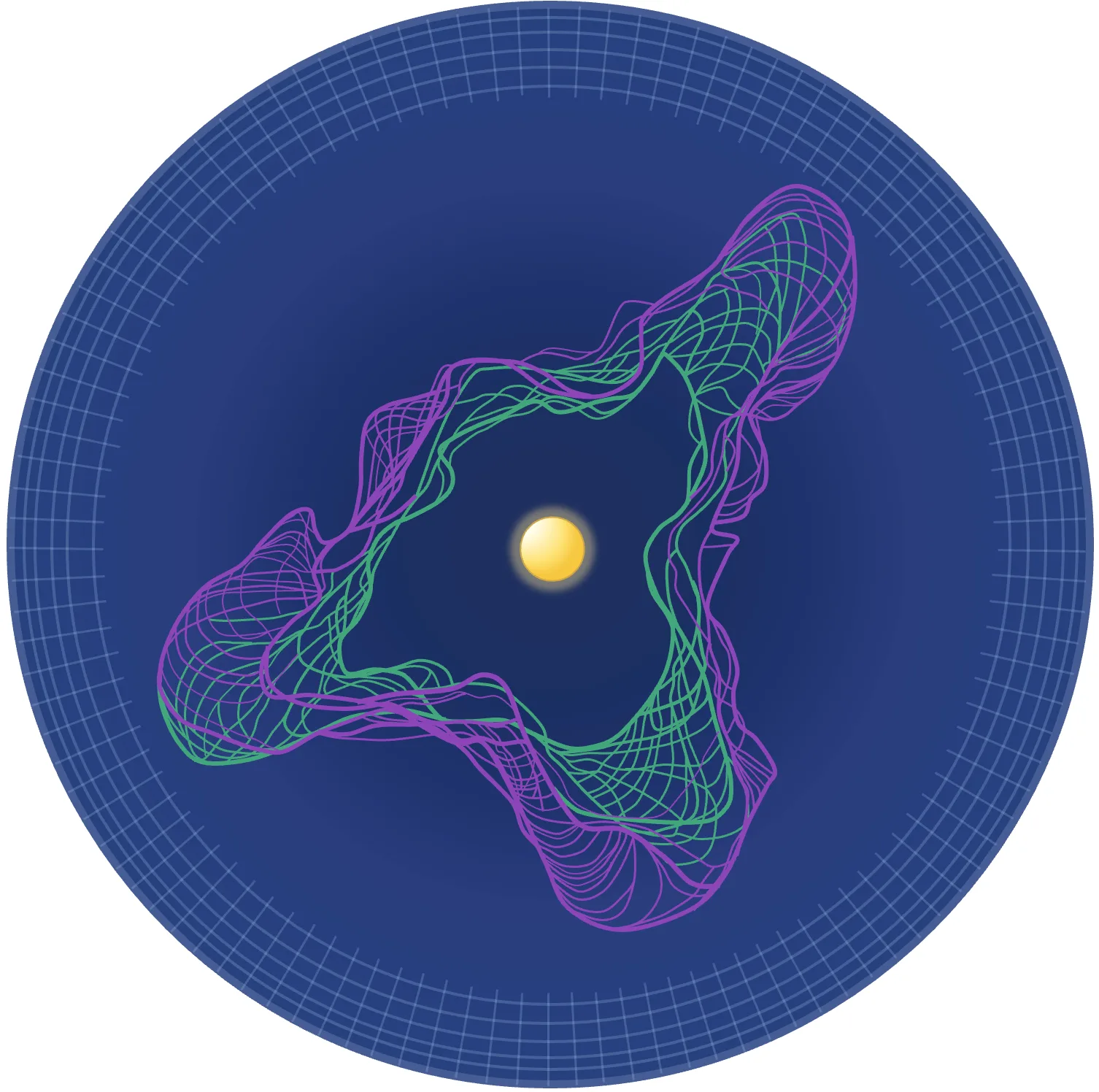
Imagine a library where instead of books, you have every conceivable combination of a few dozen quantum particles. The number of combinations grows like a snowball: add one particle, and the volume doubles. For fifty particles, there are more shelves than atoms in the visible universe. It was once thought that searching this chaos for states suitable for ultra-precise measurements was like winning the lottery. Only 'symmetric' states were considered useful, where particles behave alike, like soldiers in formation, and the number of options grows modestly, like a wedding guest list.
The authors of the new study turned this idea on its head. They showed that if you properly 'shuffle' random quantum operations, useful states for measurements emerge not as a rare lucky ticket, but as a matter of course. Almost any state from a specially prepared set gives precision at the limit dictated by nature itself — the so-called Heisenberg limit (the most precise measurement possible). It's as if, in our giant library, every other book turned out to contain the recipe you needed.
This approach has an unexpected bonus: robustness to disorder. If the system's parameters drift slightly (say, due to thermal jitter or imprecise tuning) random states don't lose their properties. They're like a crowd moving toward an exit: even if someone stumbles, the overall direction is maintained. This makes the method attractive for real-world sensors, where ideal conditions don't exist.
Original abstract
as written by the authors arXiv:2605.31442
The exponential growth of many-body Hilbert space presents a fundamental barrier to quantum technology, obscuring the search for physically significant states within an astronomically vast landscape. Consequently, resources for quantum-enhanced metrology have been largely confined to the symmetric subspace whose dimensionality scales only polynomially with the particle number-leaving the vast majority of the Hilbert space largely unexplored and poorly understood. Here we challenge this paradigm by demonstrating that metrological advantage can arise as a ubiquitous feature across exponential-dimensional manifolds. By tailoring the first-moment structure of random unitaries, we uncover dense manifolds of engineered random states (ERSs) where Heisenberg-limited scaling emerges as a statistically generic property. This ubiquity endows these resource states with inherent resilience against parameter disorder. We experimentally validate this framework on a trapped-ion processor, achieving a metrological enhancement of $$6.98 \pm 0.38$$ dB beyond the standard quantum limit. Potential applications extend to diverse platforms, ranging from superconducting circuits and waveguide QED to solid-state spins and polar molecules. Our results establish a powerful paradigm where quantum-enhanced precision can be harvested from the exponential vastness of the Hilbert space.
The number of possible quantum states for 50 particles exceeds the number of atoms in the observable universe by about a billion billion times. If each state were a grain of sand, they could cover the entire Milky Way in a layer several meters thick.
In Greg Egan's novel 'Despair', quantum computers use random states to model consciousness — long before physicists seriously considered the practical use of such states.