How a Single Photon Creates a Double Charge express
Sunlight hits a material, and each photon knocks out one electron. That's the usual order of things, which is why ordinary solar cells can't convert more than a third of the energy into electricity — the rest is lost as heat. But there's a process akin to a billiard shot where one ball splits into two: carrier multiplication. One photon generates not one but several charged particles.
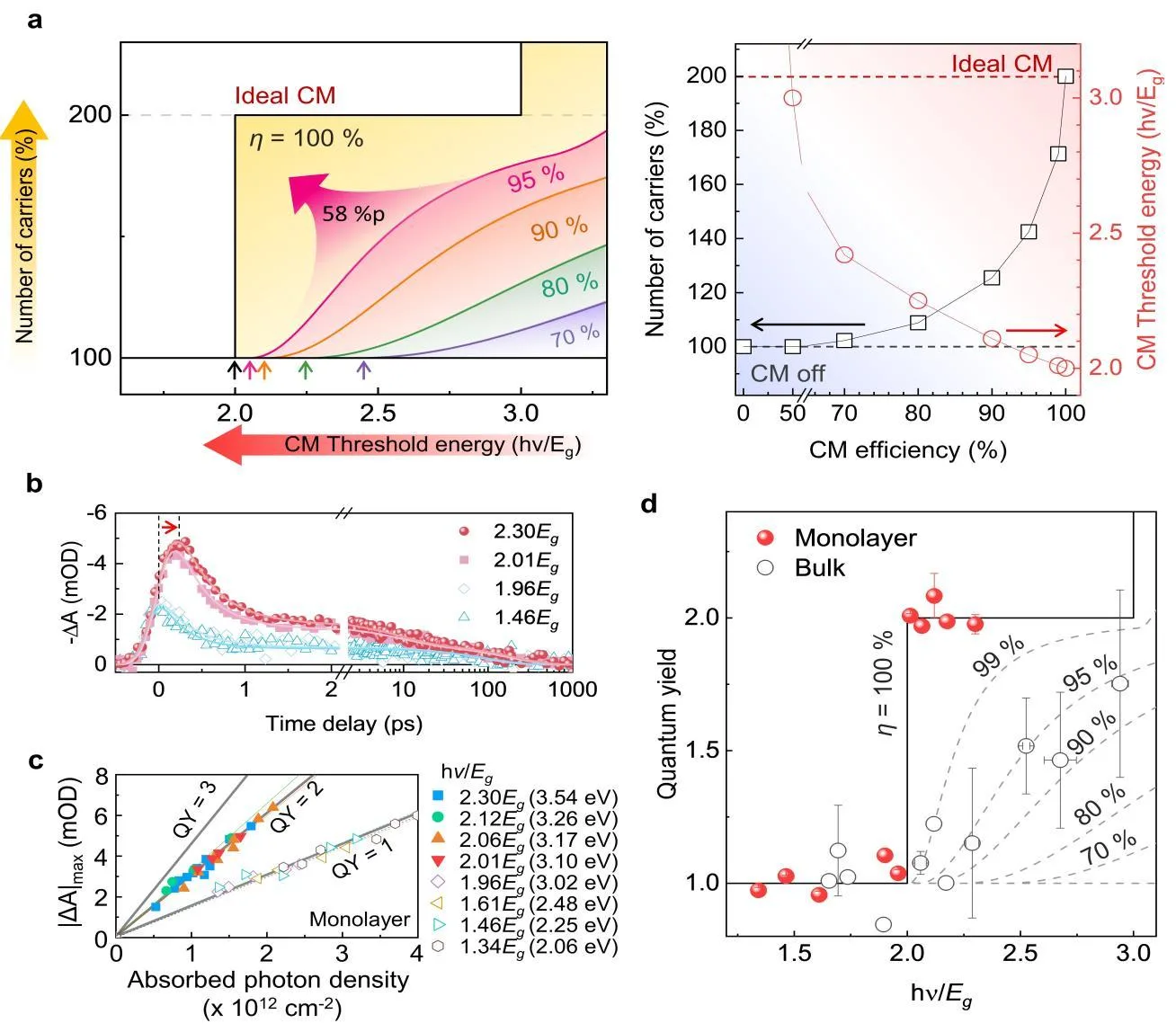
Until now, perfect multiplication was elusive: the generated carriers quickly lost energy by colliding with the atomic lattice, like runners tripping over bumps. The authors took a monolayer of molybdenum diselenide, a film just one atom thick, and tracked the motion of hot carriers using ultrashort laser pulses (ultrafast spectroscopy). They found that in such a thin layer, scattering almost vanishes: particles fly freely without wasting energy on collisions. At the same time, the material's band structure, so-called band nesting, opens up many channels for generating pairs.
Comparison with a thick crystal of the same composition highlighted the difference: in the bulk, multiplication was much worse. In the monolayer, efficiency reached the theoretical limit set only by the conservation of energy and momentum. This is not just a lab record — the material could become the basis for new solar cells that bypass the classical Shockley–Queisser limit, bringing us closer to batteries where almost every photon gives up everything it has.
A MoSe2 monolayer can be obtained by simply peeling it off a crystal with Scotch tape — the same method used in 2004 to obtain the first graphene.
In Stanislaw Lem's novel "Solaris," the planet's ocean transforms radiation with incomprehensible efficiency — carrier multiplication in a monolayer hints at a step toward such fantastical energy conversion.