The Carnot limit is the maximum theoretical efficiency any heat engine can achieve when operating between two thermal reservoirs at different temperatures. It is a fundamental consequence of the second law of thermodynamics, which states that entropy in a closed system never decreases. The limit depends only on the temperatures of the hot and cold reservoirs, not on the working substance or engine design, making it an absolute benchmark for all heat-to-work conversion.
History
Sadi Carnot introduced the concept in 1824 in his work 'Reflections on the Motive Power of Fire', laying the foundation for the second law of thermodynamics, later formalized by Clausius and Kelvin.
How it works
The Carnot cycle consists of four reversible processes: isothermal expansion, adiabatic expansion, isothermal compression, and adiabatic compression. During isothermal steps, the engine exchanges heat with the reservoirs; during adiabatic steps, it does work without heat transfer. The efficiency is given by 1 - T_cold/T_hot, where temperatures are in kelvin. Any real engine has lower efficiency due to irreversibilities like friction and heat loss.
In practice
The Carnot limit guides the design of power plants, refrigerators, and heat pumps, and it is used to benchmark quantum heat engines, as explored in the provided titles on relativistic and quantum motors.
Fun fact
A Carnot engine operating between room temperature (300 K) and liquid nitrogen (77 K) would have an efficiency of about 74%, but real engines rarely exceed half of that.
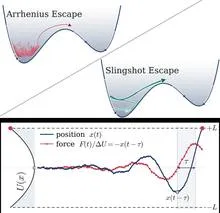
A particle sits in an energy pit like a pea in a dimple. To get out, it needs to go over the barrier, and usually this is rare: the higher the barrier, the longer the wait. The Arrhenius law says the waiting time grows exponentially, meaning doubling the barrier height increases the time by hundreds of times.
A superconductor is a material in which electricity flows without loss, like water through a perfectly smooth pipe. But if you squeeze it slightly, like a spring, its properties change. Scientists have long wanted to measure how much heat such a compressed material absorbs, but instruments couldn't fit into the cramped setup. Now they've devised a way around this obstacle.
Inside an ultracold chamber, two atomic clouds collide: a few dozen cesium atoms acting as the working fluid, and thousands of rubidium atoms serving as the heat reservoir.
A conventional computer computes by shuttling electric charges along wires. But can you compute with heat? A network of pipes carrying hot and cold water can perform simple logic operations if the pipes are connected in the right order.
A black hole has three laws, just like an ideal gas. The first: energy is conserved. The second: the horizon area never decreases. And the third, the most finicky, demands that at zero temperature the entropy (a measure of disorder) tend to zero or a universal constant.
In a crystal, heat travels on waves. Atoms vibrate, and these vibrations, called phonons, carry energy from the hot edge to the cold one. For a long time, it was believed that if phonons hit resonance (their frequencies exactly match) and can exchange energy, heat would flow like an avalanche. It turns out that's not the case.
In an oven, as temperature rises, molecules move faster and disorder increases. With language models like ChatGPT, it's the opposite. When developers increase the 'temperature' parameter, the model gets access to a wider choice of words, but its long texts suddenly start looping.
A team of researchers tested 11 different AIs by generating 12,000 text continuations.
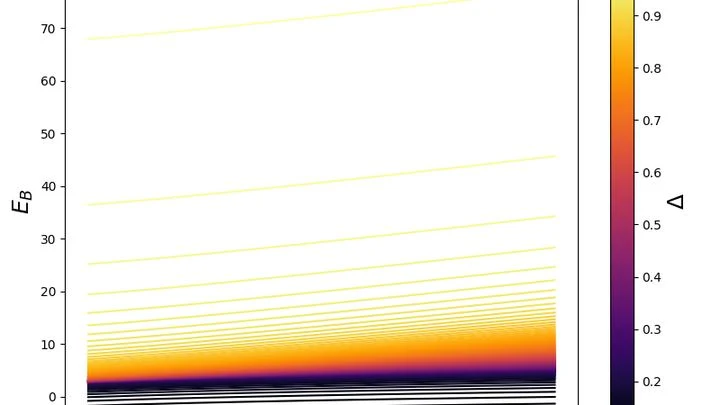
Many materials behave like finicky ice: at one pressure they melt, at another they turn harder. Superconductors in the cuprate family are no exception. Their ability to carry current without loss depends on how tightly the crystal lattice is squeezed. In a new study, physicists traced this dependence for the compound Bi-2223.
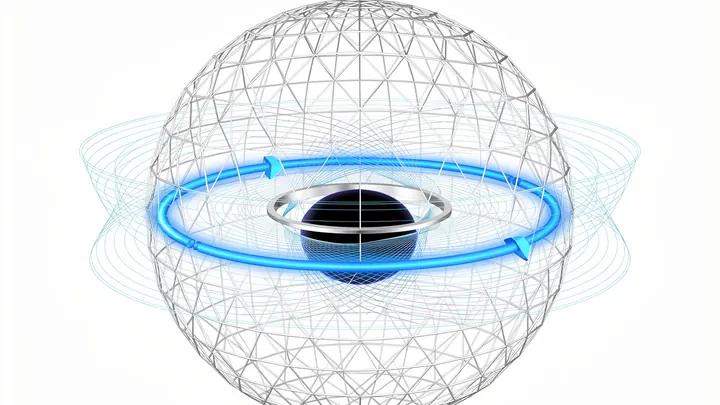
The Kerr-NUT black hole is not just a cosmic vacuum cleaner. It's a solution to Einstein's equations where the hole has mass, rotation, and a strange NUT parameter. This parameter behaves like a magnetic charge for gravity: seemingly invisible, yet it alters the properties of surrounding space.
The river splits in two. One branch is wide and fast, with water flowing smoothly, but as temperature rises, the flow slows: eddies and waves appear. The second branch is narrow, with rapids, where water leaps from rock to rock. This flow, on the contrary, becomes more lively with warming.
A pot of boiling water is covered with two lids — an inner and an outer one. The thermometer under each shows its own temperature, but their harmonic mean (a special averaging method where you add the reciprocals) always remains unchanged. Heat seems to obey an invisible rule.
Inside every cell, logistics is in full swing: tiny protein motors, like couriers, haul cargo along a network of microtubules. One of the main workhorses is kinesin, which steps using the energy of ATP (the cell's main energy currency). For a long time, researchers tried to evaluate it like a car: how much fuel it burns, how fast it gets there.
In classical thermodynamics, heat engines are like a virtuoso musician on stage: the closer to perfection in performance (Carnot efficiency), the slower the tempo (power).
Imagine water as a ballroom, where each molecule is a dancer, constantly forming fleeting partnerships. These hydrogen bonds give rise to local patterns: some resemble a stiff waltz — an ordered network with cavities (low-density structure), others a wild jitterbug, where partners crowd into chaotic dense clusters.
At the centers of many galaxies lurk supermassive black holes. One of them, Sagittarius A* at the heart of the Milky Way, has become a testing ground for a new idea. The authors of the work took Einsteinian gravity and added an unusual electromagnetic field to it.
Imagine a steam engine where instead of a steel piston there is an event horizon, and the cylinder is curved space itself. This metaphor has gained mathematical flesh: physicists have for the first time constructed a complete set of reversible heat cycles with a Schwarzschild black hole confined in a spherical cavity.
In the first moments of its life, the Universe resembled a boiling cauldron. As it cooled, phase transitions occurred — much like steam turning into water, but instead of molecules, the very state of space changed. In this cauldron, bubbles of the new phase were born, akin to bubbles in a pot coming to a boil.
The old question of Maxwell’s demon, can an intelligent being circumvent the second law of thermodynamics and pump heat from cold to hot, gains new resonance in the quantum world.
The void is never truly empty. In curved spacetime (for instance, in an expanding universe or near a black hole) the vacuum heats up. This is reminiscent of how acceleration makes particles appear seemingly out of nowhere: a phenomenon known as thermal vacuum radiation.
In boiling water you can see a prototype of a quantum trick: if part of the liquid turns into long-lived vapor bubbles, the main mass cools down. This is exactly what happens when you sharply jolt a system of interacting electrons: doublons flare up — pairs of particles that absorb excess energy and don’t decay for an astonishingly long time.
Every winter, the tropical Pacific Ocean seems to replay the same script: sea surface temperatures off the coast of Peru rise, trade winds weaken, and a wave of droughts and floods spreads across the planet. This is El Niño, and its peak almost always falls in December. Why winter in particular?
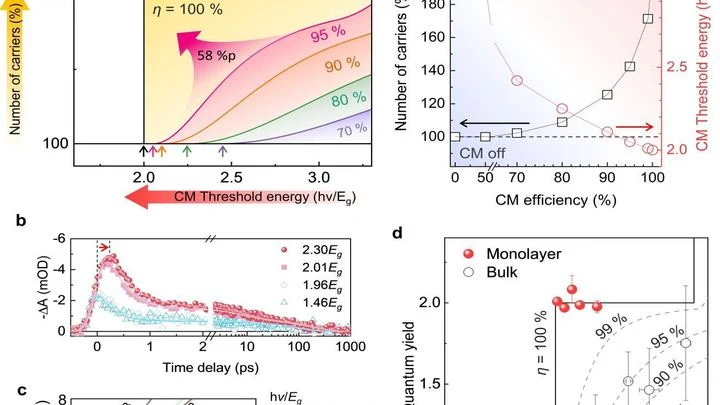
Sunlight hits a material, and each photon knocks out one electron. That's the usual order of things, which is why ordinary solar cells can't convert more than a third of the energy into electricity — the rest is lost as heat. But there's a process akin to a billiard shot where one ball splits into two: carrier multiplication.
In 1867, James Clerk Maxwell proposed an image that still stirs physicists today. Two compartments of gas are separated by a door. Molecules dart about chaotically: fast and slow. A tiny gatekeeper opens the door only for fast ones, letting them through to one side, and slow ones to the other. The hot compartment gets hotter, the cold one colder.
A pot of water on the stove eventually settles down: the temperature evens out, the liquid stops boiling. Physicists call this thermal equilibrium — a state where energy is distributed in the most probable way.
A heat engine doesn't have to be made of iron. In the microworld, a single electron can play the role of a piston, and the measurement process itself can serve as fuel. Two neighboring 'pockets' for electrons are connected by a narrow bridge.
Steam rising from hot metal is a familiar sight in the kitchen. But if you use rubidium instead of water, that cloud becomes a battery. It doesn't run on chemical reactions but on the quantum coordination of atoms.
A piece of metal heated at one end produces a weak electric current: this has been known for nearly two hundred years. But what if, instead of a simple metal, you take a layered "sandwich": a superconductor, a thin insulator, and a flat layer of electrons?
The quantum battery works like a sponge that absorbs light but won't release it without a forced squeeze. The inspiration came from bacteria's natural solar traps: capturing solar photons, they transfer energy almost losslessly, as proven by spectroscopy.
An ordinary heat engine is like a mill between the hot and cold banks of a river: the greater the drop, the stronger the current. Here, the drop is tiny, just one or two degrees, but water can still turn the wheel. The secret is that water is made to boil not by heating but by a sudden drop in pressure, so steam bursts out even from barely warm liquid.
Every machine, whether a car engine or a tiny nanocooler, runs with a jitter. Fuel burns unevenly, electrons slip through contacts off schedule, and the power needle on your instruments vibrates slightly. These vibrations are called fluctuations. They are not just noise: they tell you how stable a device is and how much energy it wastes.
Run a current through a wire, and the wire heats up. Anyone who has ever touched a phone charger knows this. Physicists call this heating Joule heating, after James Joule, who in the mid-19th century measured how much heat electricity produces. Since then, the formula has been simple: the greater the resistance and the current, the hotter the wire.
The idea of a expanding universe, proposed by Georges Lemaître, finds an unexpected analogy. Space behaves like a piston in a cylinder: dark energy pushes it, much like steam. The relationship between pressure and volume in this 'engine' is strikingly similar to that of a steam boiler.
Water in a glass cools, ice melts, and a kettle heats the stove: that's how the world works: heat always flows from hot to cold. This is the second law of thermodynamics, a law that has never been broken.
A regular motor burns fuel and wastes a ton of energy as heat — that's dictated by the laws of thermodynamics. A quantum engine does it differently: its fuel isn’t heat, but a perfect rhythm. Physicists call this rhythmic precision quantum coherence.
Water always flows downhill, and heat from hot to cold. That's what энтропия dictates. But the quantum world finds loopholes.
Physicists made light particles interact with hot and cold environments in an uncertain sequence — like a flipped coin that hasn't landed yet.
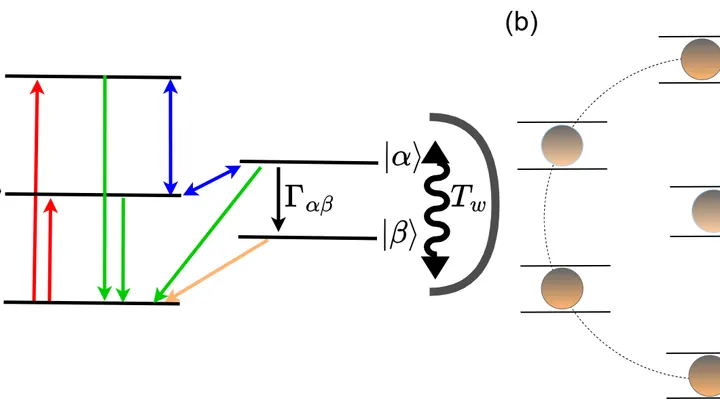
Atoms, like a swarm of fireflies, shine in unison. When they flash together, the light multiplies — a hundred atoms shine ten thousand times brighter than one. Physicists have turned this trick into a heat engine. A typical motor needs both a hot and a cold source, but here the atoms operate with just a cold one.
An orchestra without a conductor, where each musician hears only the hall's echo, can create a powerful melody. That's how a quantum battery works: many particles, immersed in a warm environment, don't dissipate heat but exchange it synchronously. Instead of chaos, an orderly charge emerges.
A thermometer dipped into a sample usually tells you only the temperature. But if the temperature oscillates slightly and the sample responds with a delay, that response hides more: the imaginary part of the heat capacity, which turns out to be able to hear the quantum echo of time.
A heat engine is like a sailboat: to move forward, it needs a difference. Usually that means a temperature difference between hot and cold reservoirs. But what if the reservoir itself starts moving? The wind that fills the sails is created not only by a pressure difference but also by the motion of air masses.
Two qubits, quantum bits, two-level systems, glide through hot and cold thermal baths. One moves at 0.8 times the speed of light. At that moment, familiar thermodynamics cracks: a moving qubit senses temperature differently than a stationary one. For it, the cold bath can feel hotter, and the hot bath colder.