Quantum Trick Accelerates the Universe Without Dark Energy express
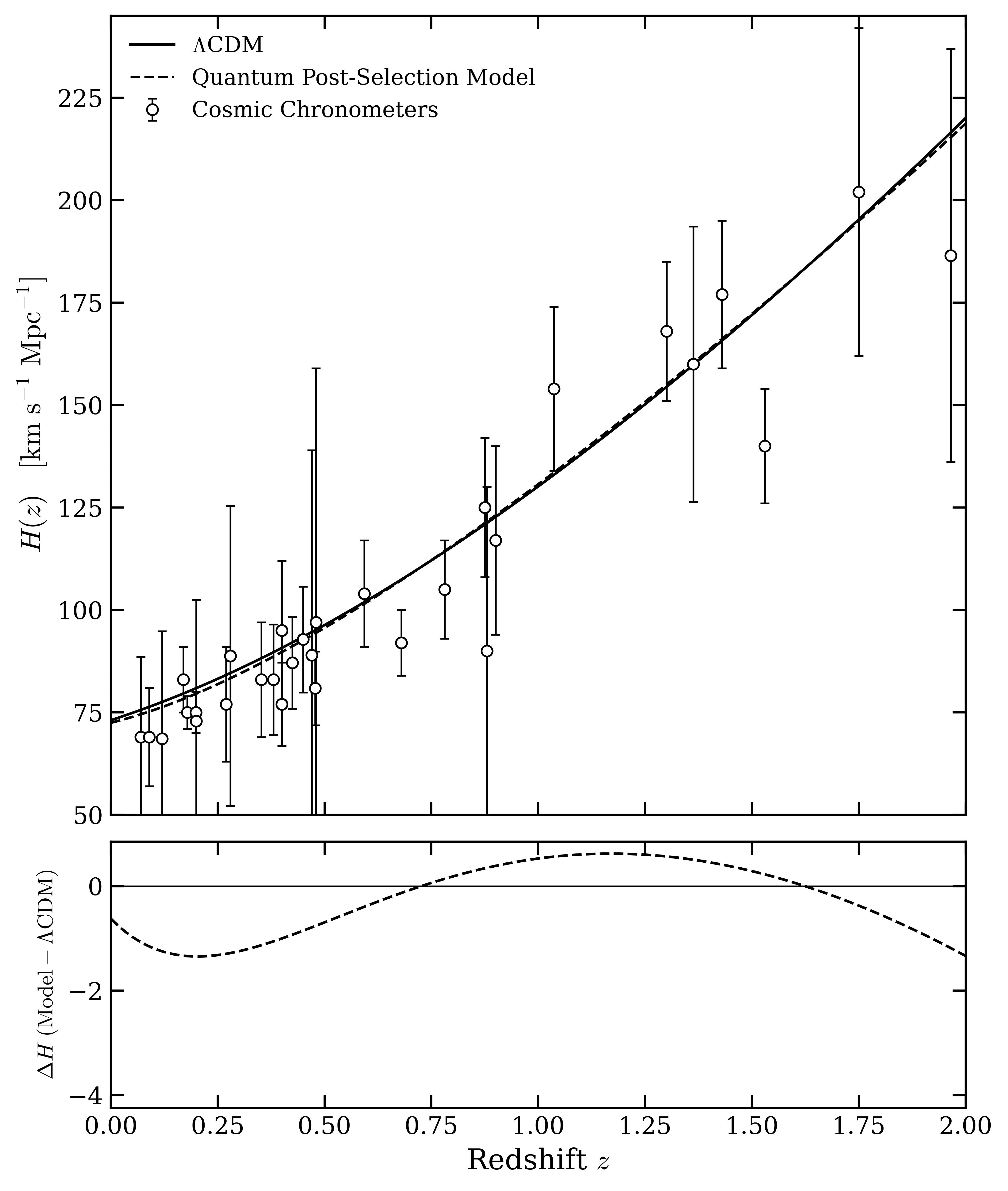
Since the end of the 20th century, we've known: the expansion of the Universe is accelerating — galaxies are flying apart faster and faster. The discovery brought a Nobel Prize to Adam Riess, Saul Perlmutter, and Brian Schmidt. The standard explanation relies on dark energy — an invisible force pushing space apart. New work proposes a different mechanism: it's all about post-selection — a quantum rule, like a detective story with a known ending where the clues are fitted to match it. The future selects only those event scenarios that lead to the desired outcome. This solves a longstanding mystery: why acceleration started just now, when both we and galaxies exist. The model introduces no mysticism and fits perfectly with data on supernovae and the age of galaxies. It also correctly describes the early epochs after the Big Bang. An unexpected conclusion: without such 'fitting,' acceleration would have started in an era of mere atoms — and stars would never have ignited.
Original abstract
as written by the authors arXiv:2606.12297
The origin of cosmic acceleration remains a central problem in cosmology, commonly attributed to a cosmological constant within the $$\Lambda$$CDM model or to dynamical dark energy. Here, we develop an alternative approach in which acceleration emerges from quantum post-selection, a standard feature of quantum theory that is not usually incorporated into cosmological modelling. While quantum theory admits both pre-selected and post-selected ensembles, quantum cosmological models are almost exclusively formulated in terms of initial conditions. Building on previous work on post-selected quasiclassical dynamics, we construct a minimal predictive cosmological model in which post-selection and coarse-graining generate effective late-time acceleration without introducing a cosmological constant, dark energy, or modifications of general relativity. The resulting expansion history is highly constrained theoretically and depends on at most two parameters beyond standard Friedmann evolution. Confrontation with type Ia supernova and cosmic chronometer data yields statistically competitive fits while naturally avoiding the coincidence problem. The model also reproduces the standard radiation- and matter-dominated behaviour at early times and predicts a present-day jerk parameter significantly different from the $$\Lambda$$CDM value. These results suggest that cosmic acceleration may arise as a macroscopic quantum cosmological effect rather than from additional cosmological fluids or modified gravitational dynamics.
Type Ia supernovae are stellar explosions with nearly identical power: they are used as standard 'rulers' to measure distances over billions of light-years.
Post-selection resembles the plot of Ted Chiang's story 'Story of Your Life,' where knowledge of the future determines actions in the present.