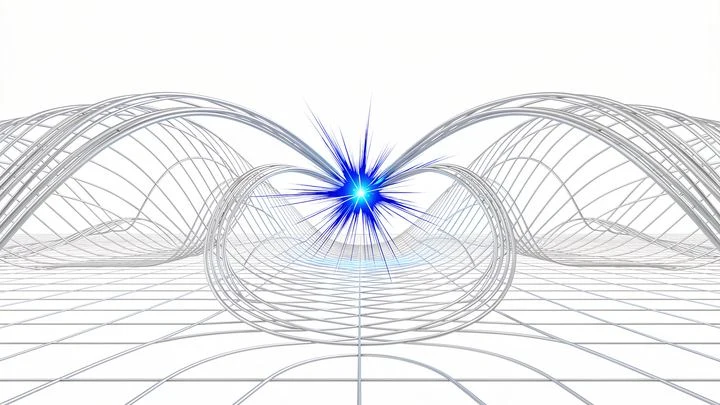
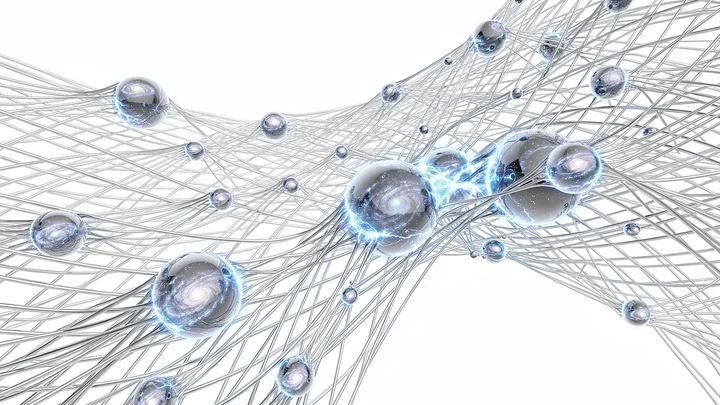
Eternal inflation is a cosmological scenario in which the rapid exponential expansion of space that occurred just after the Big Bang never fully ends. Instead, in most regions of the universe, inflation continues forever, while in some patches it stops, giving rise to 'bubble universes' like our own. This model transforms the universe from a single, unique event into a vast multiverse, where countless separate universes are constantly being created, each with potentially different physical constants.
History
The concept was developed in the 1980s by Alexander Vilenkin and, independently, by Andrei Linde, building on the earlier inflationary theory proposed by Alan Guth in 1981.
How it works
Inflation is driven by a field with a quantum nature, meaning it fluctuates. In some regions, quantum fluctuations push the field back up the energy hill, causing inflation to continue there. Meanwhile, in other regions, the field rolls down, ending inflation and creating a hot, dense patch that expands and cools to form a universe. Because the inflating regions grow exponentially faster than the non-inflating ones, inflation never ends globally, even though it ends locally in our observable universe.
In practice
Eternal inflation provides a framework for understanding the 'fine-tuning' of our universe's physical constants, as different bubble universes could have different values, and we naturally find ourselves in one that allows for our existence.
Fun fact
In eternal inflation, our universe is just one bubble in an infinite foam of universes, and the process of bubble creation is ongoing — new universes are constantly popping into existence.
A spotlight beam fades into the darkness, but if you trace it backward, you hit the lamp. The history of the universe might be the same: tracing its expansion backward, we run into a beginning.
Physicists took the simplest model — a universe that stretches equally in all directions, like a cube with all sides growing.
It all started with stretching. In the first fractions of a second, the universe ballooned — physicists call this inflation. Then the rapid expansion gave way to a phase where the field's energy converted into ordinary particles.
A black hole is like a perfectly smooth sphere. It has no features — only mass, charge, and spin. This rule is called "no-hair." But nature loves to complicate things: sometimes a cloud of a scalar field (a special field described by a single number at each point) spontaneously appears around a black hole.
The quantum vacuum is not empty: it is permeated by entanglement linking distant regions. But when physicists tried to compute this entanglement, it turned out to be infinite. The culprit: particles with very low energy that can smear out over arbitrarily large volumes. They are like waves with no shores to contain them.
Imagine a factory capable of producing a million parts per hour, yet it only makes a hundred. That's roughly how our Universe behaves when viewed through the lens of entropy — a measure of disorder that, according to physics, must only increase. The main "machines" of this factory are supermassive black holes.
Clocks in the Universe are tricky things. Usually, in calculations of the birth of the world, a special scalar field plays the role of a clock — something like an invisible fluid filling all of space. It ticks, and physicists watch how the world changes relative to that ticking. But these clocks are man-made, introduced for convenience.
The authors of the new work took a different path.
The universe is a vast, dark ocean. We see only the glowing foam on its surface — stars and galaxies. But hidden in the depths are two invisible forces: dark matter, which with its gravity keeps galaxies from flying apart, and dark energy, which, on the contrary, pushes space itself apart, making the universe expand faster and faster.
The first moments after the big bang: space expands rapidly — physicists call this period inflation. Inside this swelling fabric, like soap bubbles in a stream of air, regions of new vacuum begin to form — a first-order phase transition. Most bubbles pop or merge as soon as they appear.
Gravity is a remarkably weak force. A small magnet holds a paperclip against the pull of an entire planet. Physicists have long sought the reason for this weakness, and one guess leads us into hidden dimensions. Perhaps gravity 'leaks' into them, losing strength in our three-dimensional world.
2.1 × 10⁻⁹ — that's the temperature variation across the sky, about the same as measuring ripples a fraction of a millimeter high on the ocean surface. This microscopic non-uniformity is imprinted in the cosmic microwave background and tells the story of the very beginning of time.
10⁻¹²⁰. That's not just a small number: it's a chasm. That's the ratio of dark energy density to the Planck density, the natural scale of quantum gravity. The colossal difference of 120 orders of magnitude has long seemed an unsolvable puzzle. But the answer might lie in a drama played out at the dawn of time.
In the first moments after the Big Bang, the Universe underwent a rapid expansion, inflation, blowing up quantum fluctuations to scales visible today in the cosmic microwave background.
The early universe expanded at a breakneck pace: this phase is called inflation. But how exactly did it do it? Some models describe the expansion as a steep exponential surge, others as a more gentle power-law motion.
When the cooling cosmos, in the aftermath of the Big Bang, lost its primordial symmetry, tensions arose in the fields, like microcracks forming in solidifying glass. Global monopoles, predicted by Gerard 't Hooft and Polyakov, became such “scars” on the fabric of the universe. Each monopole is a tiny but incredibly massive knot of field.
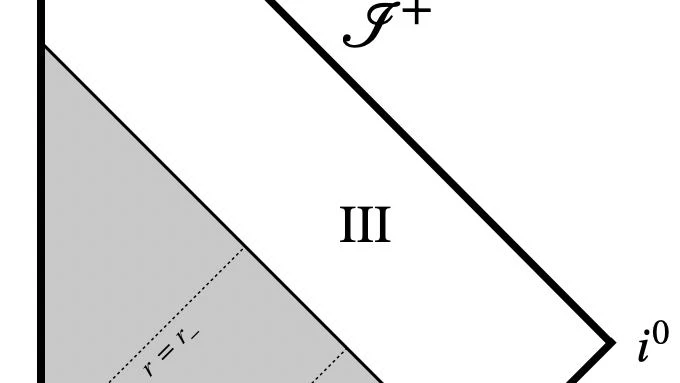
When a giant star runs out of fuel, it collapses into a black hole. Such a hole has an outer boundary — the event horizon, beyond which even light cannot escape. But many black holes also have an inner boundary — a second horizon that separates the outer layers from the singularity core.
A new tuning fork for the cosmic symphony sounded from the Chilean highlands: the ACT telescope refined the note of primordial perturbations — the spectral index nₛ shifted upward, disrupting the harmony of many previous models.
A runner on the middle of a track suddenly switches to a walk — not speeding up or slowing down, but maintaining a constant pace. Something similar may have happened to the universe itself shortly after the Big Bang.
The Universe is an orchestra playing the symphony of the Big Bang. For a long time, the conductor was thought to be dark energy — an unwavering metronome setting the pace of expansion.
In a recent study, astrophysicists showed how pre-recombination physics, particularly early dark energy, affects the spectral running $$α_s$$ and, consequently, the viability of scenarios forming primordial black holes from an ultra-slow-roll (USR) phase during inflation.
In the first moments after the Big Bang, the universe inflated at an unimaginable rate. This inflation left behind ripples — tiny overdensities in the hot radiation and plasma.
The universe hasn't always been expanding. In some models, it first contracted, nearly empty and flat, and then, upon reaching a limit, bounced back and started growing, like the world we know. This scenario is called bouncing cosmology.
In the first instants after birth, the universe might have been multidimensional, like a sheet of paper that suddenly gained thickness. This "thickness"—the extra dimensions — began to inflate rapidly. Such superfast growth is called inflation.
The early universe underwent a rapid expansion — inflation. In a tiny fraction of a second, minuscule quantum jitters were stretched to galactic scales and became the seeds of all large-scale structure.
A translator hears not just words, but intonation, pauses, the tremor in a voice. Ordinary entropy analysis of cosmic perturbations is like meeting minutes: it records facts but loses the nuances. Pseudoentropy entropy is a new tool that captures the hidden "music" of the early universe.
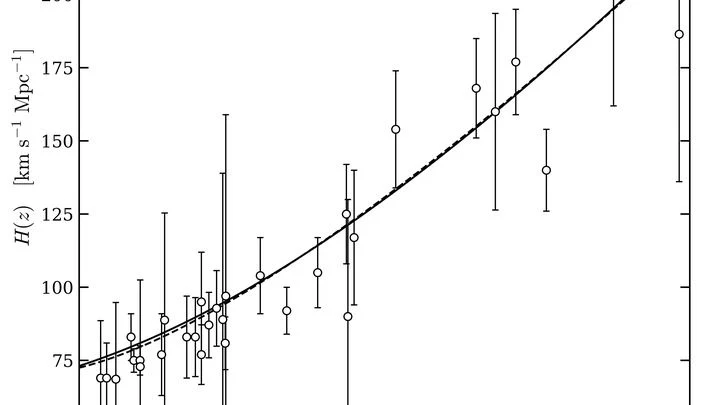
Since the end of the 20th century, we've known: the expansion of the Universe is accelerating — galaxies are flying apart faster and faster. The discovery brought a Nobel Prize to Adam Riess, Saul Perlmutter, and Brian Schmidt.
Inflation is the ultra-fast expansion of the universe in its first moments. It was driven by a field resembling a ball rolling down a hill. But there could have been a second, almost imperceptible ball nearby. The authors of this work considered exactly that scenario: a light spectator field (the axion), frozen at the top of its potential.
Two particles separated by kilometers change their states in concert, as if there were no distance between them. This is called quantum entanglement, and since its discovery it has baffled physicists: no known carrier can travel faster than light, yet correlations appear instantaneously.
In the first moments after the Big Bang, space behaved like an elastic film. It underwent an explosive expansion — inflation (the theory of Alan Guth and Andrei Linde).
The origin of the hot Big Bang is one of the greatest mysteries. The familiar picture: after inflation, the inflaton field transfers energy to ordinary particles, reheating the Universe. Yet dark matter and dark energy hint that nature has hidden sectors.
The cosmic vacuum is not emptiness but a living ocean: its energy swells and subsides, echoing the expansion. Like a lunar tide, vacuum density sensitively responds to Hubble’s tempo — the conductor’s baton of the universe.
Immediately after the Big Bang, in the seething cauldron of the cooling Universe, much like in unevenly hardening glass, stresses appeared — hairline cracks in reality, cosmic strings. Picture a tightrope walker balancing on an invisible cable stretched across the abyss of warped spacetime.
A taut sheet wrinkles. If you tug a corner, a smooth wave runs across; if you sharply bunch the fabric, a sharp crease forms. Space and time in Einstein's equations behave much the same way. Gravitational waves resemble the gentle ripples of the sheet, while shock fronts are like stiff folds where matter's properties change abruptly.
An eternal Universe where the measure of disorder (энтропия) grows is, for most of its time, a homogeneous void. In it, complex structures occasionally assemble by chance, such as fleeting consciousnesses — ‘мозги Больцмана’.
A sponge thrown into a bucket of water eagerly soaks up moisture and swells before your eyes. But if you keep adding water and squeeze and release the sponge, absorption becomes harder and takes longer. That's roughly how tiny black holes behaved at the very beginning of the universe.
A magnet with only one pole — north, but no south. Split it in half, and instead of two ordinary magnets, you get two more one-pole magnets. In our world, no such particle has been found, although many theories predict their existence. These hypothetical objects are called magnetic monopoles.
The authors of the study noticed a curious connection.
Cosmology is going through strange times. On one hand, the standard model with dark matter and dark energy beautifully describes the large-scale structure. On the other, it's cracking at the seams.
The classic story of the Universe’s birth from a blazing point called the Big Bang raises uncomfortable questions: why is the cosmos so homogeneous, and what was before the singularity?
Our Solar System isn't an island in the void: it's a sensitive web stretched in a dark cosmic corner. Planets circle their orbits like dewdrops on threads, and we are the spider sensing the faintest tremor. That tremor betrays the approach of the catastrophe astronomers call the Big Rip.
Cosmology has long sought a loophole behind the Big Bang. Inflation, proposed by Alan Guth, stretches and smooths out primordial inhomogeneities, but what lit the fuse itself?
A pendulum chooses how to swing on its own. If you give it a strong push, it quickly returns to a smooth rhythm. If you hold it at its extreme position, it will stay there, but as soon as you let go, it resumes its usual motion.