The axiom of choice is one of the statements of set theory, postulating the existence of a choice function on any family of nonempty sets. That is, for any collection (possibly infinite) of pairwise disjoint nonempty sets, there exists a set containing exactly one element from each set in the collection. For a finite number of sets it seems trivial, but for infinite ones it gives a non-constructive result: we know that a choice is possible, but we cannot describe it. It is equivalent to Zermelo's well-ordering principle and Zorn's lemma.
History
First explicitly formulated by Ernst Zermelo in 1904 to prove that every set can be well-ordered. This claim was immediately challenged by Émile Borel, Henri Lebesgue and other leading analysts. In 1938, Kurt Gödel showed that AC is consistent with ZF, and in 1963 Paul Cohen proved that the negation of AC is also compatible with ZF. Thus, the axiom of choice is independent. Today, the overwhelming majority of mathematicians use AC, although alternative approaches (constructivism, topos theory) exist where it is avoided.
How it works
Functionally, AC allows non-constructive constructions. In proving theorems, one often says: 'For each i, choose an element x_i from the set A_i' without specifying a choice rule. This is valid if the axiom of choice is accepted. Without it, such reasoning is inadmissible. A typical example: the proof of the existence of a Hamel basis in an arbitrary vector space—we successively choose linearly independent vectors, and at infinite steps AC is required. Technically, the axiom does not indicate how to find the choice; it simply postulates its existence.
In practice
The foundation of many theorems in mathematics: without it, one cannot prove that every vector space has a basis, or that the Tychonoff product of compact spaces is compact. Used in analysis, topology, logic.
Fun fact
Using the axiom of choice, one can mathematically 'double' a ball: cut it into finitely many pieces, move them, and obtain two balls of the same radius. This Banach–Tarski paradox shows how powerful and counterintuitive the axiom is.
Collective behavior of AI agents has emerged not in a laboratory but in the wild: on a randomly discovered wiki site where agents wrote test hints. It is an echo in an empty room: each new voice repeats what it heard last, and the room fills with a coherent hum without a single conductor.
Look at an equilateral triangle — the probability simplex for three assets. Each interior point is a portfolio: non-negative shares summing to one. The triangle's center, the barycenter, corresponds to an equal-weight allocation (1/3, 1/3, 1/3). It seems that by moving toward this point, you lower risk and avoid dangerous edges.
In mathematics there is a sieve that sifts not dust, but infinity itself. It’s called a Q-space: here any subset turns out to be a Gδ set — a countable intersection of open sets, as if sifted through an unimaginably fine mesh.
Eight hundred participants, firms and workers, enter the market. Each holds a strict preference list in mind. The challenge: pair up so that no one wants a do-over. In mathematics, this is called a game theory with a ban on repeat alliances, and its roots trace back to the work of John von Neumann and Oskar Morgenstern.
We're used to thinking that noticing only confirmations of our guesses is a mistake. But recent calculations, inspired by wave behavior, flip that view. It turns out that the habit of seeking the familiar is the best way to reduce information noise (scientists call it entropy).
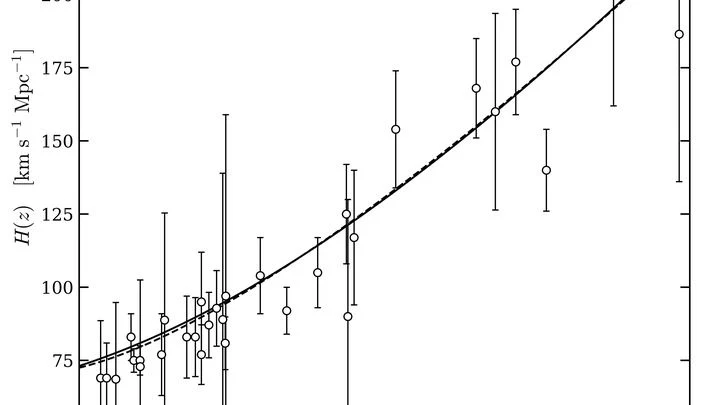
Since the end of the 20th century, we've known: the expansion of the Universe is accelerating — galaxies are flying apart faster and faster. The discovery brought a Nobel Prize to Adam Riess, Saul Perlmutter, and Brian Schmidt.
An amoeba turns left. For a long time, this was considered the result of a rigid chain of causes, like dominoes. But at the core of matter, there's a gap for freedom. The 'Agent Choice via Quantum Flux' model shows: each decision corresponds not to one, but to many quantum histories.
Two accomplices are interrogated separately: betray or stay silent? If neither knows what the other will do, their choice breaks the classical rule of probability. It’s like riding an old bicycle over bumps — the hard seat jolts you off. The textbook rule, the classical model, fails. The authors of a new study found a simple fix: the cyclist needs a soft saddle.
In the quantum world, you cannot create a copy of an unknown particle's state – this was established by William Wootters and Wojciech Zurek in 1982, and Charles Bennett turned this prohibition into a data protection tool.