The expansion of the universe is not a simple, steady process. It is a cosmic tug-of-war between the outward push of the initial Big Bang and the inward pull of gravity from all matter and energy. For most of cosmic history, gravity was winning, slowing the expansion down. But about five billion years ago, something changed: the expansion began to accelerate, driven by a mysterious force now called dark energy. This discovery, which earned the 2011 Nobel Prize in Physics, fundamentally altered our understanding of the cosmos and its ultimate fate.
History
The discovery of cosmic acceleration was made in 1998 by two independent teams, the Supernova Cosmology Project and the High-Z Supernova Search Team, led by Saul Perlmutter and Brian Schmidt/Adam Riess respectively. They used Type Ia supernovae as standard candles to measure the expansion history.
How it works
The rate of expansion is governed by the Friedmann equations, which relate the expansion rate to the energy content of the universe. Matter (both normal and dark) and radiation cause the expansion to decelerate, as their gravitational pull works against it. However, if there is a component with negative pressure — like dark energy, or a cosmological constant — it can cause the expansion to accelerate. The transition from deceleration to acceleration happened when the density of matter dropped below the density of dark energy, which occurred about 5 billion years ago. This is why distant supernovae appear dimmer than expected: they are farther away than they would be if the expansion were only decelerating.
In practice
This concept is central to modern cosmology, including interpreting cosmic microwave background data, large-scale structure surveys, and constraining the properties of dark energy. It also underpins the standard ΛCDM model of the universe.
Fun fact
The acceleration of the universe means that galaxies beyond our local group are moving away from us faster than the speed of light, and we will never be able to reach them, even with a light-speed spacecraft.
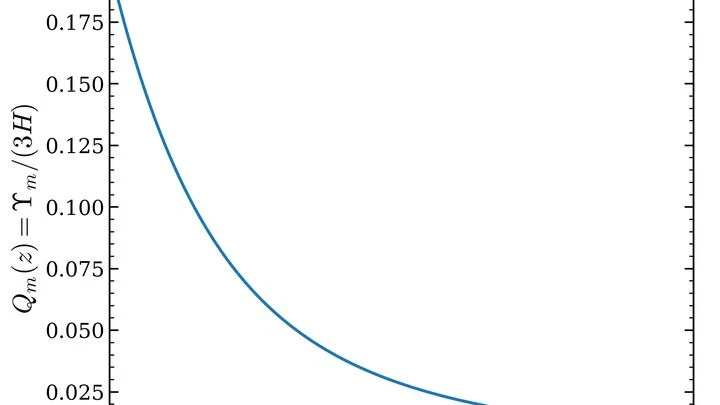
Space is expanding, and that expansion is accelerating. But what if, in the first instants after the Big Bang, gravity behaved differently? The authors of a new study added an invisible field to Einstein's equations that siphons energy from ordinary matter and radiation.
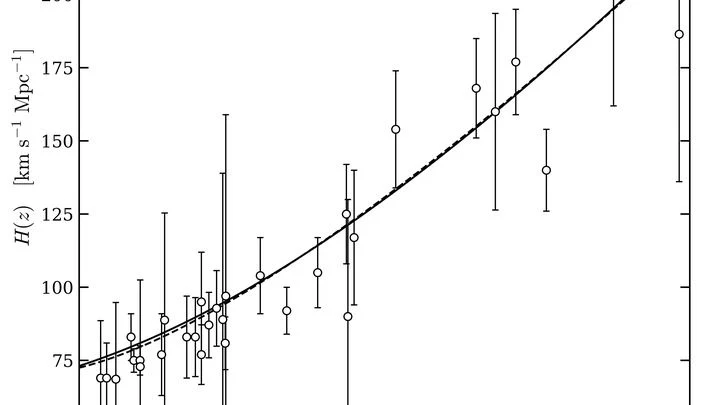
In 1929, Edwin Hubble pointed his telescope at distant galaxies and discovered they were receding. Ninety years later, two measurements of this recession rate, from ancient light and from nearby stars, stubbornly disagree. A 9% discrepancy cannot be chalked up to error. It is as if the Universe in its youth and in its maturity runs on different clocks.
Cosmic ripples begin with tiny clumps. 380,000 years after the Big Bang, the universe was nearly homogeneous — density fluctuations were only one part in 100,000. But gravity turned these weak ripples into galaxies, clusters, and giant voids.
A quantum computer relies on two forces: entanglement (particles behaving as a single whole) and "magic"—a measure of how far a state is from familiar classical physics. But how these two resources relate as a many-particle system evolves in time has remained a puzzle.
The authors approached the problem through time.
Decades of radio astronomy have listened to space, hoping to catch narrowband radio transmissions — the technogenic 'voice' of distant exoplanets. But our own technological evolution reveals a paradox: loud analog signals, like 1960s TV broadcasts, are just a brief squawk of a newborn civilization.
A drama is brewing in cosmology: two principal musical instruments, the orchestra of the early Universe and the chamber ensemble of the modern cosmos, play the same symphony of expansion at different tempos.
The standard model of cosmology, based on the field equations proposed by Einstein, describes the Universe as a cocktail of dark matter (discovered thanks to Vera Rubin) and dark energy in roughly a 1:3 ratio.
Imagine a cosmic orchestra performing a symphony from the Big Bang to the present day. The conductor, dark energy, long seemed an impassive metronome: the cosmological constant Λ motionless, like a baton frozen in mid-air.
When we peer deep into space, we see the past. Edwin Hubble’s law turns redshift into a time machine: light from galaxy UDS 12999 traveled to us for 7.6 billion years — more than half the age of the Universe.
Einstein’s cosmological constant — a blunder or a boomerang insight? The universe’s acceleration caught physicists off guard: ΛCDM works, but why is the vacuum energy so absurdly tiny? Imagine an ocean heaving with quantum fluctuations, yet on the surface only a microscopic ripple.
The universe is expanding at an accelerating rate, like dough that keeps rising faster even though the yeast ran out long ago. For twenty years, astronomers have been searching for the cause and call it dark energy. But what it is remains a mystery.
New work proposes an unexpected source: the vacuum inside the atomic nucleus.
Since the end of the 20th century, we've known: the expansion of the Universe is accelerating — galaxies are flying apart faster and faster. The discovery brought a Nobel Prize to Adam Riess, Saul Perlmutter, and Brian Schmidt.
The Universe grows like a metropolis: galaxies skyscrapers are erected on an invisible scaffold of dark matter: its gravity pulling in construction material. Meanwhile, dark energy makes the city itself continuously expand.
A vast city lights new streetlamps every night. But then a hurricane sweeps in, rips all the fuel from the warehouses, and the lamps go out one by one. Something similar has been spotted by astronomers in a galaxy whose light has traveled 12.5 billion years to reach us.
The late-stage Universe can be thought of as a crowd dispersing after a concert. In the standard cosmological model ΛCDM, people shuffle away quietly, not bothering each other. But what if thousands of concertgoers suddenly start gently nudging their neighbors?
In the late 1990s, astronomers including Saul Perlmutter discovered that the universe is expanding at an accelerating rate. The cause was dubbed dark energy — an invisible force stretching the cosmos.
The cosmic vacuum is not emptiness but a living ocean: its energy swells and subsides, echoing the expansion. Like a lunar tide, vacuum density sensitively responds to Hubble’s tempo — the conductor’s baton of the universe.
Our universe isn't just expanding: it's doing so faster and faster. It's like raisin bread dough in the oven: the raisins move apart, and the farther they've already separated, the faster they continue to recede. The strange force pushing the cosmos apart is called dark energy. Most scientists think it's constant, like a permanent spring built into the very fabric of space.
Immediately after the Big Bang, space may have vibrated like a string from quantum effects. As these oscillations faded, they would have left a mark on the expansion of galaxies — a memory effect. The search for this echo in telescope data turned up nothing.
The universe is expanding, and its history features two puzzling episodes that don't fit into a simple picture. The first is a brief period in its youth when everything flew apart faster than expected, as if someone had floored the gas pedal. The second is today's acceleration, as if the same pedal were pressed again, but more gently.
An inflating balloon starts out slowly, then suddenly expands faster and faster, as if someone is pumping it up from inside. That's roughly how our universe behaves: galaxies are receding with acceleration. The culprit behind this acceleration is called dark energy.
The Universe is a vast city. In it, dark matter is the invisible framework of buildings, and dark energy is the force stretching the streets. For a long time they were considered independent, but new research has caught them in secret communication.
A galaxy is like a cosmic highway where stars, like cars, race along circular orbits. Their speed is set by the invisible "cargo" of mass enclosed within the orbit: the more massive the central region, the faster the stars at the periphery.
A pendulum chooses how to swing on its own. If you give it a strong push, it quickly returns to a smooth rhythm. If you hold it at its extreme position, it will stay there, but as soon as you let go, it resumes its usual motion.
In a thin sandwich of semiconductors, light creates pairs, an electron and a positive hole, that stick together like a ball on a rubber band. Normally, such pairs, called excitons, quickly emit light and vanish. But there are others, dark ones, that live hundreds of times longer because their internal structure forbids them from easily giving off energy.
Imagine inflating a balloon. It expands quickly at first, then slows down, and then suddenly speeds up again, as if someone gave the pump another squeeze. That's what seems to be happening to our universe.
Two black holes, orbiting each other, behave like a boat rowing with stars. Each passing star is flung away, like a stroke of an oar, and transfers momentum to the pair. For a long time, it was thought this simply brings the black holes closer. But new analysis has shown: by flinging stars unevenly, the system pushes itself sideways, spins, and tilts the orbit.
The Universe is like an inflating balloon. Quantum mechanics forbids measuring exactly how big it is and how fast it's inflating at the same time. This principle permeates the cosmos: a new equation states that the Universe's expansion and its size are linked by a fundamental uncertainty.
You're inflating a balloon, but with each pump of the bulb, the rubber doesn't just stretch: it subtly changes its elasticity. Gravity works similarly in the new model: not as a rigid stage for the cosmic play, but as a living material that responds to every speck of matter.
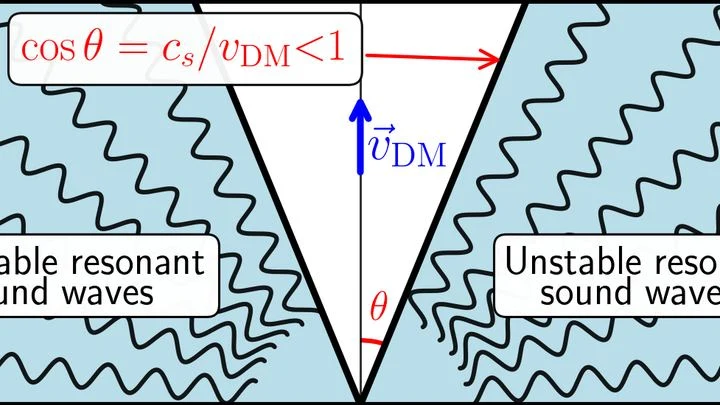
After the Big Bang, dark matter and ordinary matter (mostly hydrogen) went their separate ways in terms of speed. Their gravitational pull acts like a bow gliding across a string: when frequencies match, resonance occurs, and sound waves start to rapidly grow in ordinary matter.
Imagine inflating a balloon. At first, it expands slowly; then someone gives a sharp blast of air, and it swells faster. But as the airflow weakens, the balloon's growth slows again. According to a new study, the Universe has behaved much the same way: after the Big Bang, it expanded, then suddenly accelerated, and now that acceleration is fading.
No one has ever seen dark matter, but every galaxy feels its pull. Usually, it's pictured as a sea of identical, silent particles. The new work paints a livelier picture: two kinds of particles, heavy and light, constantly exchanging between them.
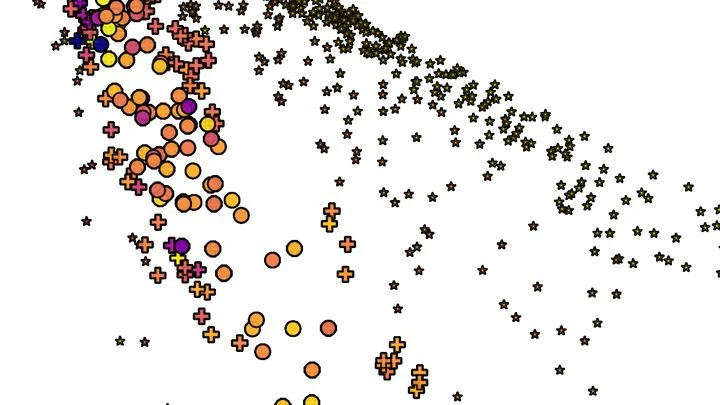
Drop two identical pebbles from a mountain peak: one lands a centimeter to the left, and a minute later they end up in different valleys. A galaxy is the same mountain, only with billions of pebbles and a slope that stretches over millions of years. The authors of a new study simulated a disk of 40 million point-like stars and tested how quickly it forgets where it started.
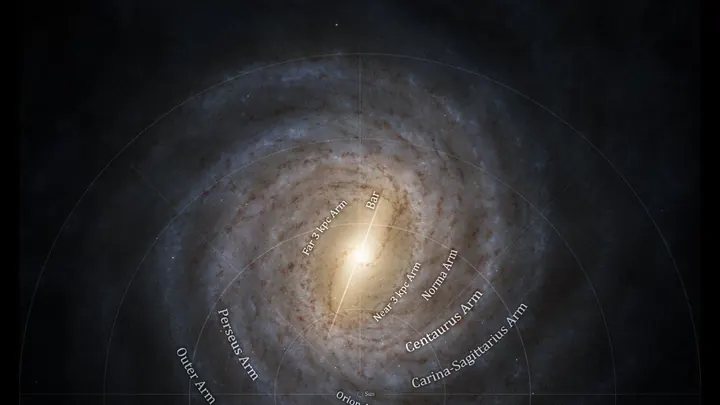
Other galaxies are just ancient snapshots, but we watch the Milky Way live. Comparing data over 30 years, scientists found that the Galaxy’s center is, like, speeding up: the supermassive black hole got heavier, swallowing the mass of a large asteroid each year; the stellar bar (a huge beam of billions of suns, like the…
Galaxies are flying apart, but the expansion rate measured from the afterglow of the Big Bang and from supernova explosions doesn't match: this problem has been called the Hubble tension. It's like two dancers losing their rhythm because they can't feel each other.
Scientists proposed a model in which the mysterious force (dark energy) possesses something like inertia: it needs time to respond, like a heavy pendulum. Because of this, the expansion of the Universe doesn’t accelerate forever, but instead decays, like a pendulum in thick honey.
In the thirties, Pauli realized: without tiny ghost-like particles, the energy of stars doesn't add up. Thus neutrinos were born — intangible wanderers that permeate everything.
The early universe was far from perfect: some regions stretched faster than others, creating folds and warps. But a quantum bounce — the transition from contraction to expansion, driven by the laws of the microworld — fixes everything.