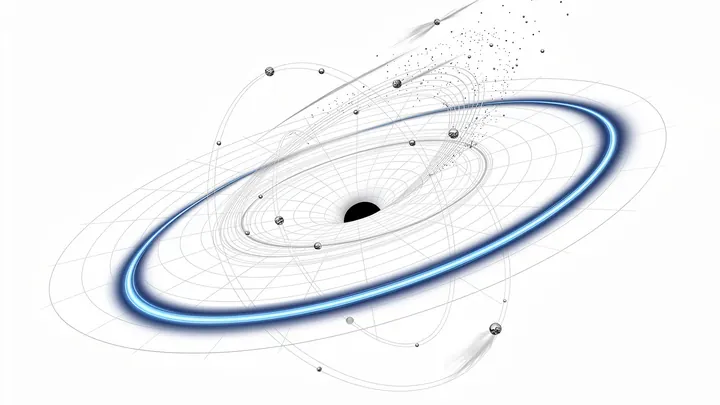
Cosmic particle acceleration refers to the processes by which astrophysical objects—most notably black holes and their relativistic jets—boost charged particles like protons and electrons to energies far beyond anything achievable on Earth. These mechanisms are responsible for producing cosmic rays, ultra-high-energy neutrinos, and gamma rays observed across the universe. The study of this phenomenon connects black hole physics, plasma dynamics, and particle astrophysics, explaining how the most extreme environments in nature act as natural particle colliders.
History
The concept of cosmic particle acceleration dates back to the 1940s, with Enrico Fermi's proposal of acceleration by moving magnetic fields. The connection to black holes and jets was established in the 1970s–1980s through theoretical work by Roger Blandford and Roman Znajek, among others.
How it works
The dominant mechanism is Fermi acceleration, where particles repeatedly cross shock fronts in the jet or surrounding medium, gaining energy with each bounce. Near a black hole, the immense gravitational potential and magnetic fields can also directly accelerate particles via magnetic reconnection or the Blandford–Znajek process, which extracts rotational energy from the black hole itself. The accelerated particles then emit radiation across the electromagnetic spectrum, from radio to gamma rays, and can produce neutrinos when they interact with matter or radiation.
In practice
Understanding these mechanisms helps interpret data from observatories like IceCube and the Event Horizon Telescope, and informs models of cosmic ray origins that affect satellite electronics and astronaut safety.
Fun fact
Some ultra-high-energy cosmic rays detected on Earth carry more energy than a baseball pitched at 100 km/h, yet they are single subatomic particles.
A black hole is not an eternal vacuum cleaner. It slowly loses mass by emitting particles, much like a heated stone cooling as it radiates heat. This process, discovered by Stephen Hawking, is barely noticeable for large holes, but for tiny ones, with masses comparable to a mountain, it becomes a violent evaporation.
At the centers of many galaxies, not only supermassive black holes lurk, but also vast clouds of invisible matter. If this matter consists of ultralight particles, it can gather into dense clumps — a kind of 'star' made of dark matter.
In 1933, Fritz Zwicky first spoke of an invisible mass holding galaxy clusters together. Decades later, Vera Rubin mapped galactic rotation, revealing the ghostly presence of dark matter. Today we know it pervades the cosmos, but its particle nature remains elusive.
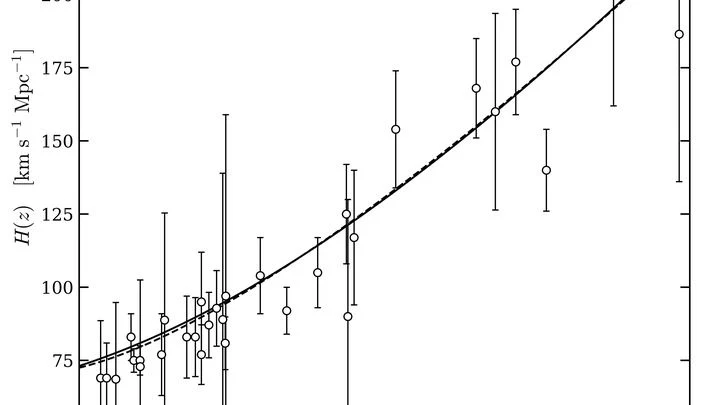
Since the end of the 20th century, we've known: the expansion of the Universe is accelerating — galaxies are flying apart faster and faster. The discovery brought a Nobel Prize to Adam Riess, Saul Perlmutter, and Brian Schmidt.
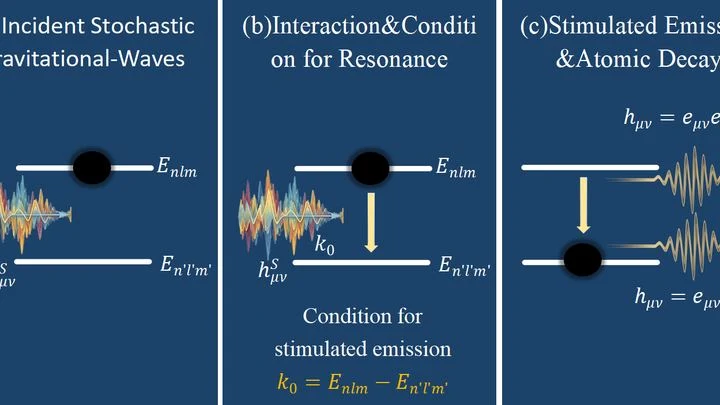
Gravitational waves — the cosmic tremors from distant cataclysms — are so faint that detecting them is like trying to hear a whisper in a hurricane. But a black hole can amplify that whisper many times over.
For almost a century, cosmologists have been grappling with the mystery: what makes the Universe expand ever faster? The standard answer — dark energy — creates a monstrous discrepancy between the theoretical vacuum density and observations. But there's another path, one that turns causality on its head.
In the usual picture, a black hole is a featureless pit in spacetime. But if a shell of matter vibrates around it, the gap between the edge of the abyss and this shell becomes a resonant cavity.
Two black holes, orbiting each other, behave like a boat rowing with stars. Each passing star is flung away, like a stroke of an oar, and transfers momentum to the pair. For a long time, it was thought this simply brings the black holes closer. But new analysis has shown: by flinging stars unevenly, the system pushes itself sideways, spins, and tilts the orbit.
A balloon inflates on its own, even though no one is blowing it up. That's roughly how the accelerated expansion of the universe looks, and to explain it, scientists usually invoke dark energy, an invisible and poorly understood force. But what if the balloon expands because new air molecules are continuously appearing inside it?
A tiny black hole the size of an atomic nucleus floats in the hot soup of the early universe. Normally, such a little one should quickly evaporate, releasing energy like a drop of water on a hot skillet. But if space is more complex than it seems and contains hidden dimensions, everything changes.
The universe is expanding faster and faster, and scientists blame it on dark energy. Its origin is explained in a new way: dark energy isn't eternal, but appears only after dark matter clumps together into lumps — future galaxies.
The mechanism works like a pump that turns on when pressure drops.
A stream of water from a hose hitting a wall splashes sideways. Astrophysical jets behave similarly — narrow plasma flows ejected from the vicinity of black holes or young stars. When such a flow encounters resistance from surrounding gas, a shock wave forms inside it, akin to a standing wave in a fast-flowing river.
A spinning black hole acts like a cosmic generator: its rotation pumps energy into an invisible scalar cloud — a prime candidate for dark matter. A scalar field is like temperature: at every point in space it's just a single number, with no arrows or vectors. The cloud grows until it overflows.
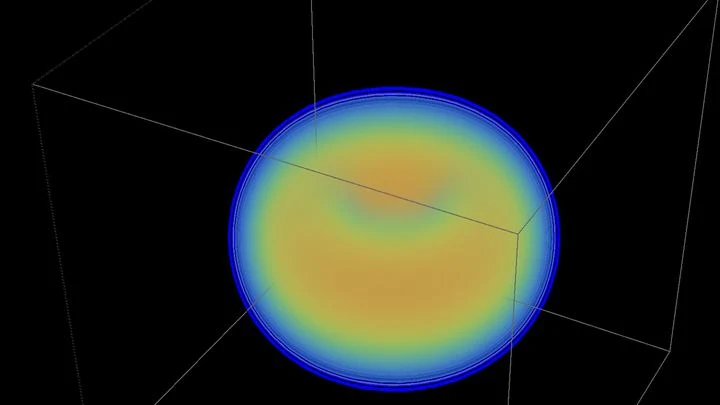
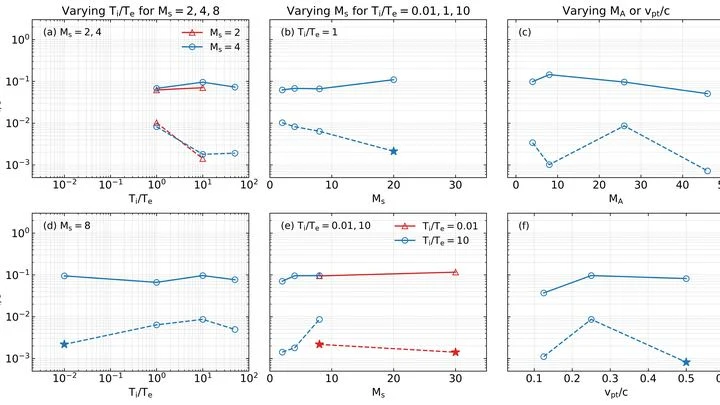
A new study confirms: shock waves in plasma around supermassive black holes at the cores of galaxies act like ocean swells, shoving protons to near-light speeds. Even a weak wave passes on a tenth of its energy, like a gentle surf launching a surfer into space.
In 1929, Edwin Hubble discovered that galaxies are receding — the universe is expanding, like rising dough. Today we know it's growing faster and faster, and usually the accelerator is called dark energy.
Right after the Big Bang, primordial black holes floated in the hot plasma — clumps of mass the size of a mountain squeezed into the volume of an atom. According to Hawking's prediction, they slowly evaporated, emitting radiation like tiny stoves.