A quasistar is a hypothetical type of star that forms in the early universe, consisting of a massive black hole at its core surrounded by an enormous, diffuse envelope of gas. The black hole is not formed by collapse but grows by accreting gas from the envelope, while the envelope itself is supported by the radiation pressure generated by accretion. Quasistars are proposed as a solution to the puzzle of how supermassive black holes (millions to billions of solar masses) formed so early in cosmic history, less than a billion years after the Big Bang.
History
The quasistar concept was proposed by Mitchell Begelman and colleagues in 2008, as a theoretical model to explain the formation of supermassive black holes in the early universe. It remains a hypothesis, with no direct observational evidence yet.
How it works
In the early universe, dense primordial gas clouds could collapse directly into a black hole of about a thousand solar masses. This black hole would be embedded in a massive gas envelope. The accretion of gas onto the black hole releases enormous energy, which heats the envelope and creates radiation pressure that counteracts gravity, preventing the envelope from collapsing. The system resembles a giant star with a black hole 'core'. Over time, the black hole grows by consuming the envelope, eventually leaving a supermassive black hole when the envelope is depleted.
In practice
Quasistars are primarily a theoretical construct used in astrophysical models to explain the growth of supermassive black holes in the early universe. They are not directly applicable to technology but guide observational searches for early black hole seeds and inform simulations of galaxy formation.
Fun fact
A quasistar could be as bright as a small galaxy, but its surface temperature would be relatively cool (about 10,000 K) because the energy is spread over an enormous surface area.
A little monster hides in a dwarf galaxy, and its neighbor feeds it. The satellite galaxy is slowly merging with a massive companion, and gas from the outer regions falls toward the center, where a black hole sits. By cosmic standards, it is not large: only 800 to 5000 solar masses, but its appetite is ferocious.
An old city gains new suburbs. In the center, narrow streets where life has nearly stopped, while on the outskirts construction is booming. That is what a spiral galaxy looks like when its core stars have long aged and new stars are still being born in the outer disk.
At the center of an ultra-compact dwarf galaxy, a very dense stellar system spanning tens of light-years, there is a vacuum cleaner at work. But instead of dust, it sucks in gas shed by dying stars. This gas does not fly off in all directions; instead, it spirals into a funnel, a rotating disk that gradually settles onto the black hole.
Two stars circle each other like dancers who come together and drift apart. Over time, one swells, and its outer layers spill onto its neighbor. The star that receives foreign matter looks no different from a single star, but its surface remembers everything.
Drop a pebble into a pond, and ripples spread across the water. Something similar happens when a black hole merges with another: it emits gravitational waves that resemble the fading ring of a bell.
A homogeneous, spherical cloud of cosmic dust begins to contract under its own gravity. At some point, by classical laws, it should collapse into a point of infinite density — a singularity.
A neutron star is the ultra-dense remnant of a supernova: the mass of the Sun packed into a sphere the size of a city. For billions of years, it travels through space, gathering around itself invisible matter, dark matter, which emits no light but pulls with gravity.
A black hole is not silent. When perturbed, it rings like a bell, and that ring is its quasinormal modes — damped oscillations. Physicists delved into the world of charged black holes in anti-de Sitter space (a universe with negative curvature, like a saddle).
At the heart of our Galaxy lives the supermassive black hole Sagittarius A*. If an invisible companion orbits nearby, their dance can be spotted through the light of other stars. The pair's gravity works like a lens: as the black holes pass in front of a background star, its light briefly brightens and splits into two.
Imagine a factory capable of producing a million parts per hour, yet it only makes a hundred. That's roughly how our Universe behaves when viewed through the lens of entropy — a measure of disorder that, according to physics, must only increase. The main "machines" of this factory are supermassive black holes.
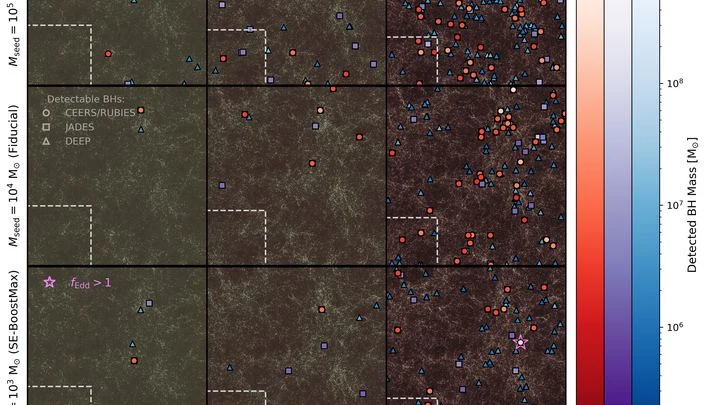
A marathon lasting 13 billion years started with different weights. A hundred solar masses — lighter than some gas clouds. A hundred thousand — gravitational dominance, comparable to an elephant among kittens. That's what black hole seeds looked like, ones that by our time should have turned into supermassive giants.
After a hit, a black hole rings like a bell. But instead of sound, it emits gravitational waves whose frequency rapidly decays: these are called quasinormal modes. From such a 'ring,' you can infer the hole's mass, spin, and other properties.
Eight hundred million years after the Big Bang, and at the heart of a young galaxy a monstrous engine is already throbbing. A black hole with a mass of ten billion suns devours matter so greedily that its radiation should outshine everything around it. But outside, silence.
In the early universe, just a few hundred million years after the Big Bang, astronomers see strange objects — little red dots. They are compact, red, and in their spectra, broad Balmer lines scream the presence of supermassive black holes. But how did the hole manage to accumulate millions of solar masses in such a short time?
A campfire burns steadily and long. But when the wind blows, the flame flickers out, leaving only embers. A similar story plays out with the gravastar — a hypothetical object that was supposed to replace the black hole.
An ordinary black hole hides a singularity — a point where the laws of physics break down.
Three invisible strings oscillate in the intergalactic void. This is not poetry, but a hypothesis about the nature of dark matter — an ultralight quantum field with spin 1, carrying three polarizations.
A mosaic of squares and triangles covers the floor without gaps, yet it never settles into a simple repeating pattern. Such a pattern is a quasicrystal — a solid where atoms are arranged not periodically but according to a pattern of several waves of different lengths. These waves are incommensurate with each other, and together they create long-range order.
In 2016, astronomers saw something incredible: a distant star, named Icarus, flared up for several weeks, crossing the abyss of space. Gravitational lensing, an effect predicted by Einstein, had kicked in: a massive object bends spacetime and focuses light like a giant magnifying glass.
For a long time, the event horizon behaved like a cosmic dictator: everything that crossed its boundary vanished irretrievably from our Universe. But quantum mechanics, like a dissident's voice, whispered: information cannot simply disappear.
In 1984, the world of crystallography was turned upside down: sharp diffraction peaks with fivefold symmetry were discovered in an alloy of aluminum and manganese – as if nature had mocked the strict theorems forbidding repeating patterns from having axes of order 5, 8, 10, or 12.
An ordinary black hole is surrounded by a thin photon sphere — a place where light can loop around before falling in or escaping. In the new work, this region has puffed up into a whole layer packed with massless particles that zip around at nearly the speed of light and don't press against the walls.
Observations by James Webb showed: already 500 million years after the Big Bang (at redshifts z~10), the Universe was aglow with black holes with masses of billions of solar masses. This baffles theories of gradual growth: matter would not have time to 'feed' the seeds at the required rate.
A black hole is not a dead object. After a disturbance, such as merging with another hole, it rings like a bell. This ring is not just a sound but a complex set of damped oscillations called quasinormal modes. Their frequency and damping rate depend on the hole itself: its mass, charge, and spin.
In the centers of distant galaxies, X-ray 'beacons' sometimes light up. They don't flash randomly but on a strict schedule: every few hours or days. These bursts are called quasi-periodic eruptions (repeating at nearly regular intervals).
In the search for the nature of dark matter, one of the most intriguing hypotheses traces back to the first moments after the Big Bang. Back then, quantum fluctuations of the inflation field gave rise to clumps of matter that could collapse into primordial black holes.
At the center of a galaxy, gravity condenses dark matter into a dense 'spike.' Such a dark spike resembles a funnel of invisible particles around a massive body. But if both the center and the particles are primordial black holes, the picture breaks down.
The galaxy NGC 1277 is like an old book that no one has opened for billions of years. It formed quickly at the dawn of the Universe and has barely changed since — no collisions with neighbors, no new layers added.
A giant cloud of invisible matter acts like a funhouse mirror — distorting the light from a distant galaxy. From these distortions, astronomers can weigh the cloud and peer into its depths.
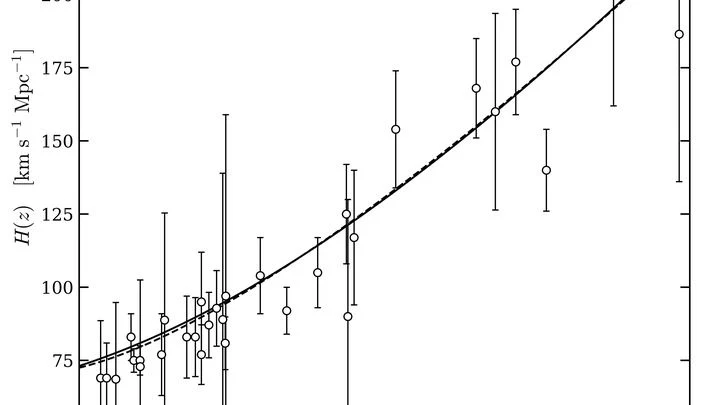
Since the end of the 20th century, we've known: the expansion of the Universe is accelerating — galaxies are flying apart faster and faster. The discovery brought a Nobel Prize to Adam Riess, Saul Perlmutter, and Brian Schmidt.
Drop a pebble into a pond, and ripples spread across the water. A black hole 'sounds' much the same when matter falls into it or when its spacetime gets a gentle jolt. These fading oscillations are called quasinormal modes, like the tolling of a bell that gradually fades away.
A black hole is like a bottomless well. You can measure how much water has flowed into it by watching the level from outside. But how do you find the mass of the water itself if you're standing inside the well? That's roughly the problem the authors of a new paper tackle.
Heir to the ideas of Edwin Hubble, the James Webb Space Telescope has peered back to an era when the expansion of the universe was still picking up speed. At redshifts z>4, it spotted bizarre objects—"Little Red Dots" (LRDs).
The James Webb space telescope peered into an era when the Universe was less than a billion years old and discovered hundreds of strange objects there. Tiny yet dazzlingly bright, they glowed a deep red — like burning coals scattered across the black velvet of space.
Using the James Webb telescope, astronomers peered into an ancient quasar — the dazzling heart of a galaxy where a giant black hole sucks in matter. It turns out it doesn't just destroy, but also creates: its powerful outflows and shock waves act like a true cosmic mill.
In the silent theater of the cosmos, a star’s life plays out over billions of years. But sometimes an invisible director sneaks onto the stage — a primordial black hole.
The James Webb Space Telescope has spotted astonishing objects in the depths of space — tiny red dots that shine so brightly it's as if a spotlight were hidden inside a small bulb. These dots are not stars or galaxies in the usual sense, but rather 'cocoons' around supermassive black holes greedily gulping down surrounding gas.
Just a few hundred million years after the Big Bang, in the ocean of invisible dark matter, giant black holes were already taking shape. They were born from the matter itself — without any help from stars. This mechanism, based on the equations of Lemaître, explains their early appearance.
If you squeeze a handful of sand, it gets denser, but at some point the grains press against each other: there's no more room to compress. Some theorists think space behaves similarly at ultra-small distances: it has a limit to divisibility, a kind of 'grain.' In this new study, that principle was applied to the birth of black holes in the early universe — the very ones that…
A giant black hole tore apart a star, leaving behind a lopsided disk of scorching gas — like a vinyl record warped by the heat. Now a tiny black hole (or a star) zips around and repeatedly pierces that disk. Each puncture is a bright X-ray flare.