How Fast Alpha Particles Calm the Plasma express
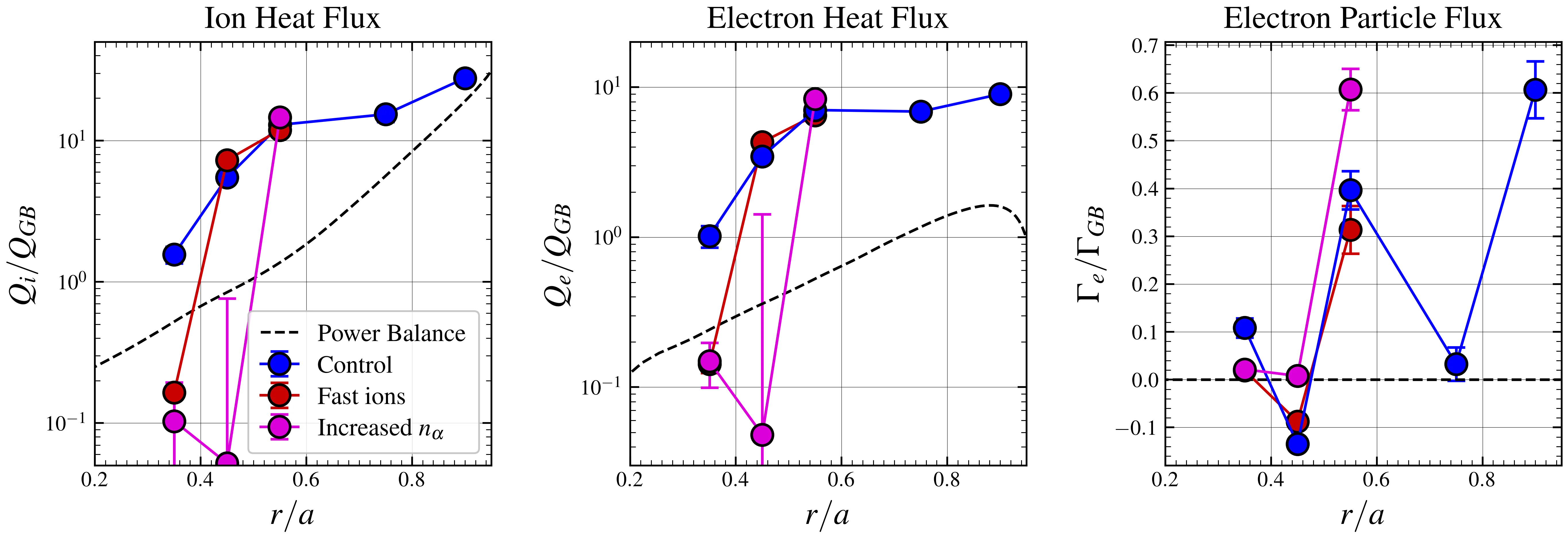
Water boils in a pot: bubbles churn, heat quickly escapes into the air. In the center of the ARC fusion reactor, plasma behaves similarly — except instead of bubbles, there are turbulent eddies, and instead of air, there's a magnetic field that must hold the heat. The eddies are a problem: they carry heat outward and cool the plasma.
But fast alpha particles (helium nuclei flying out of the fusion reaction) are born inside the plasma. They don't just add heat. Simulations showed that in the inner zone of the reactor, up to half the radius, these particles act like a conductor who quells chaotic oscillations. Turbulent heat and particle fluxes decrease. The key mechanism is the interaction of fast ions with special waves in the plasma. These waves spontaneously organize into an ordered flow, and it, like an invisible barrier, separates the hot core from the cold edges.
Importantly, the effect strengthens as the number of alpha particles and the plasma's magnetic pressure increase. The more fast particles, the calmer the plasma behaves. This is similar to how a weight on a spring stops swinging if you add another, properly tuned pendulum. However, the calming only works where these particles are abundant. Farther from the center, turbulence returns. This means we can look for ways to keep fast particles longer in the desired zone.
The alpha particles that calm the plasma are the same helium nuclei that fill party balloons. But in the reactor, they fly at speeds of tens of thousands of kilometers per second.
In Andy Weir's novel The Martian, the protagonist uses a radioisotope generator for heat — here, alpha particles from fusion reactions themselves become a 'smart' tool for plasma confinement.