Fusion energy is the energy released when two light atomic nuclei combine to form a heavier nucleus, the process that powers the Sun and other stars. Unlike nuclear fission, which splits heavy atoms, fusion offers the promise of abundant, low-carbon power with minimal long-lived radioactive waste. The challenge is that on Earth, fusion requires temperatures of hundreds of millions of degrees to overcome the electrostatic repulsion between positively charged nuclei, and containing such a hot, ionized gas (plasma) is extraordinarily difficult.
History
The concept of fusion as an energy source emerged in the 1920s with Arthur Eddington's suggestion that stars are powered by nuclear fusion, and the mechanism was worked out by Hans Bethe in 1939. The first controlled fusion reactions on Earth were achieved in the 1950s in experimental devices like the Z-pinch and stellarator, though sustained energy production remains elusive.
How it works
At its core, fusion relies on quantum tunneling: even when nuclei lack the classical energy to overcome their mutual repulsion, there is a small probability they can tunnel through the barrier and fuse. In a reactor, this is achieved by heating a fuel like deuterium and tritium to extreme temperatures, creating a plasma where nuclei collide frequently enough for fusion to occur. The energy released comes from the mass difference between the reactants and products, described by E=mc². To sustain the reaction, the plasma must be confined—either magnetically in devices like tokamaks, or inertially by compressing tiny fuel pellets with lasers.
In practice
Fusion research drives development of advanced superconducting magnets, high-power lasers, and plasma diagnostics, with experimental reactors like ITER aiming to demonstrate net energy gain.
Fun fact
The Sun's core produces fusion energy at a rate of about 276.5 watts per cubic meter—roughly the same power density as a compost pile.
After a nuclear explosion, soot rises into the sky. It settles high above the clouds, in the stratosphere, and stays there for years. This soot acts like a thick curtain: it blocks some sunlight and alters the chemistry of the sky.
Inside a solar flare, magnetic field lines snap like stretched rubber bands and reconnect — releasing in minutes enough energy to power humanity for millions of years. In the lab, this process, magnetic reconnection, could long be triggered but not stopped. Now physicists have a switch.
Atomic batteries powered by plutonium decay have been running pacemakers and space probes for over sixty years. But the raw material is scarce: worldwide, only a few kilograms of plutonium-238 are produced each year, barely enough for the most critical missions.
The 21-kilometer ring near Protvino was once planned to accelerate protons. Today, the same tunnel could host a very different machine — a muon collider. The muon is a heavy cousin of the electron, and that's its strength. On a curve, an electron radiates like a searchlight, losing precious energy. A muon radiates a billion times less.
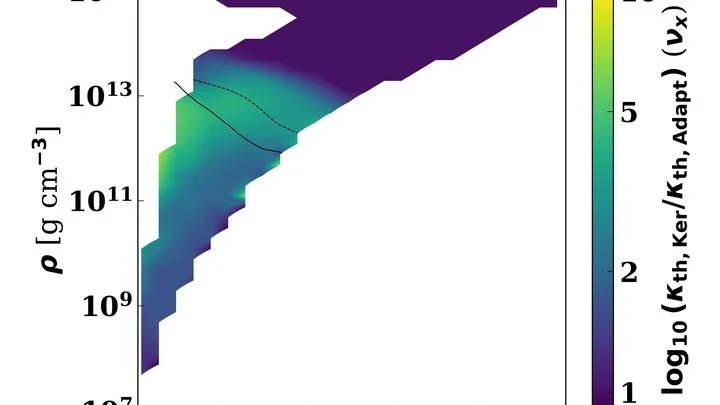
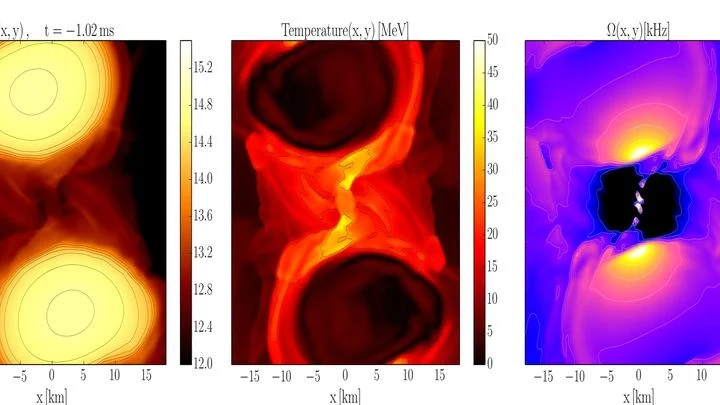
The collision of two neutron stars is a cosmic laboratory where matter is compressed to unimaginable densities. In the first moments after the merger, a hot cloud forms and cools by emitting neutrinos. These ghostly particles carry away energy and dictate how much matter is ejected into space and which heavy elements are synthesized.
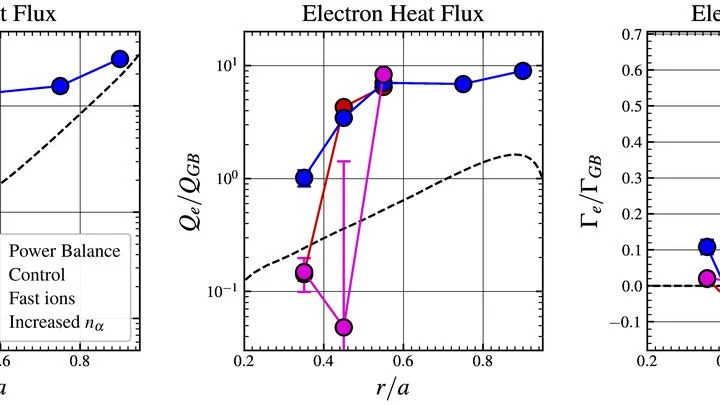
Water boils in a pot: bubbles churn, heat quickly escapes into the air. In the center of the ARC fusion reactor, plasma behaves similarly — except instead of bubbles, there are turbulent eddies, and instead of air, there's a magnetic field that must hold the heat.
A tightly twisted phone cord snaps and scatters sparks. Magnetic fields on the Sun behave the same way: they twist, break, and reconnect, powering flares. For the first time, astronomers have witnessed this process directly. One loop was twisted by 540 degrees — one full turn and then half again. That’s three times more than previously thought possible.
In 2017, detectors picked up a tremor in space — gravitational waves from the merger of two neutron stars. Telescopes immediately found a flash of light: a cosmic explosion astronomers dubbed a kilonova. In that fiery cauldron, it turned out, the heaviest elements of the periodic table are born — gold, platinum, uranium.
Two neutron stars (the remnants of dead stars, compressed to the size of a city but weighing as much as the Sun) spiral around each other and eventually collide. At that moment, something between a black hole and a super-powered magnet is born: a field billions of times stronger than that of the most powerful MRI machine.
A typical photon source can be likened to a club entrance with a single bouncer. He tries to let people in one at a time, but occasionally couples sneak past. Physicists call this the purity problem: photons must arrive strictly solo, otherwise quantum computing breaks down.
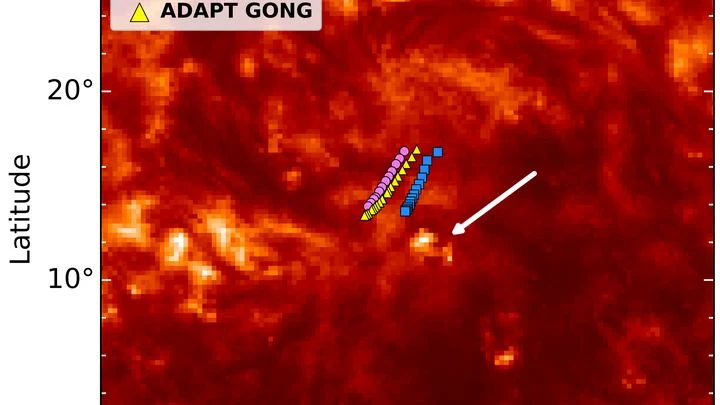
In December 2011, Comet Lovejoy boldly raced through the searing corona of the Sun. Right after — a flare. Scientists checked whether the comet could have caused it. The atmosphere of the Sun is threaded with taut magnetic loops, like a drawn bowstring.
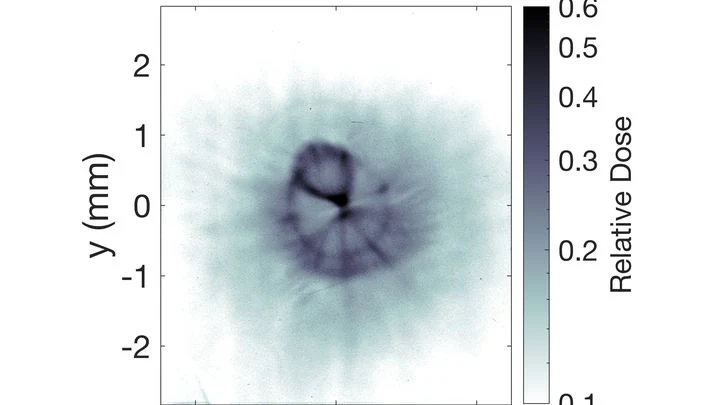
A pot of boiling soup bubbles away, and you'd love to know how hot individual droplets are inside. But you can only dip your thermometer at the edge, where things are calmer. Laser fusion is a bit like that: a powerful laser pulse hits a target, creating a cloud of fast protons.
If you squeeze a handful of sand in your fist, it first compacts, but then starts to resist — the grains have nowhere left to go. In the depths of a neutron star, something similar happens, except instead of sand grains, you have elementary particles, and instead of your hand, you have monstrous gravity.
Fusion, the merging of a proton with a boron-11 nucleus, promises a near-perfect energy source: no dangerous neutron flux, just a stream of charged particles that can be directly converted into electric current. But there's a fundamental problem: the Coulomb barrier.
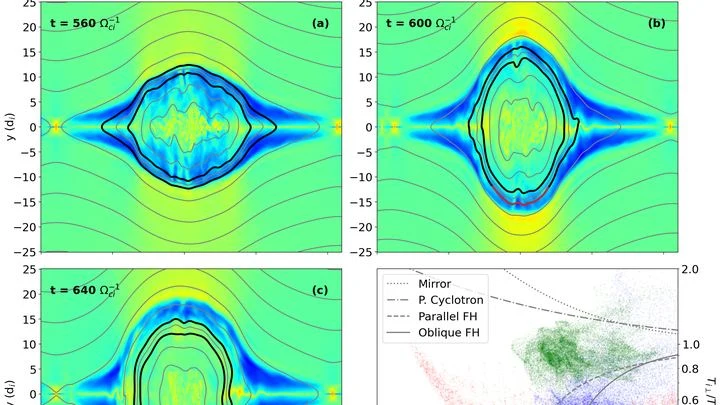
Space plasma is not a calm gas but a boiling soup of charged particles threaded with magnetic fields. These fields behave like stretched rubber bands: sometimes they snap and immediately reconnect, but in a different configuration. This process, called magnetic reconnection, releases enormous energy.
Deep inside a massive star, two carbon nuclei collide and merge into a single magnesium nucleus. This process determines how quickly the star burns its fuel and which chemical elements it manages to create. But calculating such a fusion on paper has proven incredibly difficult: nuclei are not billiard balls but quantum systems that can rearrange themselves in many ways.
Inside a future fusion reactor, a magnet weighing as much as a small car will float. It holds the superheated plasma like an invisible hand holding a cloud. Previously, such a magnet was considered unsuitable for deuterium-tritium fuel: neutron fluxes would quickly destroy it.
Sunlight is a turbulent stream carrying inseparable pairs of droplets. That’s what quantum entanglement looks like: two particles are so connected that a fluctuation in one instantly resonates in the other. In the past, creating such pairs required a 'calm pool' — a perfectly tuned laser beam.
At the heart of a neutron star, matter is squeezed so tightly that protons and neutrons transform into heavier particles — hyperons. These particles resemble neutrons but contain a strange quark. For a long time, physicists couldn't understand how a star with hyperons inside could be as heavy as observations show.
Light from an ordinary bulb is a stream of individual photons, like drops from a faucet. But there is also light where photons come in pairs, like twins walking together. Such grouped light has long been desired for measuring distances and imaging objects hidden around corners. But sources of this light were either too dim, or their flashes too short for ordinary detectors to catch.
Light from an ordinary lamp is chaos: photons scatter in all directions with no order. But if you make many atoms emit light simultaneously and in sync, you get a short, powerful flash, like applause that turns individual claps into a single burst. Such coordinated emission is called superradiance.
Igniting a miniature sun is a long-held dream of humanity. Typically, scientists try to confine scorching plasma (a gas of charged particles) at temperatures of hundreds of millions of degrees. But plasma tends to escape magnetic traps, and confinement comes at enormous cost.