A plasmawave is an oscillation or disturbance that propagates through a plasma—a gas of charged particles—involving the collective motion of electrons and ions. Unlike ordinary sound waves, plasma waves are governed by electromagnetic forces and can take many forms, from high-frequency electron oscillations (Langmuir waves) to low-frequency ion-acoustic waves and magnetohydrodynamic waves. These waves are ubiquitous in space and laboratory plasmas, playing a central role in energy transport, heating, and particle acceleration.
History
The theory of plasmawaves was developed in the early 20th century, with Irving Langmuir and Lewi Tonks discovering electron oscillations in 1929. The full framework, including wave-particle interactions, was established by Lev Landau and others in the 1940s.
How it works
Plasmawaves arise because charged particles respond to electric and magnetic fields, and their motion creates fields that affect neighboring particles. When a group of electrons is displaced, the restoring force from the resulting electric field causes them to oscillate collectively, producing a Langmuir wave. In a magnetized plasma, waves can become anisotropic, with different speeds parallel and perpendicular to the magnetic field. Nonlinear effects can cause waves to interact, transfer energy to particles (Landau damping), or steepen into shocks.
In practice
Plasmawaves are harnessed in plasma processing for semiconductor manufacturing, used to heat fusion plasmas in tokamaks, and studied in space missions to understand solar wind heating and auroralparticle acceleration.
Fun fact
In the solar wind, plasmawaves can act as 'mixers' that transfer energy between different wave modes, a process that may explain why the corona is millions of degrees hotter than the Sun's surface.
A laser pulse slams into a gas cloud and knocks electrons out of it, leaving behind a bubble: a cavity almost devoid of particles. This bubble races through the plasma at nearly the speed of light, and its walls drag along the electrons trapped inside, much like a speedboat tows a water skier.
Plasma is a gas in which electrons are stripped from atoms and roam freely. Sometimes, regions where electrons are almost absent spontaneously appear in such a gas; they are called holes. It is like a whirlpool forming in a stream, pulling everything around it in. But exactly how such a whirlpool is born has long remained a mystery.
A regular laser beam travels straight, like the light from a flashlight. But light can be twisted into a spiral, like the thread of a corkscrew. Such a beam carries orbital angular momentum: it doesn't just illuminate, it also spins anything it encounters.
Pulsar PSR J1740+1000 is a city-sized star spinning faster than a kitchen blender. After a supernova explosion, it left behind a dense core that accelerates particles to near-light speeds. These particles fly into space, and previously it was thought they scatter in all directions, like splashes from a stone thrown into water.
Plasma is not just hot gas; it's an entire orchestra of charged particles, each group playing its own part. Heavy ions (atoms that have lost electrons) set the slow rhythm, while light electrons dart around ten thousand times faster.
In the vast clouds of rarefied gas that fill the space between stars, something is always churning. Supernova explosions, colliding streams — all of it shakes the plasma. And in this rippling, as it turns out, hides the mechanism that gives birth to magnetic fields.
Plasma is a gas in which electrons are stripped from atoms.
A factory laser that cuts and welds metal on production lines has been made to work as a particle accelerator for the first time. Physicists took a standard ytterbium laser, its heart is a crystal the size of a palm, and turned its flashes into a tool for accelerating electrons to nearly the speed of light.
The paradox of the young solar wind has long puzzled heliophysicists. Measurements showed that near the Sun, proton beams aren’t smeared out but sharply compressed, as if someone had neatly hammered them into the shape of a hammerhead.
Even Jocelyn Bell Burnell, who first detected the strict periodicity of radio signals, noticed that some pulses would suddenly vanish. Today we know: variability is not a whim, but the voice of intricate electrodynamics.
A crowd is trapped in a narrow corridor between two rows of mirrors. Every now and then, someone shoves the wall hard, and a rumble rolls down the corridor — similarly, in the plasma of galaxy clusters, whistler waves and ion-cyclotron waves appear.
A clap of the hands compresses the air, and it flies outward — the simplest shock. In space, exploding stars play the role of hands: their shock waves sharply compress gas and trigger chaotic mixing — turbulence.
A drop of thick shampoo falls into water and freezes into a strange rope. A liquid that both flows and springs back is called viscoelastic. In it, tiny particles under ultrasound behave quite differently than in water. Viscoelasticity is a material's ability to both spread like honey and return to shape like rubber.
A thin layer of oil on the surface of water breaks into separate droplets at the slightest disturbance. Something similar happens in the pulsar wind — a stream of particles ejected by a rapidly rotating neutron star. This stream also contains plasma layers, which can break apart into clumps — magnetic islands.
The crown of a huge tree sways in the wind, but the roots and trunk are hidden underground. On the Sun, magnetic fields play the role of such invisible roots. They emerge from the depths, thread through the entire atmosphere, and govern the motion of the hot gas — plasma.
The solar wind isn't a smooth flow: it's gusty. Inside it, protons and helium nuclei don't all travel at the same speed; they spread out like droplets in a hose stream. Usually, this spread is described by a simple bell-shaped curve.
When water boils in a kettle, waves of steam ripple through the kitchen. A similar process happens in space, in plasma — gas so hot that electrons are stripped from atoms. Around black holes and neutron stars, this plasma isn't just hot: its particles zip around at nearly the speed of light.
When a massive star dies, its core collapses into a neutron star, and the outer layers are blown off in an explosion. At that moment, an unimaginably dense cloud of neutrinos is born — particles that barely interact with matter but actively 'talk' to each other. There are so many of them that together they behave like a fluid, with waves rippling across it.
A neutron star is a city the size of a metropolis squeezed into a small asteroid. Around it, plasma, a gas of charged particles, seethes, and waves ripple through it like ripples on a pond. There are three kinds of waves: Alfvén (A), ordinary (O), and extraordinary (X).
A neutron star the size of a city spins faster than a kitchen blender, flinging particles around itself. A glowing cloud forms around it — called a pulsar halo. The shape of this cloud depends on invisible magnetic fields that, like ocean currents, steer the particles.
The Big Bang was like a cosmic thunderclap that set the fabric of space vibrating. These vibrations — gravitational waves — still echo through the Universe like a fading rumble from that ancient event. The louder the initial 'bang,' the more primordial black holes should have formed.
A swarm of fireflies in a night forest flashes randomly: each beetle blinks on its own, and the light scatters equally in all directions. Now imagine the fireflies agreeing to blink so that their combined light goes only north — even though they stay put and none of them turns. That's roughly what physicists did with atoms inside a thin glass tube.
Ahead of the bow shock that Earth creates in the solar wind, giant bubbles of rarefied gas sometimes appear. Inside them, particle density drops by factors, and electric fields start to tremble like a plucked string.
A laser beam usually travels straight, like a jet of water from a hose. But what if you twist that jet like the thread of a corkscrew? You get a light spring — a beam that, as it moves, also spins around its own axis. At every point in space, its brightness traces a spiral, and if you place a flat screen in its path, you'll see a rotating spot of light.
Plasma is a gas heated so intensely that electrons are stripped from atoms. Waves run through it, akin to sound in air, but they are governed by the magnetic field. When the magnetic field becomes periodic rather than uniform, like a fence with alternating slats, waves behave differently. Some frequencies simply vanish: the wave cannot propagate and is reflected back.
In the stream of charged particles that constantly blows from the Sun, radio bursts sometimes occur — short, powerful signals at frequencies you can pick up on an ordinary radio. Until now, it was unclear how exactly these signals are born in that stream.
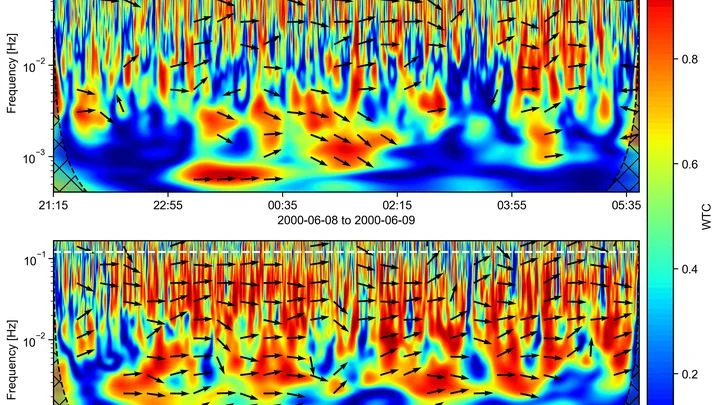
The Sun constantly emits a stream of charged particles, mostly hydrogen — the solar wind. Sometimes the Sun ejects dense blobs of magnetized gas, inside which calm usually reigns. But in 2000, scientists noticed two regions inside one such cloud where the gas was churning.
The scorching gas streaming from the Sun is not a continuous flow but rather a soup of charged particles. In this soup, waves constantly boil up: electric fields flare and fade like ripples on water from a tossed stone. One such wave is the ion-ion acoustic wave.
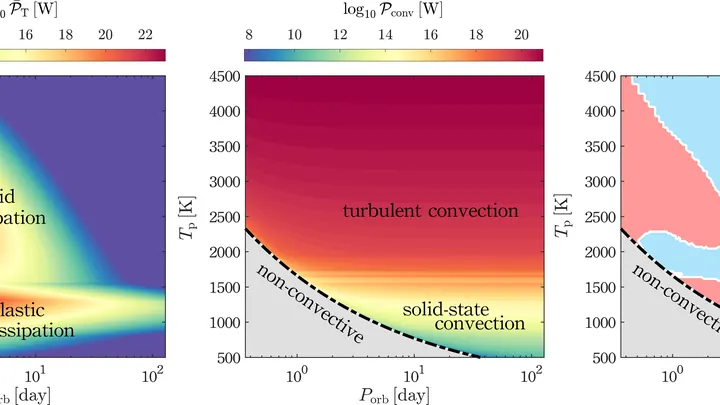
An exoplanet — a planet outside our solar system — follows a slightly elongated orbit. With each revolution, it swings closer to its parent star and then farther away.
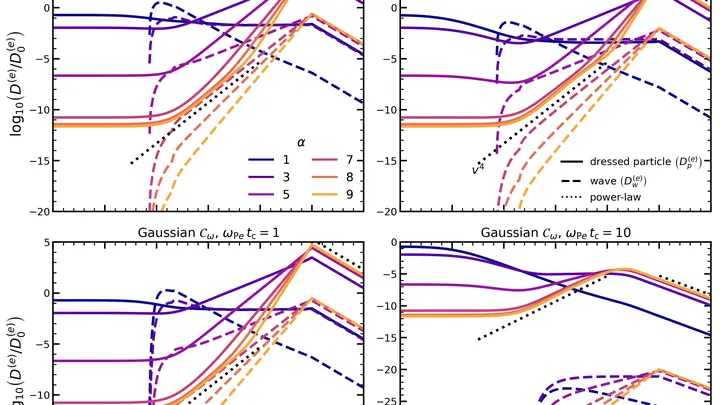
In a hot gas of charged particles — plasma — chaotic electric fields work like a sieve. A slow particle gets surrounded by a cloud of opposite charges, which cancels the external field. A fast one sheds this armor and gets accelerated.
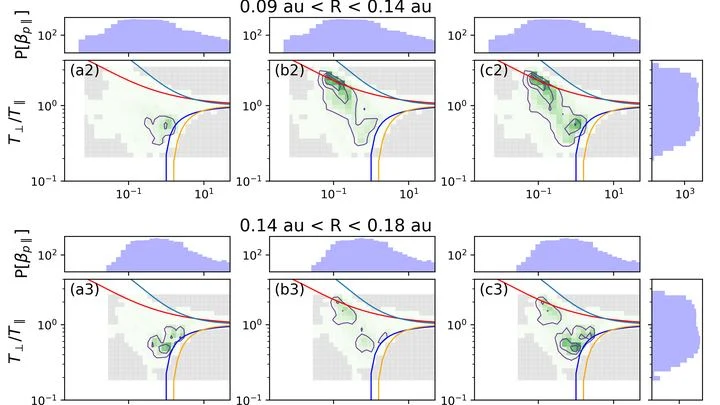
The solar wind isn't a calm stream but a bubbling soup of charged particles. Diving close to the Sun, the Parker probe picked up two types of stirring waves. Left-handed ones, like a whisk in a chef's hand, whip up the material when the temperature differs along and across the flow.