How Tidal Waves Sort Planets express
A pot of boiling soup is shaken hard — the liquid sloshes, waves crash against the walls. Something similar happens inside a gas planet when it swings past its star on an elongated orbit. The star's gravity excites powerful internal waves in the planet, known as tidal fundamental modes. These waves can completely change the planet's fate.
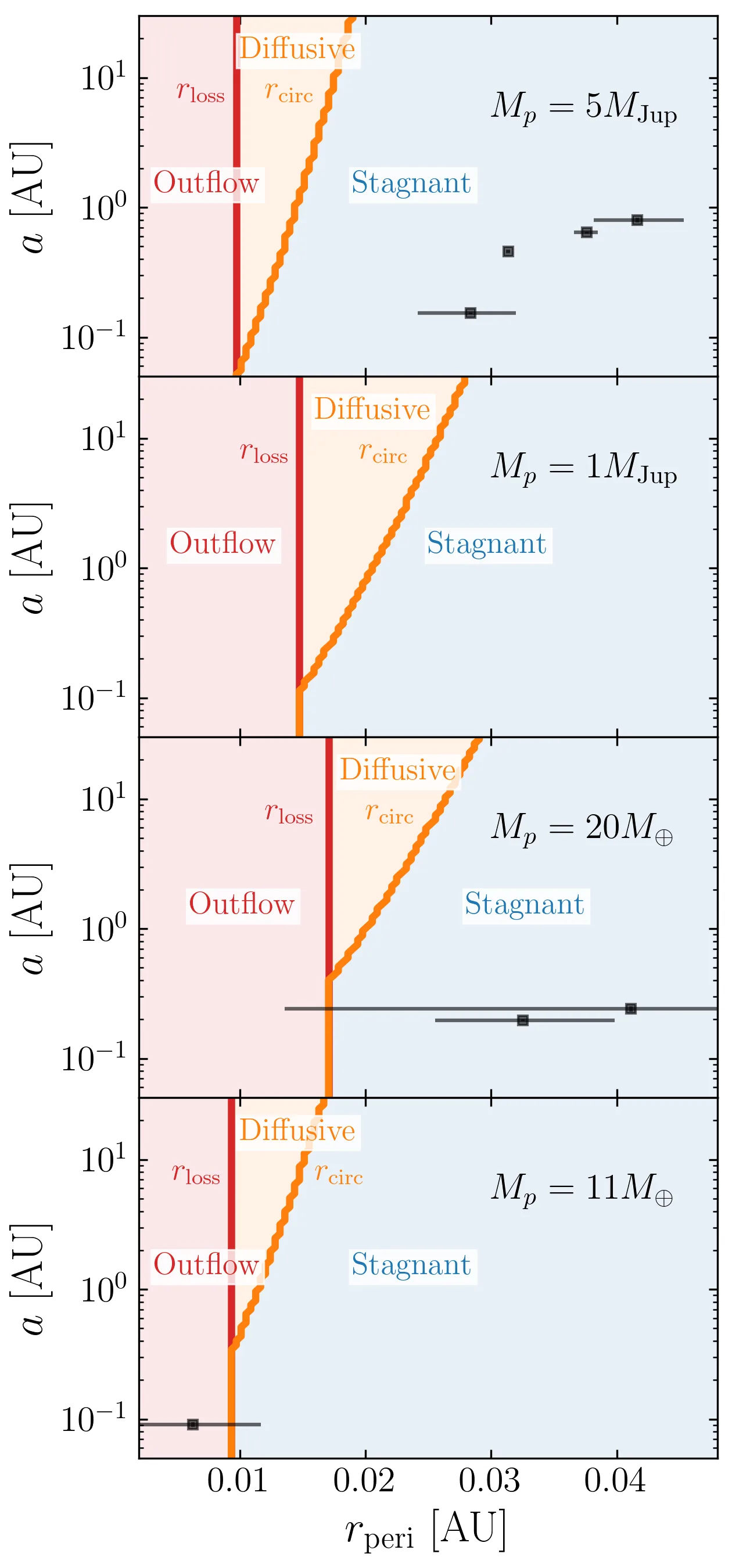
For a long time, it was a mystery where the energy of these waves goes. The authors of the new study, using hydrodynamic simulations, have for the first time shown two scenarios. If the wave penetrates shallowly, its energy is lost through radiation and heating — the planet gradually calms down, its orbit becomes circular, and it joins the "pile" of hot Jupiters on orbits of 5–6 days. But if the planet gets too close to the star, the waves accelerate to supersonic speeds and turn into shock waves. They literally strip the gaseous envelope, leaving a bare core: this is how the "Neptune desert" arises on orbits shorter than three days.
This process also explains another oddity. Planets that survive envelope stripping should retain a memory of the catastrophe: their rotation axis will be strongly tilted relative to their orbit, and the process itself may be accompanied by bright flares. Thus, lone rocky cores in the "desert" become not a mystery but a natural result of a turbulent youth. And the fate of each planet, like the soup in the shaken pot, depends on how strongly its close star shook it.
Original abstract
as written by the authors arXiv:2606.20789
The period distribution of hot gaseous exoplanets depends strongly on mass. Clustering between the orbital periods of $$\sim$$3 to $$\sim$$5-6 days is seen for sub-Saturns ("Neptune ridge") and Jovians ("hot Jupiter pile-up"), contrasting with a sharp deficit interior to 3 days for sub-Saturns, not seen for Jovians ("Neptune desert"). During high-eccentricity migration, tidally-excited fundamental-modes (f-modes) act as a reservoir for orbital energy, and can take gaseous planets formed beyond several AU and place them at short separations. However, how f-modes relinquish their energy into the planet interior is unknown. Here, we show how f-modes can not only circularize orbits -- causing clustering near the Neptune ridge and hot-Jupiter pile-up -- but can also shock and unbind mass, leaving sub-Saturn cores in the Neptune desert. Our hydrodynamical simulations demonstrate that close approaches tidally excite f-modes, whose super-sonic velocities shock gaseous envelopes. Atmospheres cool by radiative diffusion or winds when shocks penetrate shallow versus deep depths. Planetary structural and orbital evolution is followed over many periastron passages using an iterative map: shocks that diffusively cool circularize and bunch orbits near the hot Jupiter pile-up and Neptune ridge, while shocks that drive outflows unbind envelopes and place gas giant cores in the Neptune desert. Sub-Saturns that dwell in the desert are predicted to arrive with large spin-orbit misalignments after producing luminous flares.
Shock waves inside a planet can accelerate material to speeds comparable to the speed of sound in hydrogen — about 10 kilometers per second. That's faster than a bullet.