A Magnetic Compass for the Brain, Without the Noise express
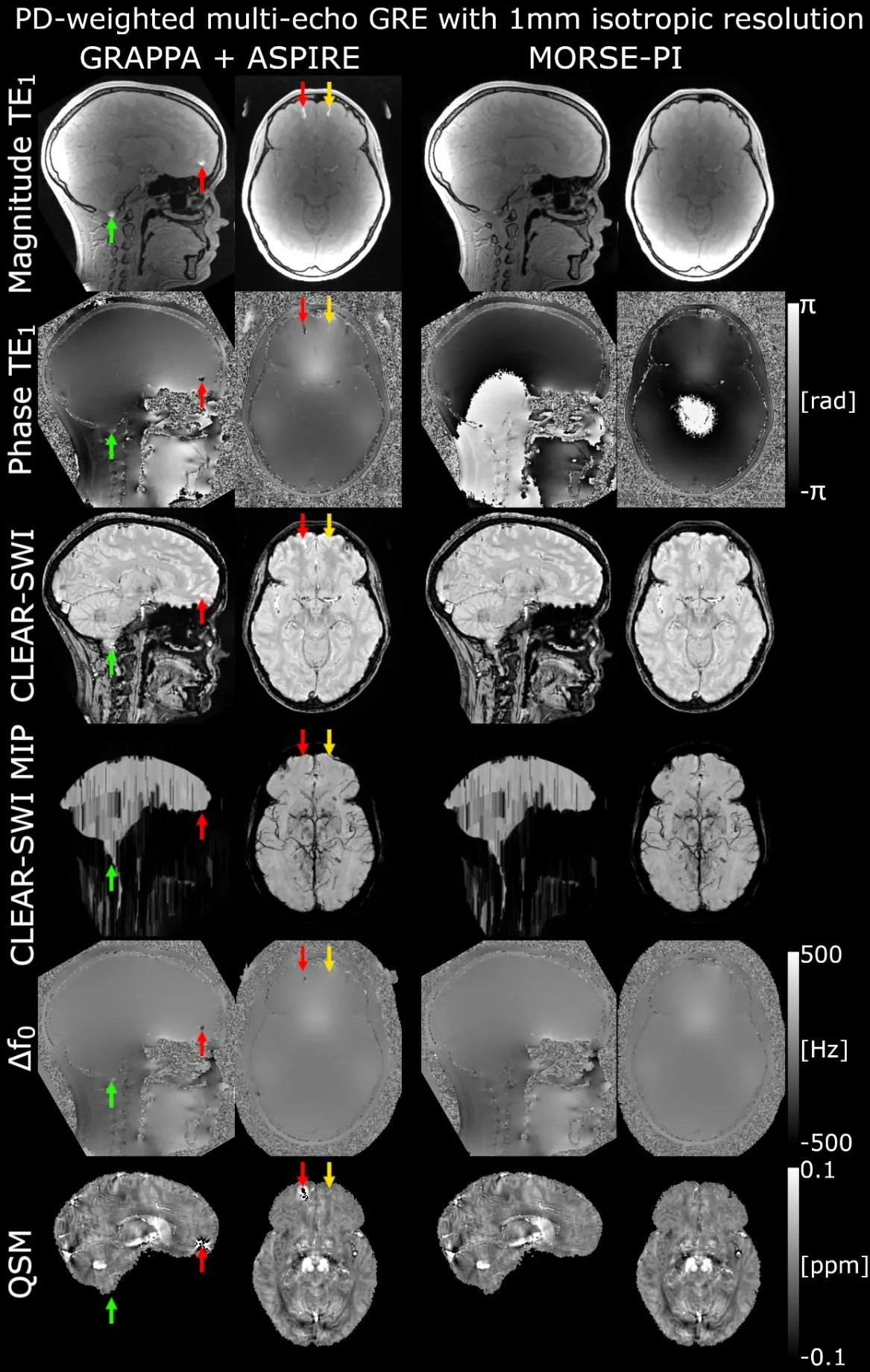
The powerful magnet of an MRI scanner induces weak electric currents in tissues. Their phase behaves like a compass needle trembling with every gust of wind — the slightest disturbance turns the map into a ripple, where instead of small vessels or iron deposits, all you see is noise.
MORSE-PI works like a clever conductor for an orchestra of receiver coils. It creates a virtual reference coil that picks up the signal from the entire brain equally well, and with its help, the phases of all coils are aligned into a single, clean rhythm.
The method doesn't just remove noise: it prevents it from turning into false swirls on the map. The compass needle no longer spins in a vortex of interference. Now you can reliably measure magnetic susceptibility (QSM)—a key indicator for spotting microbleeds or Parkinsonian changes. All of this works at any field strength: from the familiar 3 tesla to experimental 7 tesla.
Original abstract
as written by the authors arXiv:2606.21336
Phase imaging applications such as QSM are highly sensitive to noise amplifications, phase singularities, and other artefacts, particularly in challenging scenarios such as ultra-high field (7T), under-sampled or single-echo acquisitions. We present a novel image reconstruction method, MORSE-PI, designed to produce high-SNR, artefact-free, and singularity-free phase images for both structural and functional phase-based brain imaging. MORSE-PI extends our previous approach, MORSE, by introducing a Virtual Reference Coil (VRC). The VRC is constructed as a linear combination of coil sensitivity maps, with correlations enhanced between coil elements using the noise covariance matrix. Such a VRC ensures robust signal support across the entire brain and is used to correct phase offsets in the MORSE-derived coil sensitivity estimates, resulting in artefact-free, high SNR phase. Compared to GRAPPA with ASPIRE phase correction, MORSE-PI demonstrates greater robustness to artefacts such as noise amplification and aliasing, and shows improved reproducibility in structural imaging at both 3T and 7T. Unlike ESPIRiT and GRAPPA combined with adaptive coil combination methods, MORSE-PI yields singularity-free phase maps. MORSE-PI enables high-SNR reconstructions even for the most challenging scenarios, such as single-echo EPI at 7T. Its efficient, containerised implementation using the Gadgetron framework supports deployment on the MRI scanner console during measurements. MORSE-PI offers a flexible and computationally efficient solution for generating high-SNR, artefact- and singularity-free phase images in both single- and multi-echo GRE and EPI acquisitions. This makes it particularly well-suited for structural and functional QSM, as well as other phase-based MRI applications. Its robustness and rapid computational time facilitate efficient deployment on scanners across field strengths.
An ultra-high-field 7 tesla scanner generates a magnetic field 140,000 times stronger than Earth's: it can yank a paperclip out of your pocket from across the room.
In the novel "Minority Report," precogs were sought out by glitches in magnetic brain maps — MORSE-PI would have made their detection far more accurate.