Magnetic susceptibility is a dimensionless quantity that measures how strongly a material responds to an applied magnetic field. It tells you whether a material will be attracted to a magnet (paramagnetic), repelled by it (diamagnetic), or retain magnetization after the field is removed (ferromagnetic). The value is defined as the ratio of the magnetization produced in the material to the applied magnetic field strength, and it can be positive, negative, or even zero.
History
The concept was formalized in the 19th century, with key contributions from Michael Faraday, who studied magnetic induction in various substances, and later by Pierre Curie, who established the temperature dependence for paramagnets.
How it works
When an external magnetic field is applied, it aligns the magnetic moments of atoms or electrons within the material. In paramagnetic materials, the alignment is weak and temporary, giving a small positive susceptibility. In diamagnetic materials, the field induces opposing magnetic moments, yielding a small negative susceptibility. Ferromagnetic materials have domains that align strongly and can retain alignment, giving large positive values that depend on the material's history.
In practice
It is used in materials science to classify substances, in magnetic resonance imaging (MRI) to enhance contrast, and in geophysics to map underground mineral deposits.
Fun fact
Water has a negative magnetic susceptibility, which is why a strong magnet can make a frog levitate — the water in its body is diamagnetically repelled.
A magnet weighing just a few grains of sand hovers in midair with no support. It doesn't touch the walls, doesn't rub against bearings — it just hangs in a magnetic trap like a speck of dust in a sunbeam. Researchers have turned this tiny object into an ultra-sensitive compass: the device detects changes in the magnetic field of 23 femtotesla.
A pendulum weighing a few grains of sand swings on a hair-thin glass fiber. Its motions are so faint that the thermal jostling of air molecules seems like a hurricane. Yet such a pendulum is the key to witnessing quantum wonders in the world of large objects.
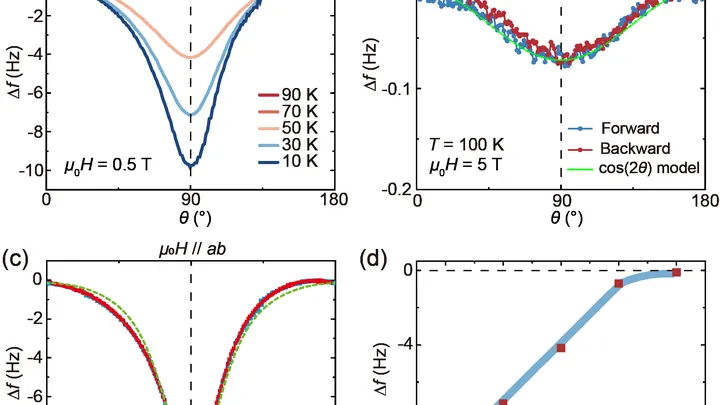
A magnet, like a compass needle, likes to point in a certain direction. But what if the material is layered, like a stack of pancakes? Scientists took just such a magnet made from a compound of chromium, germanium, and tellurium and set out to find out how stubbornly it resists having its magnetization turned.
A dust grain in interstellar space is like a tiny compass. Inside it sit inclusions of magnetic minerals that make the grain rotate along invisible magnetic field lines. How obediently the grains align determines how they polarize the light of distant stars and what radiation they emit.
A glass of solidified glass may seem motionless, but inside, the atoms are frozen in random positions, never having found perfect order. A similar situation occurs in spin glasses: the magnetic moments of atoms freeze, pointing in different directions, and the material loses the ability to be simply magnetized.
Two pieces of graphite rub against each other, and the resistance vanishes as if an invisible film of oil separated them. Previously, this was only seen under a microscope, on tiny contact patches.