A Magnetic Compass for the Brain, Without the Noise express
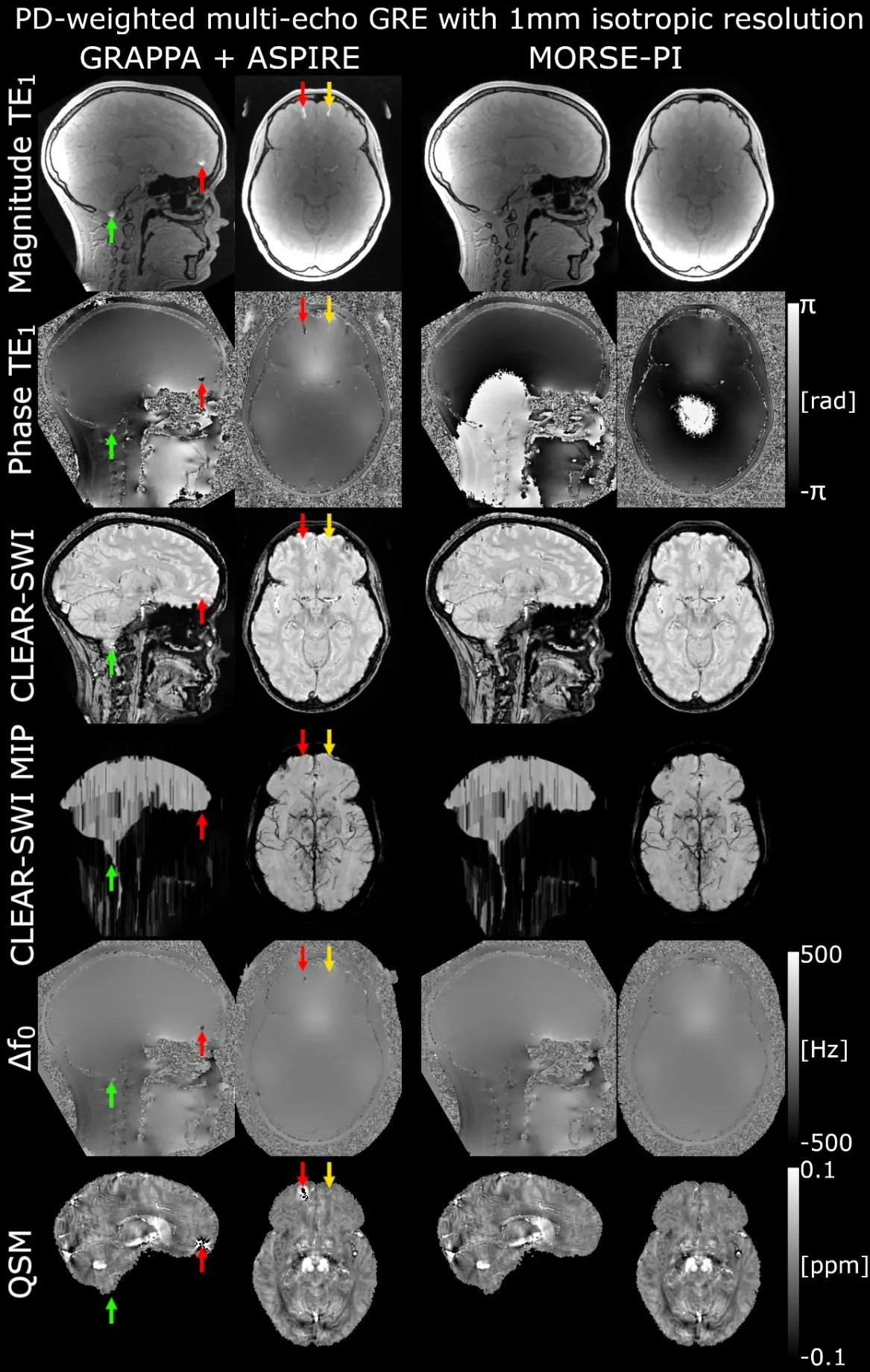
The powerful magnet of an MRI scanner induces weak electric currents in tissues. Their phase behaves like a compass needle trembling with every gust of wind — the slightest disturbance turns the map into a ripple, where instead of small vessels or iron deposits, all you see is noise.
MORSE-PI works like a clever conductor for an orchestra of receiver coils. It creates a virtual reference coil that picks up the signal from the entire brain equally well, and with its help, the phases of all coils are aligned into a single, clean rhythm.
The method doesn't just remove noise: it prevents it from turning into false swirls on the map. The compass needle no longer spins in a vortex of interference. Now you can reliably measure magnetic susceptibility (QSM)—a key indicator for spotting microbleeds or Parkinsonian changes. All of this works at any field strength: from the familiar 3 tesla to experimental 7 tesla.
An ultra-high-field 7 tesla scanner generates a magnetic field 140,000 times stronger than Earth's: it can yank a paperclip out of your pocket from across the room.
In the novel "Minority Report," precogs were sought out by glitches in magnetic brain maps — MORSE-PI would have made their detection far more accurate.