Magnetic resonance imaging (MRI) is a non-invasive imaging technique that produces detailed three-dimensional images of the inside of the body. Unlike X-rays or CT scans, it does not use ionizing radiation, making it safe for repeated use. Instead, it exploits the magnetic properties of atomic nuclei, primarily hydrogen protons in water and fat, to create contrast between different soft tissues. This makes MRI the go-to method for visualizing the brain, spinal cord, muscles, joints, and internal organs with exquisite anatomical detail.
History
The underlying principle of nuclear magnetic resonance was discovered independently by Felix Bloch and Edward Mills Purcell in 1946, for which they shared the Nobel Prize in Physics in 1952. The application to imaging was developed by Paul Lauterbur and Peter Mansfield in the 1970s, who were awarded the Nobel Prize in Physiology or Medicine in 2003.
How it works
The patient is placed inside a powerful, superconducting magnet that aligns the magnetic moments of hydrogen protons in the body. A radio-frequency pulse is then applied, knocking these protons out of alignment. As they relax back to their original state, they emit radio signals that are detected by receiver coils. The timing and strength of these signals depend on the local chemical environment, allowing a computer to reconstruct a high-resolution image. By varying the sequence of pulses, different tissue contrasts can be emphasized, such as highlighting blood flow or detecting edema.
In practice
MRI is a cornerstone of medical diagnostics, used for detecting tumors, brain abnormalities, spinal cord injuries, ligament tears, and cardiovascular disease. It is also a powerful research tool in neuroscience for mapping brain activity (functional MRI) and in materials science for non-destructive testing.
Fun fact
The world's most powerful MRI machines use superconducting magnets that must be cooled to near absolute zero with liquid helium, and the magnetic field they generate is strong enough to lift a car.
Light knocks electrons out of a crystal, and they fly toward the detector like arrows toward a target. From their trajectories, physicists reconstruct how electrons behaved inside the material: with what energy and in which direction they moved. But switch on a magnetic field, and the trajectories bend. The arrows start to curve, the target turns into a warped mirror, and the picture blurs.
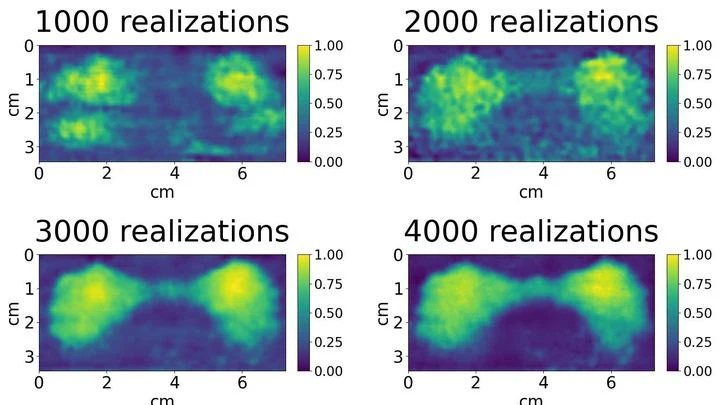
A sculptor looks at a block of marble and sees the figure within, waiting to be freed from excess material. Instead of adding clay, he removes everything that is not part of the form. The authors of a new study on magnetic resonance took a similar approach: rather than complicating the tissue model by adding ever more details, they stripped away the superfluous to reveal the essence.
Radio waves from a distant pulsar travel through the interstellar medium, encountering invisible magnetic structures the size of the distance from the Sun to Earth. One such structure is a current sheet, where the magnetic field abruptly changes direction, like a compass needle flipping from north to south.
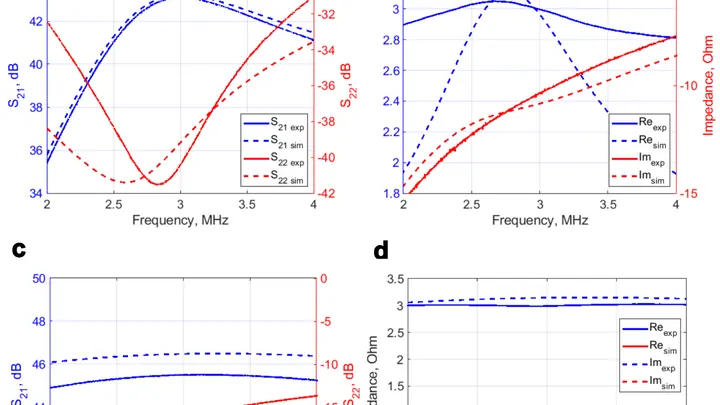
The coil in an MRI picks up radio signals from hydrogen atoms, like an antenna catching a distant radio station. But the signal is weak, and if the amplifier itself is noisy, the image comes out grainy.
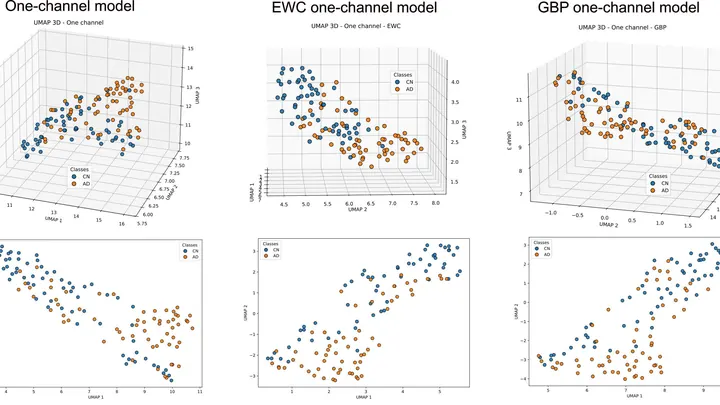
A doctor spends years learning to recognize diseases from brain scans. First, they excel at spotting signs of aging, then they master tumors, and suddenly they start confusing what they knew before. Many neural networks behave much the same way: new knowledge overwrites the old.
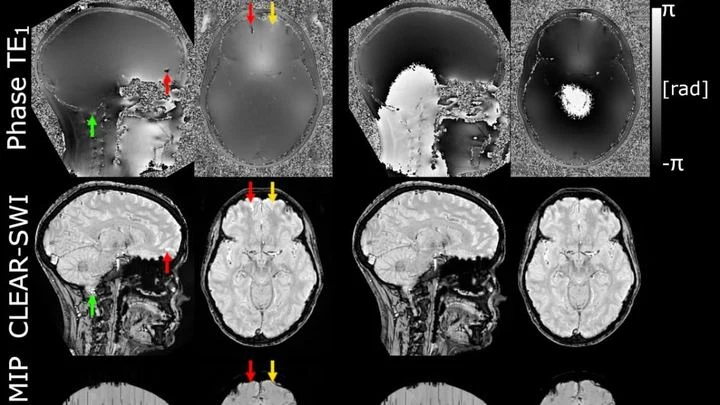
The powerful magnet of an MRI scanner induces weak electric currents in tissues. Their phase behaves like a compass needle trembling with every gust of wind — the slightest disturbance turns the map into a ripple, where instead of small vessels or iron deposits, all you see is noise.
In a piece of manganese oxide just a few atomic layers thick, electrons behave like a crowd on an escalator: each moves by its own rules, but together they create a common flow. Physicists shone soft X-rays on such a film and knocked electrons out.
Radioactive tracers are like a courier with a beacon: you inject it into the body, and it highlights the target organ on the scan. But this courier comes with strict rules: you can't send it often, it quickly 'gets tired,' and it costs a lot. Doctors have long dreamed of a way to see an organ without radiation.
A magnetic field is invisible, but you can make it 'glow' using tiny defects in diamond — nitrogen-vacancy centers. Each such defect acts as a miniature compass, telling you which way the field points. The problem is that there are many of these compasses, and reading them all in sequence is like transcribing every letter in a thick book by hand.
A warm cup or a human hand emits invisible light — mid-infrared radiation. Every substance absorbs this light in its own way, leaving a unique 'fingerprint'. From this fingerprint, you can tell what an object is made of without touching it.
Previously, seeing this fingerprint required huge lasers that fired very short pulses. They were expensive and complex.
Glioblastoma, a brain tumor, is a tricky foe: in some patients, the drug temozolomide works, while in others it barely helps. The difference often lies in a small stretch of DNA — the MGMT gene. If this region is chemically switched off (methylated), the tumor is worse at repairing its cells, and the drug hits harder.