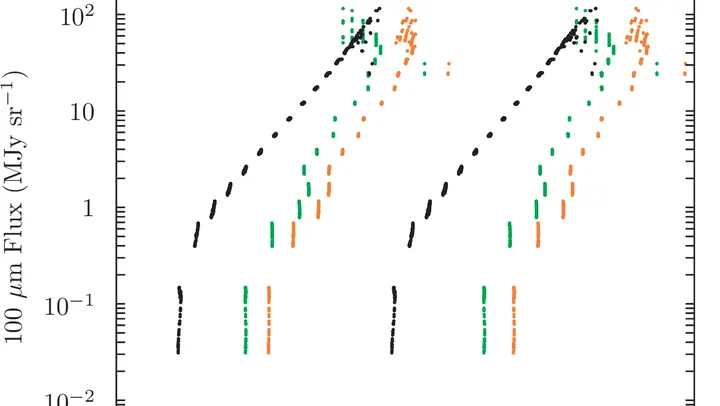
The correlation function is a statistical measure used in cosmology and astrophysics to quantify how matter is clustered in the universe. It compares the probability of finding two objects (like galaxies) at a given separation against what you would expect if matter were distributed randomly. A positive value means objects are more likely to be found near each other than chance would suggest, indicating clustering; a negative value means they are less likely, indicating avoidance.
History
The two-point correlation function was introduced into cosmology in the 1970s, notably by James Peebles and his collaborators, who used it to analyze galaxy catalogs.
How it works
To compute it, you take a catalog of objects and count the number of pairs at each separation distance. You then divide by the number of pairs expected from a random distribution with the same density. The result is often expressed as a function of separation, showing how clusteringstrength changes with scale. On large scales, the correlation function follows a power law, reflecting the hierarchical structure of the universe.
In practice
It is used to measure the distribution of galaxies and dark matter, helping constrain cosmological parameters like the matter density and the nature of dark energy.
Fun fact
The correlation function of the cosmic microwave background radiation was a key piece of evidence for the existence of dark matter.
The orchestra plays without a conductor. Each instrument follows its own schedule: the violin on Monday, the flute on Wednesday, the timpani on Saturday. Astronomers hear not music but isolated notes scattered across the calendar. A telescope sees a star only when it is above the horizon and when the schedule has allotted time for it.
The night sky looks like a random scattering of stars. But zoom out to enormous distances, and the chaos disappears. Galaxies gather into long filaments and flat walls, with colossal voids gaping between them — cosmic voids. This structure is called the cosmic web.
A weather forecaster draws a thick black line across Europe: north of it, frost; south, a thaw. That boundary, the zero isotherm, won't tell you the temperature in Stockholm or Rome, but it honestly marks where winter ends. In recent cosmology, a map has emerged where a similar frontier can be drawn.
A census that only records the distance between houses misses a lot. You can tell where the cities are and where the villages are, but you can't distinguish a skyscraper from a single-family home. That's roughly how astronomers study the universe with the standard two-point correlation function: they count how many pairs of galaxies are separated by a given distance.
A galaxy is like a glowing pancake studded with stars. If you look at it face-on, you see everything at once — both the bright spiral arms and the dark dust lanes. But tilt the pancake, and the picture changes: layers overlap, light blends together. This very effect, it turns out, creates the illusion of a tight link between radio and gamma-ray emission in distant star systems.
In one hospital ward it's +40°C, in another +10°C, and on average it's +25°C. If temperature affected something nonlinearly (say, the rate of bacterial growth) the average would give a wrong prediction. The same problem arises when cosmologists describe a universe where galaxies are packed into clusters and voids yawn between them.
In the dark clouds of interstellar gas where stars are born, matter gathers into dense knots — future cradles of stars. Astronomers measure distances between these knots from sky photographs, but a photograph is flat while the cloud is volumetric. Converting from plane to volume is not as simple as it seems.