Critical transitions are abrupt, often irreversible changes in the state of a complex system when it crosses a tipping point. In physics, these occur in systems ranging from magnets to superconductors to ecosystems, where a small change in an external parameter—temperature, pressure, or stress—triggers a dramatic reorganization of the system's macroscopic behavior. The concept unifies phenomena like the sudden onset of magnetization in a ferromagnet at its Curie temperature, the collapse of a sandpile, or the rupture of a fault during an earthquake. Understanding critical transitions is crucial because they often signal a shift from a stable, predictable regime to a new, potentially hazardous one, and they are notoriously difficult to reverse.
History
The modern theory of critical phenomena was developed in the 1960s–70s by Kenneth Wilson, who introduced the renormalization group, building on earlier work by Landau and Onsager. The concept of tipping points in complex systems was popularized in the 2000s, but the underlying physics dates back to van der Waals' work on phase transitions in the 19th century.
How it works
Near a critical point, the system's response to perturbations becomes extremely slow and nonlinear. This is because the system's free energy landscape develops a flat region where multiple states are nearly equally stable, and fluctuations can drive the system over a small barrier. In statistical mechanics, this is described by order parameters that change discontinuously at the transition, and by critical exponents that characterize how correlations grow in length and time. For example, in a ferromagnet, the alignment of spins becomes correlated over increasingly large distances as the temperature approaches the Curie point, until a single domain flips the entire system. In driven systems like earthquakes, stress accumulates slowly until friction is overcome, and the stored elastic energy is released catastrophically.
In practice
Predicting critical transitions is vital for early-warning systems in climate science, financial markets, and materials engineering, where detecting precursors like slowing recovery rates can help avoid catastrophic failures.
Fun fact
The same mathematical framework that describes how a sandpile avalanches also applies to the onset of superconductivity and the spread of epidemics—a universality that is one of the deepest insights of statistical physics.
The map of dense nuclear matter resembles a road map: lines of phase transitions cross at critical points, like highways at intersections. Until now, only two intersections were known on such a map: the nuclear liquid-gas and deconfinement, where hadrons dissolve into quarks.
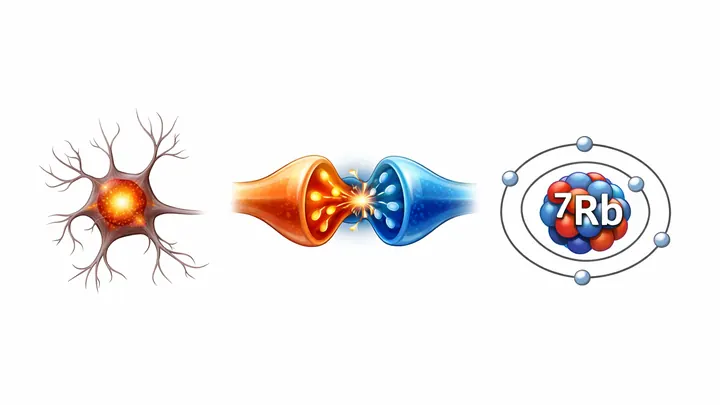
A cloud of atoms cooled to near absolute zero suddenly starts behaving like a brain. One excited atom triggers a chain reaction — neighbors light up in turn, and an avalanche of activity sweeps through the gas. Physicists call this Rydberg facilitation: atoms are easier to excite when an excited one is nearby.
Every 165 days, the giant planet dives toward its star, nearly grazing its fiery corona, then flies off into the icy void. This is TIC 241249530 b — an exoplanet with a record eccentricity of 0,94.
Superconductivity and magnetic field are age-old foes: the field barges in like a whirlwind, tearing apart the delicate pairing of Cooper pairs, destroying order.
Some materials are internally like a Möbius strip: their electronic states are twisted in a special way. Such topological properties are usually manipulated with a powerful magnetic field, as if trying to flatten the strip with a sledgehammer. A group of researchers has found a more delicate tool.
Two-dimensional worlds never cease to amaze: here even crystal melting is not a symmetry breaking but a vortex drama discovered by Kosterlitz and Thouless. At the heart of this theater are topological сингулярности, whose energy and энтропия bargain for order. This language is common to сверхтекучести и сверхпроводимости.
A long chain of atoms, each a tiny magnet. They talk to each other and to a common field, like musicians in an orchestra who hear both the conductor and their neighbors. When the external field changes, the orchestra either plays out of sync or all instruments come in together: that's a quantum phase transition.
A handful of matches falls on the table. Each lies however it lands, but in our minds we turn each into an arrow — from one end to the other. Now ask: can you get from one point to another by moving only in the direction of the arrows? A group of points where you can reach any one from any other is called a strongly connected cluster.
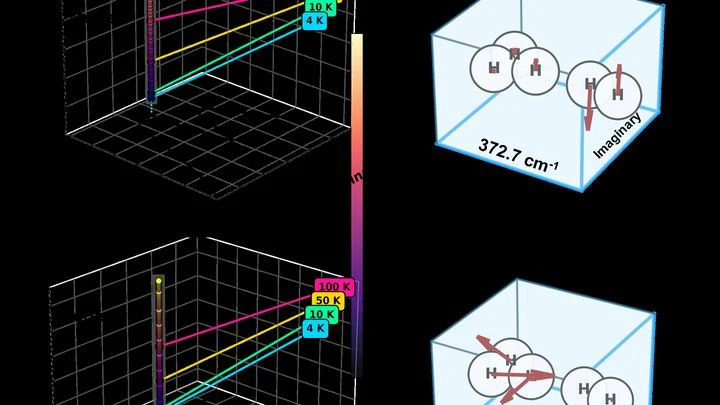
A chemical reaction resembles passing through a turnstile: a crowd creates chaos and gets stuck, while an orderly line moves. In the quantum world, however, when the jostling subsides, the barrier can become ghostly — a particle passes through it as if the turnstile has vanished.
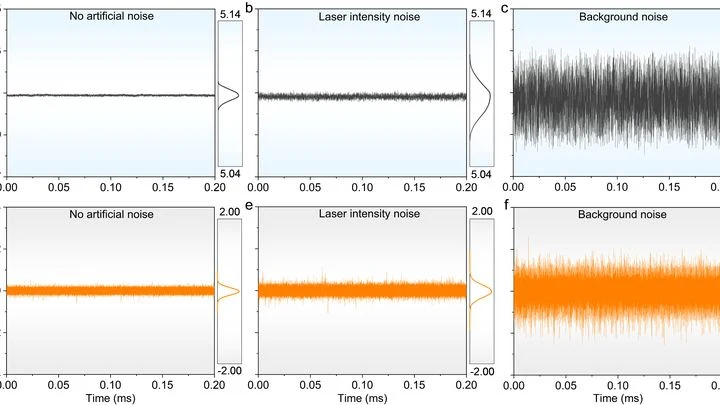
The heart beats steadily, then slips into arrhythmia. The climate holds its familiar rhythm for decades, then shifts to a new state over a single summer. Such regime shifts are like a flick of a switch, but in real data we see only a noisy one-dimensional signal in which the moment of the break is hidden.
A compass needle turns slowly, but inside some materials, tiny magnetic moments can flip over timescales that are hard to imagine. A team of physicists has calculated how to make them change direction in a quadrillionth of a second — faster than a lightbulb blinks.
Water in a kettle, as it boils, clearly separates into liquid and steam. But under enormous pressure, the boundary vanishes: the substance enters a supercritical state — neither one nor the other, but something in between.
Black holes can do this too.
A quiet tube with a heated grid inside. The voltage on the grid is suddenly raised, and the tube starts to hum, sustaining itself. This is not a malfunction but a transition to another stable state, like a ball rolling over a hill into a neighboring hollow.
A magnetic film divided into tiny arrow-shaped cells behaves like a crowd in a square. While it's cold, all arrows point in the same direction — perfect order. Heat the film, and the arrows start darting around like pedestrians who have lost their purpose. Somewhere between these extremes, there is a moment when the system stops being uniform but hasn't yet dissolved into random noise.
Light is trapped in a tiny cavity and circles around like a ball in a groove. If you slightly change the material inside, the light notices immediately, and gives a signal. Usually, such sensors work like spring scales: the harder you press, the more noticeable the shift. But there's another, trickier approach: make even a weak perturbation produce a disproportionately large response.
Superconductors are materials that conduct electricity without loss, but their properties are usually fixed. In the new work, scientists made a device resembling a crossroads of two superconducting tracks. By applying a weak magnetic field perpendicular to this crossroads, they were able to change the current the device can carry by a factor of four.
Physicists built a chain of Rydberg atoms — atoms with electrons in enormous orbits, comparable to planetary paths. These giant atoms feel their neighbors intensely, turning the chain into a quantum analog of a string.
Run a current through a contact between a superconductor and a ferromagnet, and you will hear the whisper of the quantum world. In the lab at 0.3 K, that whisper turned into a roar: the shot noise—electrical noise due to the discreteness of charge—was a hundred times louder than theory allows for ordinary contacts.
At 78 K, a crystal of Mn₃Si₂Te₆ turns into an inductor that needs neither copper wire nor a superconductor. The electrons inside it spontaneously organize into closed vortices with a definite sense of rotation: chiral orbital currents.
In 1988, the surface temperature of the Pacific Ocean began to change long before meteorologists declared the onset of El Niño. Points on the map scattered along the equator started behaving in concert: if water warmed in one place, it did so in a neighboring one too.