Laser Maestro for Sound in Diamond ✛ ✎ ✦
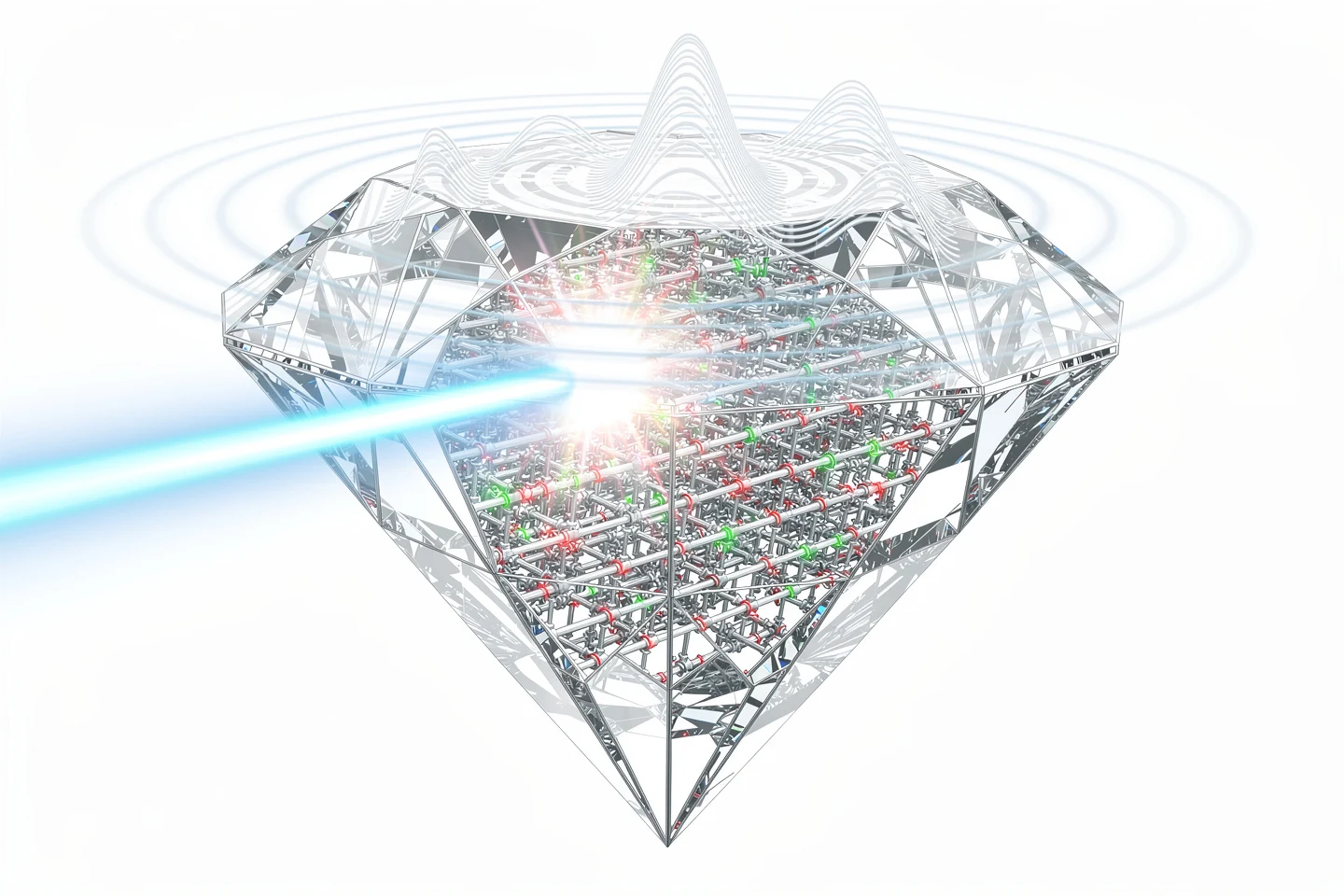
A choir of singers on a bridge: each hums their own tune, and the bridge barely trembles. But at the conductor's signal, voices merge — and the bridge vibrates tens of times stronger. Something similar happens in a diamond plate with artificial 'atoms' — microscopic defects sensitive to light and sound.
A sound wave runs across the surface, slow as a ripple. When the laser turns on, all the defects oscillate in unison, sharply amplifying the wave. Surprisingly, just a dozen defects are enough for such explosive amplification: a tiny 'choir' suddenly drowns out a hundred soloists.
This switch allows control of quantum information carried by sound. The method, discovered with atoms by Nobel laureates Serge Haroche and David Wineland, now works in crystals. The result — quantum computers and supersensitive sensors on acoustic chips.
Artificial atoms in diamond retain their quantum properties at room temperature — most quantum systems require ultra-low temperatures.