An Optical Switch for a Quantum Choir of Phonons ✛ ✎ ✦
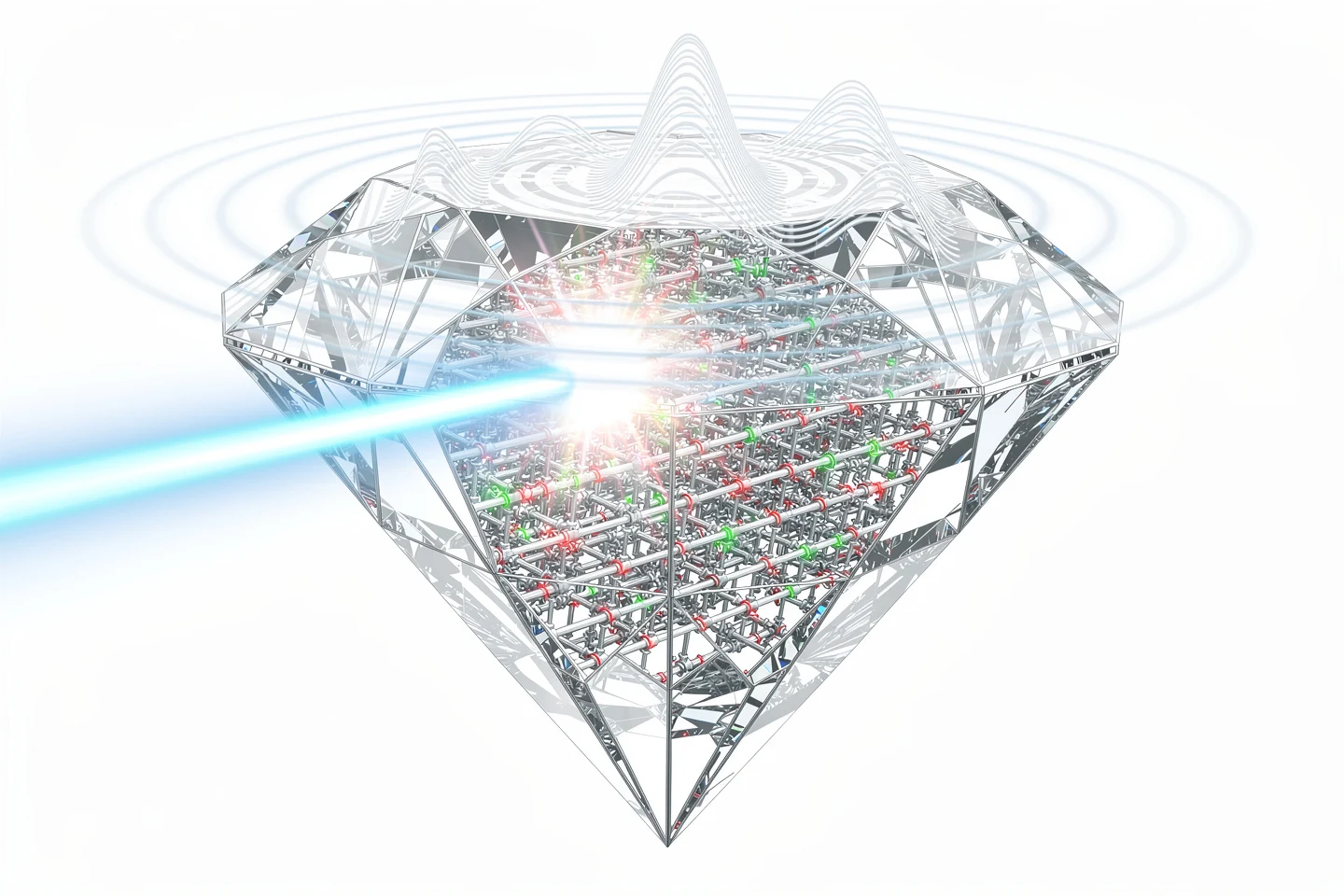
In the depths of a diamond crystal, studded with NV centers, a symphony slumbers. Each defect is like a tuning fork, ready to respond to a passing acoustic wave. But alone, their voices are barely audible: the spin-phonon coupling is weaker than a whisper. A maestro is needed, one who can turn timid vibrations into a resounding choir. And that maestro is a laser beam.
Imagine an orchestra without a conductor: dozens of instruments playing each to itself — cacophony. But a flick of the baton, and the sounds merge into a powerful chord. In the quantum world, such a transition is called superradiant: from a normal phase, where spins and phonons barely notice each other, to a phase of a single macroscopic state. In the physicists' work, the role of the conductor is played by the laser field, tuning the effective coupling of the NV-center spin ensemble with a surface acoustic wave mode. The key formula G = λΩ/ωm is as simple as a musician's gesture: the bare interaction λ is multiplied by the ratio of the laser Rabi frequency Ω to the phonon frequency ωm. The brighter the light, the stronger the coupling, and upon reaching the threshold, the quantum transition occurs.
Behind the scenes of this performance lies deep physics, inspired by the works of Serge Haroche and David Wineland. Their cavity quantum electrodynamics experiments showed how collective atomic behavior leads to superradiance. Here, it's the same Dicke model, but for phonons. Building on the principle of superposition of collective spin states, the authors derived an effective Hamiltonian that reduces to a tunable coupling. Above the critical laser intensity, an order parameter emerges, the amplitude of the phonon field, and the transition itself is of the second kind, where symmetry is broken not by temperature but by light. Remarkably, the threshold bare coupling λc decreases as Ω increases: even an initially weak interaction is compensated by the strong laser field. For small ensembles (N ~ 2–10), the sharp transition smears into a crossover, but quantum tomography reveals a three-peak Wigner function — evidence of phase coexistence, like intertwined voices.
The practical outlook is mesmerizing. This optical switch turns the diamond chip into a reprogrammable quantum interface, where phonons serve as mediators for transmission of quantum entanglement between qubits. It's a step toward quantum computer based on phonons, more resilient to decoherence, and hypersensitive sensors using collective states for quantum measurement. Moreover, the work opens the path to quantum optics — a field where sound behaves like light in quantum networks. Fundamentally, we are approaching a solution to a key challenge — achieving strong coupling in hybrid systems, where quantum decoherence is always ready to destroy the quantum symphony. The laser 'conductor' not only enhances the coupling but also actively combats noise, acting as a stabilizer. In the future — multimode phonons, nonclassical states, and quantum memory on NV centers. Experimental realization with modern high-Q SAW resonators (quality factor up to 10⁵) and small spin ensembles is already possible today. Thus, the quantum choir will sound in diamond, and perhaps we will hear its song — at room temperature, without cryostats, but with quantum precision.
Diamond is not only the hardest material but also an excellent sound conductor: the speed of acoustic waves in it reaches 12 km/s, tens of times faster than in air, and almost twice as fast as in steel.