Optically switchable superradiance of surface acoustic wave phonons in diamond ✛ ✎ ✦
Context
Controlling the quantum properties of phonons is key to advancing quantum information technologies and quantum metrology. However, achieving strong coupling for superradiance in solid-state systems remains a challenge. The proposed method opens a new avenue for coherent control of phonons.
Methods
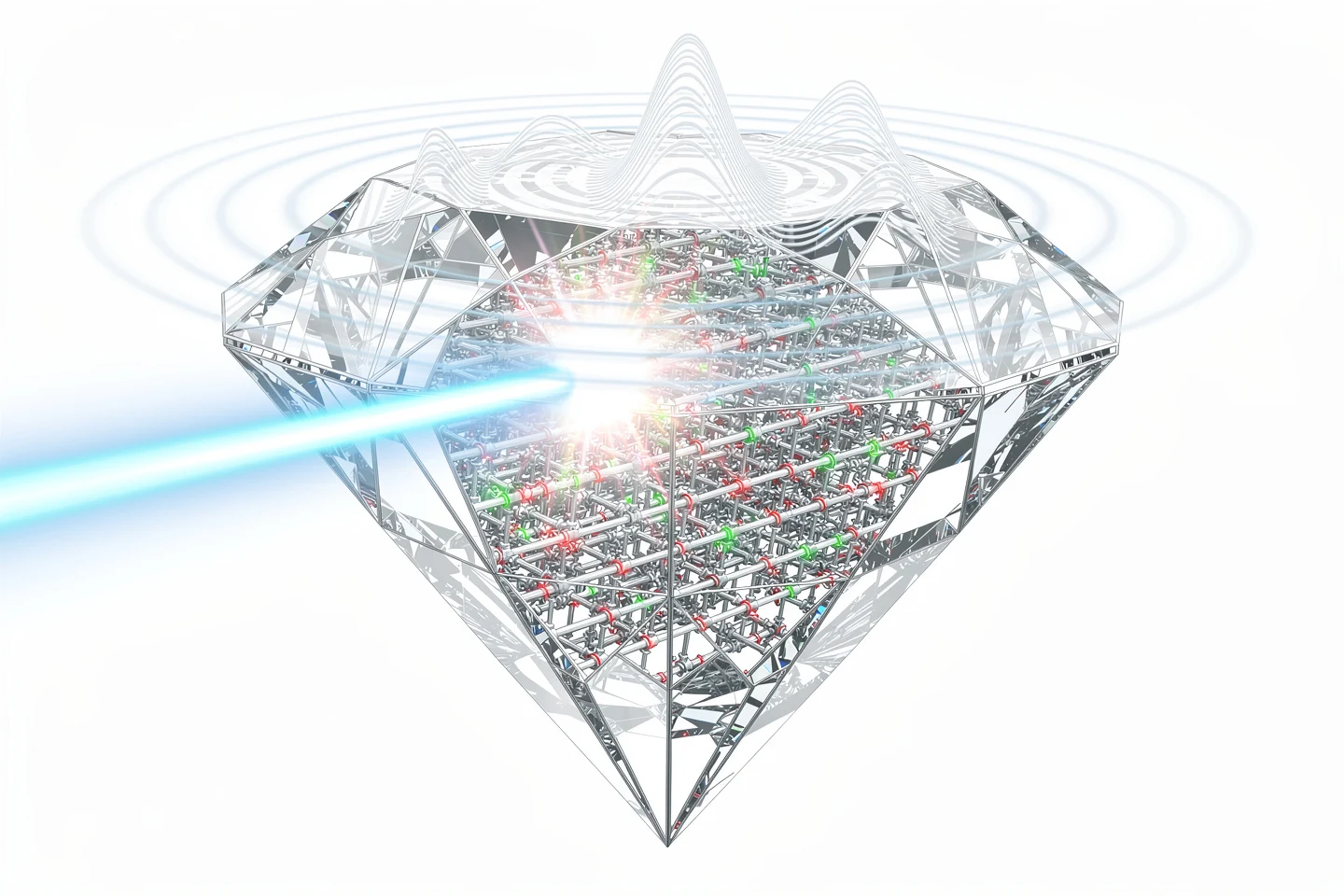
Using the superposition principle of collective spin states, the authors constructed an effective Hamiltonian describing an ensemble of NV centers in a diamond waveguide, coupled to a single mode of a surface acoustic wave (SAW) and driven by a classical laser field. Through unitary transformations accounting for dissipation, they reduced the problem to a Dicke model with tunable coupling. Then, using mean-field theory and numerical solution of the master equation, they investigated the steady states and dynamics.
Results
It is shown that when the laser intensity exceeds a critical value, the effective spin-phonon coupling G = λΩ/ωm (where λ is the bare coupling, Ω is the laser Rabi frequency, and ωm is the phonon frequency) triggers a superradiant phase transition. In the thermodynamic limit, the second-order transition is characterized by the order parameter—the amplitude of the phonon field. The critical bare coupling λc decreases with increasing Ω, enabling superradiance even for initially weak coupling. Numerically, it is demonstrated that upon switching on the laser, the system instantly transitions to the superradiant phase, acting as a quantum switch. For finite ensembles (N ~ 2–10), the phase transition smoothens into a crossover, but the Wigner function exhibits a characteristic three-peak structure—a signature of coexistence between normal and superradiant phases.
Implications
The work offers a universal mechanism for optical tuning of collective quantum effects in phononic systems. This expands the toolbox of quantum phononics and brings closer the realization of solid-state quantum networks, where phonons serve as mediators for transmitting quantum entanglement.
Future development
Future developments may include extension to multi-phonon modes, exploration of nonclassical states, and use of NV centers for quantum memory. Experimental implementation with state-of-the-art high-Q SAW resonators and small NV center ensembles appears achievable.
Impact
The results will impact the development of quantum acoustic devices, phonon-based quantum computers, and ultrasensitive sensors leveraging collective spin states.
Next steps
Experimental demonstration of the transition in diamond structures with tens of NV centers and verification of predictions for finite systems using quantum state tomography.
Key open problems
The study touches upon the fundamental challenge of achieving strong coupling in hybrid quantum systems and the issue of controlling quantum decoherence in solids. It also contributes to understanding nonequilibrium phase transitions in open many-body systems.
The knowledge machine's view
This section is addressed to the author of the paper and their colleagues. Neighbouring works were found by meaning-based search across our archive, not by word overlap. We do not review: we show the field around the work.
What the work does
The study constructs an effective Hamiltonian for an ensemble of NV centers in a diamond waveguide, coupled to a surface acoustic wave mode and driven by a laser. Using the mean-field method and numerical solution of the master equation, it is shown that when the laser intensity exceeds a critical value, a superradiant phase transition occurs, and in finite ensembles a crossover is observed with a characteristic three-peaked Wigner function.
Where its strength is
The key idea is to use optical pumping to enhance the effective spin-phonon coupling, allowing superradiance to be achieved in the regime of weak intrinsic coupling. This paves the way for switchable quantum phononic devices on a chip.
Where it could go next
- It might be interesting to compare the proposed mechanism with the implementation of a phonon laser on a diamond dust particle, which also uses sound amplification but via optical forces.based on: A Diamond Speck Becomes a Sound Laser arXiv:2601.17552
- Closely related is work on magnetic 'earphones' for qubits, where magnetic fields are used to suppress noise; combining this with phononic control might offer new ways to protect quantum states.based on: Magnetic 'Headphones' for Qubits: A New Way to Fight Quantum Noise arXiv:2605.20180
- It is worth considering the connection with a diamond qubit with millisecond memory on a carbon nanotube: there the NV center interacts with mechanical vibrations, and one could investigate how collective superradiance affects coherence time.based on: Dancing on a Carbon Thread: A Diamond Qubit with Millisecond Memory arXiv:2607.02258
Worth trying
- Test whether optical pumping can be used to rapidly switch between normal and superradiant phases in a device with a single NV center coupled to a SAW.
- Assess how the superradiant transition affects the decoherence of NV center spins and whether it can be used to generate squeezed phonon states.
- Investigate the possibility of cascaded amplification: superradiant phonons excite other NV centers, creating a distributed quantum amplifier.
Nearby works in our archive
- A Diamond Speck Becomes a Sound Lasersimilarity 0.64
- Magnetic 'Headphones' for Qubits: A New Way to Fight Quantum Noisesimilarity 0.61
- Quantum Bridge Through Magnetic Stormssimilarity 0.61
- A Diamond Quantum Orchestrasimilarity 0.61
- Quantum Hearing Without Noisesimilarity 0.60
- How an Atomic Nucleus Catches a Photon with the Wrong Energysimilarity 0.60
- Dancing on a Carbon Thread: A Diamond Qubit with Millisecond Memorysimilarity 0.59
The closest work in the archive sits at 0.64 by meaning — the usual level for our corpus.
Surface acoustic waves travel 100,000 times slower than light, offering unique opportunities for manipulating quantum states 'on the fly.' And NV centers in diamond are true 'atoms in a solid,' maintaining quantum coherence even at room temperature!
Key numbers
- SAW speed relative to light speed: 5 orders of magnitude slower
- typical SAW frequency: 818 MHz
- single-emitter spin-phonon coupling (g0/2π): ~10 MHz
- SAW resonator quality factor: 103 – 105
- number of NV centers for collective coupling λ/2π~50 MHz: ~25