Thermodynamics Through a Keyhole
Picture yourself looking into a room through a keyhole. You see only part of what's going on, yet from those fragments you can infer a great deal. Physics works the same way: we can't measure every detail of a quantum system, but from the quantities we do have access to, such as temperature, pressure and volume, we derive the laws of heat and work.
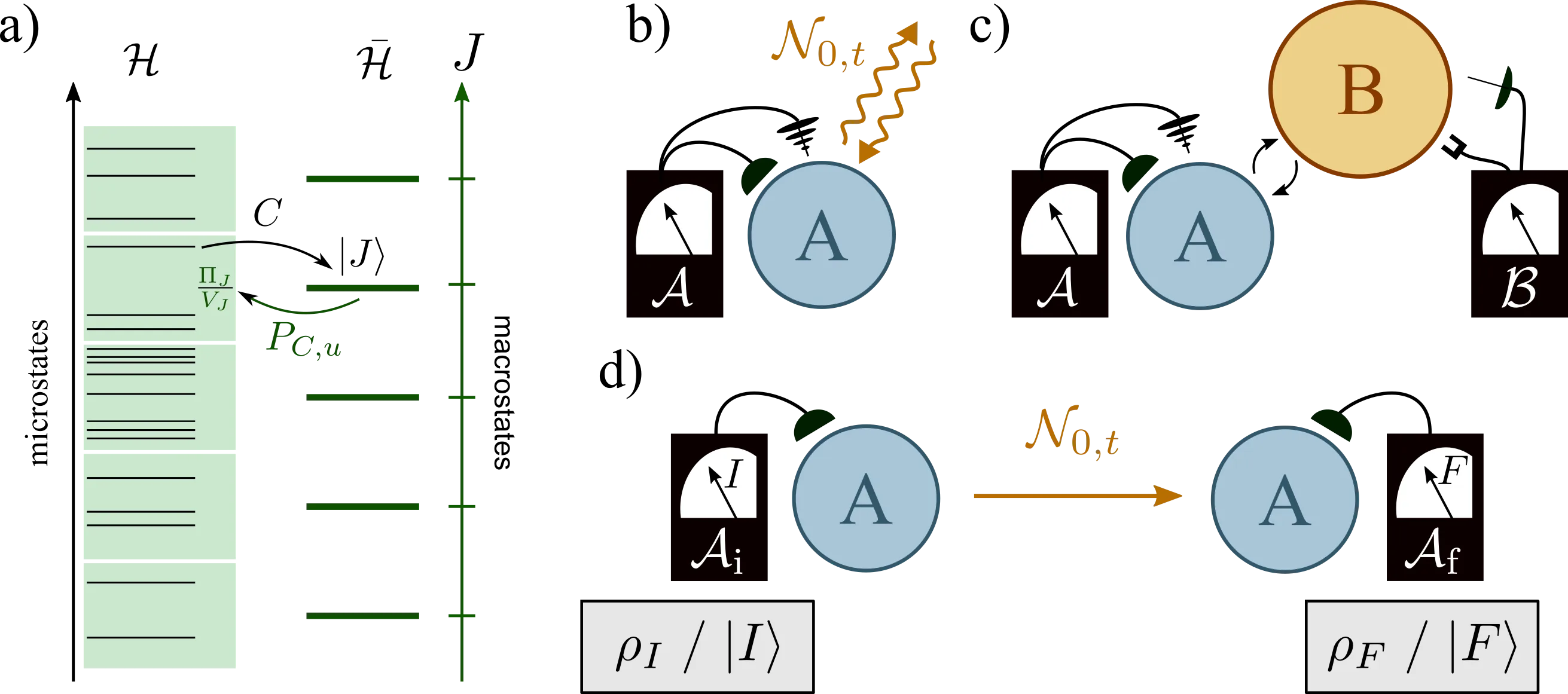
Quantum thermodynamics used to require full knowledge of a system's state, which is impossible for large objects. A new paper proposes another route: choose a set of accessible observables, that is, decide what exactly we can measure. This set forms an algebra, a mathematical structure that sets the level of coarse-graining. The fewer the observables, the coarser the description, but the closer it comes to what an experimenter can actually do.
This approach lets you derive the second law of thermodynamics even for isolated systems: entropy grows not because the system loses information, but because the observer cannot hold on to all of it. It's as if you kept forgetting the details you saw through the keyhole, and the room seemed more and more uncertain.
The paper shows that even for an isolated system, entropy can grow if the observer can measure only coarse variables. The example of a gas in a box demonstrates that a specially prepared microscopic state can lead to an apparent violation of the second law, but only by drawing on hidden information.
The idea that thermodynamic laws depend on what an observer can measure echoes the concept of 'Maxwell's demon.' The paper shows how information about the microstate can be used to extract work, reminiscent of stories about intelligent beings that violate thermodynamics.