Thermodynamics Through a Keyhole
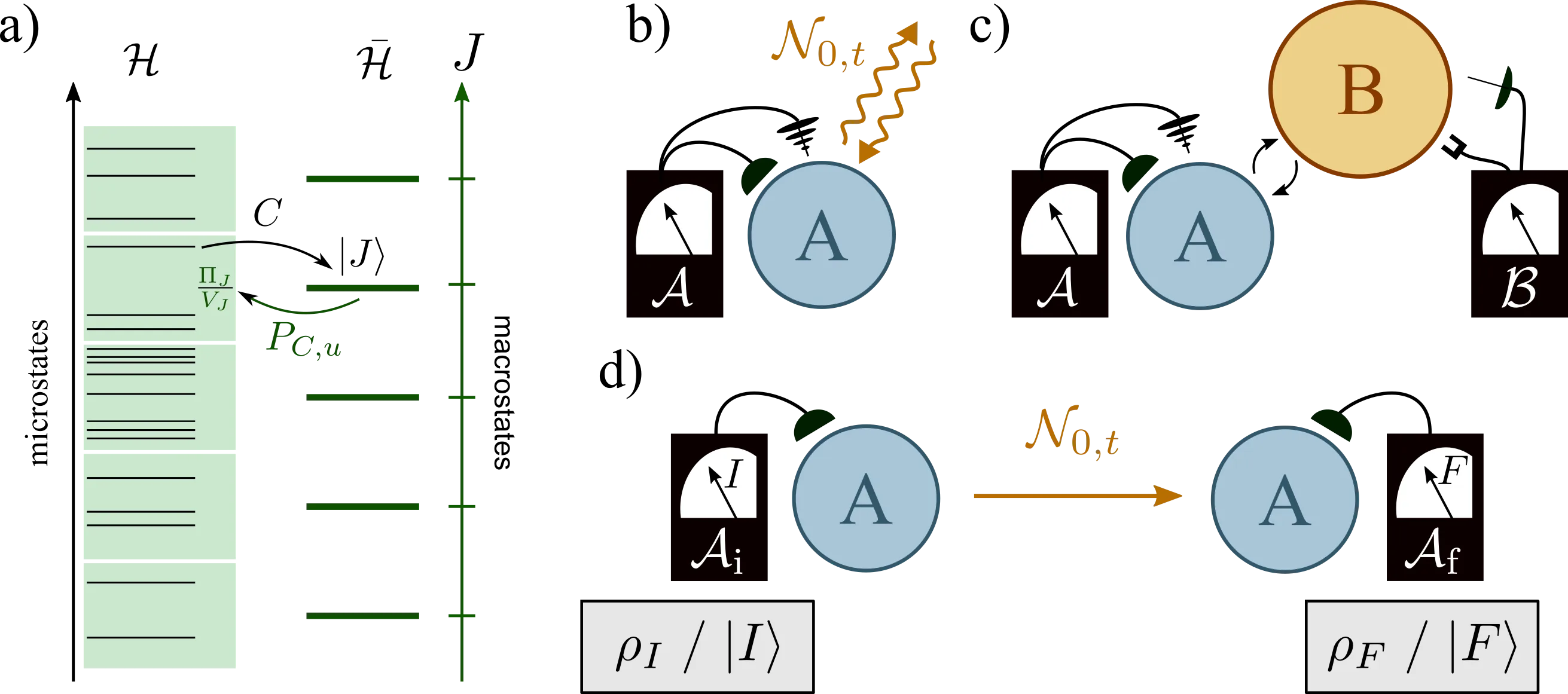
Picture a closed door with a keyhole. Behind it lies the quantum world, full of details that cannot be taken in all at once. Through the keyhole you see only a narrow beam of light picking out a few features. Thermodynamics works the same way: an observer can measure not everything, but only a handful of quantities, such as temperature, pressure, and volume. Yet it is precisely from these coarse shadows that the laws of heat and work are born.
For a long time, quantum thermodynamics required a complete description of a system's state, as if assessing a room demanded knowing the position of every atom in it. For macroscopic objects this is impossible. The authors of a new paper propose a different route: specify a set of accessible observables, that is, decide what exactly we can measure. This set forms an algebra, a mathematical structure that sets the level of coarse-graining. The fewer the observables, the coarser the description, but the closer it comes to what an experimenter can actually do.
Entropy defined through such an algebra generalizes the known measures of uncertainty. For a single measurement it coincides with observational entropy, the kind we get after reading off an instrument. For more complex algebras, the maximum entropy principle is used, yielding an algebraic entropy that interpolates between von Neumann entropy (full knowledge) and observational entropy (only outcome probabilities). As a result, the second law of thermodynamics is derived even for isolated systems: entropy grows not because the system loses information, but because the observer cannot hold on to all of it.
The work introduces quantum analogues of heat and work, and the work contribution comes not only from changes in external parameters but also from changes in the algebra itself, for instance a rotation of the measurement basis. This is new: previously, work was thought to be tied solely to changes in the Hamiltonian. Now the very way we observe can perform work.
This approach applies to any quantum systems, from a single qubit to a macroscopic gas. It makes it possible to describe quantum engines, batteries, and measurement processes in experiments where only partial information is available. The keyhole no longer gets in the way: through it, we see enough to understand how heat is born.
The paper shows that even for an isolated system, entropy can grow if the observer can measure only coarse variables. The example of a gas in a box demonstrates that a specially prepared microscopic state can lead to an apparent violation of the second law, but only by drawing on hidden information.
The idea that thermodynamic laws depend on what an observer can measure echoes the concept of 'Maxwell's demon.' The paper shows how information about the microstate can be used to extract work, reminiscent of stories about intelligent beings that violate thermodynamics.