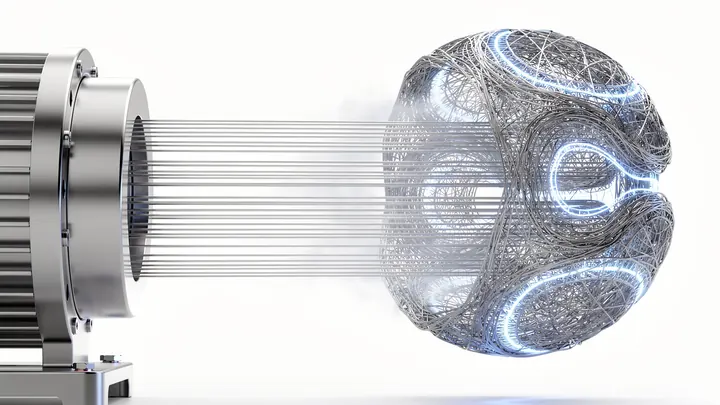
Quantum measurement theory is the branch of physics that attempts to explain how and why a quantum system, which exists in a superposition of states, appears to 'collapse' into a single definite outcome when measured. It addresses the core mystery of quantum mechanics: the transition from the probabilistic, wave-like behavior of microscopic systems to the deterministic, particle-like reality we observe. The theory incorporates the ideas of Niels Bohr, who emphasized the role of the classical measurement apparatus, and John von Neumann, who formalized the measurement process mathematically.
History
The foundations were laid in the 1920s and 1930s by Bohr, Heisenberg, and von Neumann. The measurement problem was sharply formulated by von Neumann in his 1932 book 'Mathematical Foundations of Quantum Mechanics'. Later, in the 1970s and 1980s, Wojciech Zurek and others developed decoherence theory, which clarified the role of the environment.
How it works
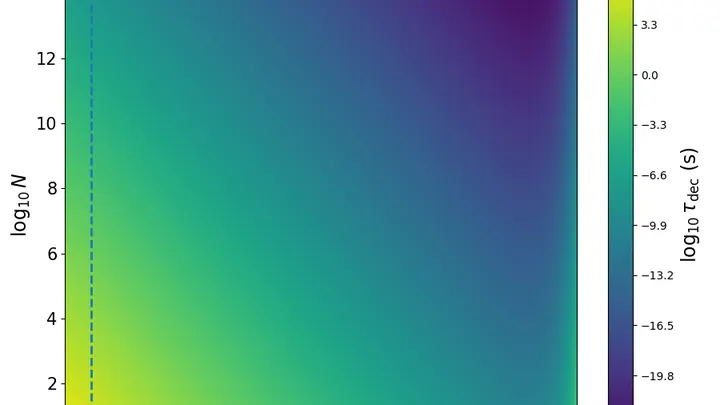
The standard framework, developed by von Neumann, divides the world into the measured system and the measuring device. The interaction between them entangles the two, leading to a superposition of correlated states. The 'collapse' is then postulated as a non-unitary process that selects one outcome with a probability given by the Born rule. However, the exact mechanism of collapse is not specified. Modern approaches, such as decoherence theory, show that the environment effectively measures the system, suppressing interference terms and making the system appear classical, but they do not explain the final selection of a single outcome.
The 'quantum Zeno effect', predicted by measurement theory, shows that continuously observing a quantum system can freeze its evolution, effectively preventing it from changing.
A quantum computer is usually like an assembly line: operations proceed one after another, and each error accumulates. In the new work, physicists tried a different path — an architecture where the computation grows out of the measurement process itself. They took 56 ions in a trap and wove them into a three-dimensional cloud of entangled particles.
If you accelerate an observer to near-light speed, the emptiness around them stops being cold. A thermal glow emerges — an effect predicted in 1976 and named after William Unruh. For earthly accelerations, this glow is vanishingly faint, like a whisper at a rock concert.
Photographing hummingbird wings with an ordinary camera gives a blurry smudge. For a sharp picture, you take many rapid shots from different angles and piece them together: that's how a quantum 'snapshot' is made. In the lab, scientists 'feel' the vibrations of a tiny mirror with a laser beam.
In quantum mechanics, everything is fuzzy: a particle is not at a single point but smeared across space, and an event does not happen at a single moment. Yet our everyday world is full of definiteness — the coin landed heads, the light bulb turned on, a note appeared in the notebook.
In a football stadium, the crowd's emotions arise from the chatter of individual fans. If mood could be both joyful and sorrowful at once, you'd have a quantum superposition. But the murmur of thousands of voices instantly forces that blend into a single definite state.
A coffee whirlpool can span two spots in a cup — a blur of swirling liquid. Quantum particles behave similarly: a spacetime whirlpool where they exist in two places at once. But gravity acts as the spoon that stirs the fabric of space and time.
A typical recipe explains how to cook a dish: step by step, from the initial ingredients to the finished result. The new approach flips the logic: imagine that the future pie itself dictates how much flour to add now. In the quantum world, researchers suggest, a particle receives signals from the future measurement outcome.
In quantum theory, a particle can run along two paths at once. When measured, we catch it on just one. According to Niels Bohr, all other possibilities vanish instantly — like a branch snapped off a trunk. Yet Hugh Everett insisted: the tree of reality grows all its branches at once, and we only see the one we’re on.
A quantum particle, an inhabitant of the elementary particle world, resembles a coin spinning in the air: neither heads nor tails, but a blend of possibilities. Yet when it lands on the table, the outcome becomes definite. What serves as the table in a measurement?
A single photon passes through two slits and leaves an interference pattern on a screen. Quantum mechanics describes this process with a wave function, but what happens to the particle itself?
In 1935, Einstein, Podolsky, and Rosen proposed a thought experiment that, in their view, exposed the incompleteness of quantum mechanics. Two particles fly apart after interacting, and measuring the momentum of one instantly gives exact knowledge of the other's momentum.
Quantum mechanics gave us a captivating image: a system’s state is not a frozen point but a wave of possibilities, dancing in an abstract space. Thanks to the work of Шрёдингера and Дирака, we represent it as vectors in Hilbert space.