Thermodynamics Through Algebra: How a Coarse Description Gives Rise to Heat and Work
Context
Macroscopic thermodynamics successfully describes the behavior of large systems using just a few state variables, because internal degrees of freedom equilibrate quickly. Quantum stochastic thermodynamics, by contrast, works with elementary systems and requires knowledge of the full density matrix, which is impossible for many-body systems. This work bridges the gap between these approaches, allowing the level of coarse-graining to be tuned and thermodynamic laws to be obtained for arbitrary quantum systems.
Methods
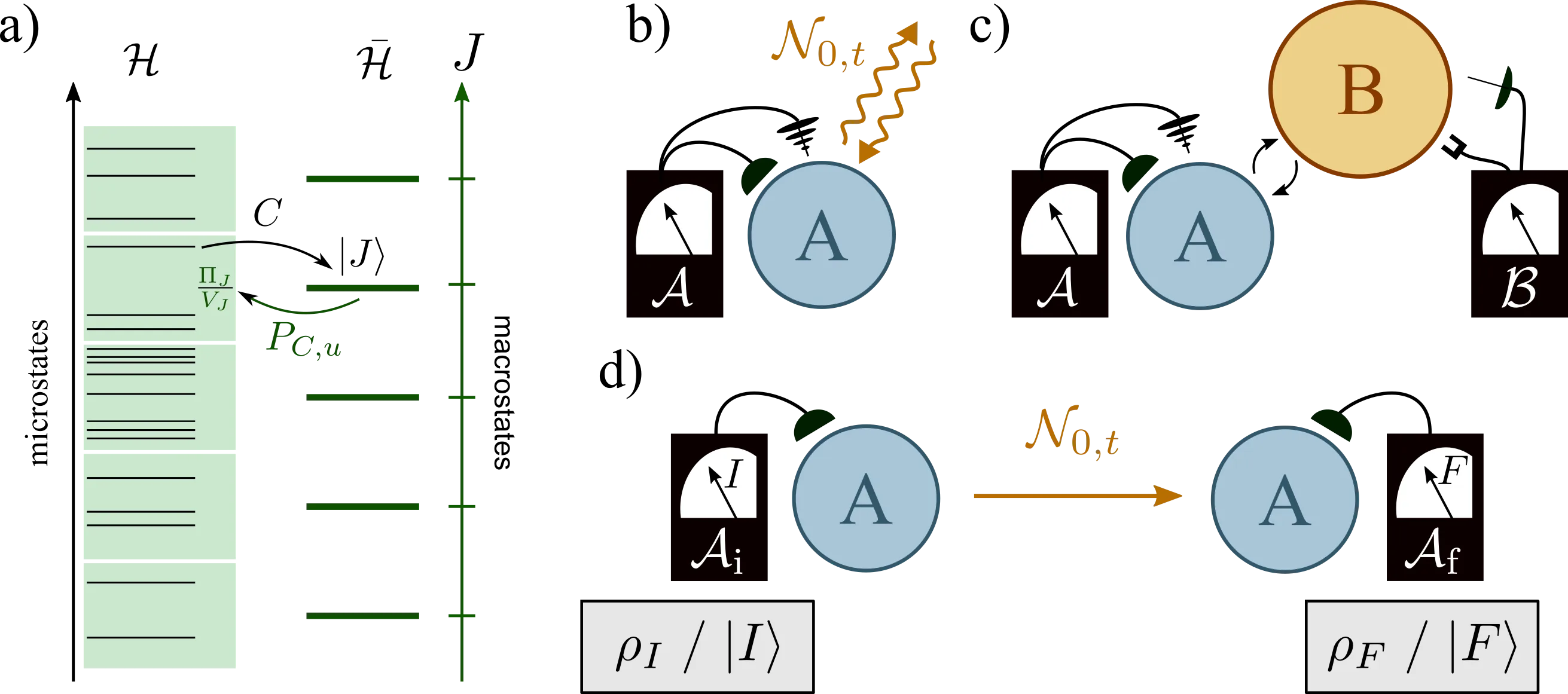
The authors formalize coarse-graining through the choice of a subalgebra of accessible observables. In the commutative case (a single measurement), the macrostate is set by outcome probabilities, and the entropy coincides with the observational entropy. For noncommutative algebras, Jaynes' maximum entropy principle is used, yielding an algebraic entropy that interpolates between the von Neumann entropy and the observational entropy. Two scenarios are considered: an open system (only the system is accessible) and an autonomous one (system and environment are isolated but measured separately). The second law and fluctuation theorems are derived for two-point measurements, and then a quasistatic limit is introduced to define heat and work.
Results
A generalized second-law inequality is obtained for the coarse-grained entropy, with corrections tied to initial correlations and to departure from internal equilibrium. In the quasistatic limit, heat and work are defined, with work including a contribution from changes in the algebra (for example, rotations of the measurement basis). The entropy production is shown to be positive when the conditions of CP-divisibility and local scale divisibility hold. Fluctuation theorems relate the probabilities of forward and reverse trajectories. Examples (a qubit, spontaneous emission, an emitter in a waveguide) illustrate how thermodynamic quantities depend on the choice of algebra.
Implications
The work offers a unified language for describing the thermodynamics of quantum systems of any size, from qubits to macroscopic objects, without needing to know their exact state. This makes it possible to study irreversibility arising both from interaction with the environment and from internal relaxation. The approach opens a path to analyzing the quantum-classical transition and measurements from a thermodynamic standpoint.
Future development
It could be applied to quantum engines and batteries based on many-body systems, where all components can be described coarsely. Extending it to type II and type III algebras would allow quantum fields and black holes to be considered. It would also be interesting to explore how thermodynamic behavior changes in the transition from noncommutative to commutative algebras under coarse-graining.
Impact
The method could influence experimental quantum thermodynamics by making it possible to analyze systems with incomplete information. It also provides a tool for studying the thermodynamics of quantum measurements and backaction.
Next steps
Apply the formalism to numerically solvable many-body models to test its predictions. Investigate the conditions under which second-law violations due to coarse-graining disappear.
Key open problems
The work links the problem of defining entropy for quantum systems with limited access to the problem of irreversibility in closed quantum systems, where the von Neumann entropy does not grow but thermalization is observed.
The paper shows that even for an isolated system, entropy can grow if the observer can measure only coarse variables. The example of a gas in a box demonstrates that a specially prepared microscopic state can lead to an apparent violation of the second law, but only by drawing on hidden information.
The idea that thermodynamic laws depend on what an observer can measure echoes the concept of 'Maxwell's demon.' The paper shows how information about the microstate can be used to extract work, reminiscent of stories about intelligent beings that violate thermodynamics.
Key numbers
- Number of particles in the gas example: N ≫ 1
- Rank of the projector in the coarse measurement: V_J = Tr(Π_J)
- Observational entropy: S_ob = -Σ p_J ln(p_J/V_J)
- Qubit relaxation time: τ ~ 1/γ