John von Neumann was a Hungarian-American mathematician and physicist whose work in the 1930s provided the rigorous mathematical framework for quantum mechanics, particularly the theory of measurement. His 1932 book 'Mathematical Foundations of Quantum Mechanics' formalized the subject using Hilbert spaces and linear operators, and introduced the concept of the density matrix to describe mixed states. He also formulated the 'collapse of the wavefunction' as a distinct process, separate from the smooth unitary evolution of the Schrödinger equation.
History
Von Neumann developed these ideas in the late 1920s and published them in his 1932 book. He also made foundational contributions to game theory, computer architecture (the von Neumann architecture), and the mathematics of quantum logic.
How it works
Von Neumann's measurement theory treats the measurement apparatus as part of the quantum system, with the interaction between the measured system and the apparatus creating correlations. He showed that the observer's perception of a definite outcome requires a non-unitary 'projection' or 'collapse' of the state vector, which he called the 'process 1'. This led to the famous 'von Neumann chain' problem: where exactly does the collapse happen — at the apparatus, the observer's senses, or their consciousness? His framework remains the standard way to describe quantum measurements, even though the physical nature of collapse is still debated.
Von Neumann was known for his prodigious memory and ability to perform complex calculations in his head, and he reportedly could recite entire books verbatim after reading them once.
The interpreter in the meeting room hears the shift in tone before it is spoken aloud. They catch subtle changes in breathing, pauses, and intonations, and already know that in a few minutes the conversation will turn heated.
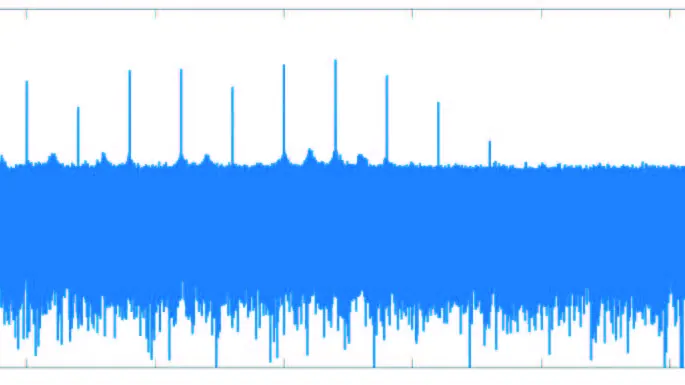
Photographing hummingbird wings with an ordinary camera gives a blurry smudge. For a sharp picture, you take many rapid shots from different angles and piece them together: that's how a quantum 'snapshot' is made. In the lab, scientists 'feel' the vibrations of a tiny mirror with a laser beam.
Eight hundred participants, firms and workers, enter the market. Each holds a strict preference list in mind. The challenge: pair up so that no one wants a do-over. In mathematics, this is called a game theory with a ban on repeat alliances, and its roots trace back to the work of John von Neumann and Oskar Morgenstern.
An orchestra plays out of tune, and the sound seems like chaos. But if you record all the notes and analyze them mathematically, you can reconstruct the shape of the concert hall — where the walls are, how high the ceiling is. Roughly in this way, physicists propose to derive gravity from quantum theory.
In everyday life, space and time are the stage on which events unfold.
A soap bubble hangs in the air, and its shape already contains everything needed to calculate the internal tension. A similar principle worked in a new study on quantum gravity. Physicists took a closed surface, an analog of such a bubble, and specified a few numbers on it: for example, the electric field strength and the curvature.
A coffee whirlpool can span two spots in a cup — a blur of swirling liquid. Quantum particles behave similarly: a spacetime whirlpool where they exist in two places at once. But gravity acts as the spoon that stirs the fabric of space and time.
On the surface of a tiny sphere live two invisible fields, like two kinds of ripples on a soap bubble. These fields don't just oscillate on their own: they constantly influence each other, like musicians playing in unison. In a new study, physicists derived exact equations that describe how this ripple changes over time, heats up, and descends into chaos.
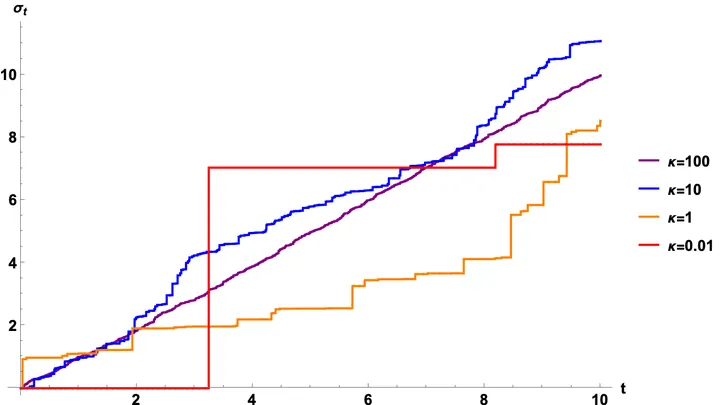
A regular wall clock runs smoothly, but quantum clocks are a different story. They tick at random moments, and each tick can have a different duration. On average, if you watch such a clock for a long time, it will show the correct time. But at any given moment, its hand might jump forward by an unexpected amount.
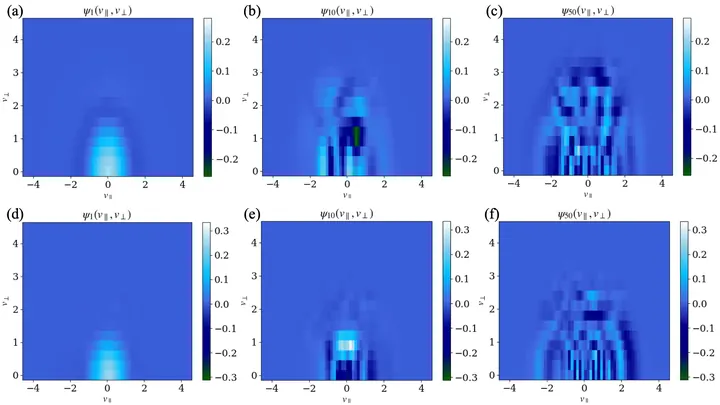
Hot plasma in a future fusion reactor is like a packed dance floor: billions of particles whirl in a complex rhythm, colliding and changing speed. Figuring out how tangled this dance is — no easy task. Scientists have found a way to measure its complexity without watching every move.
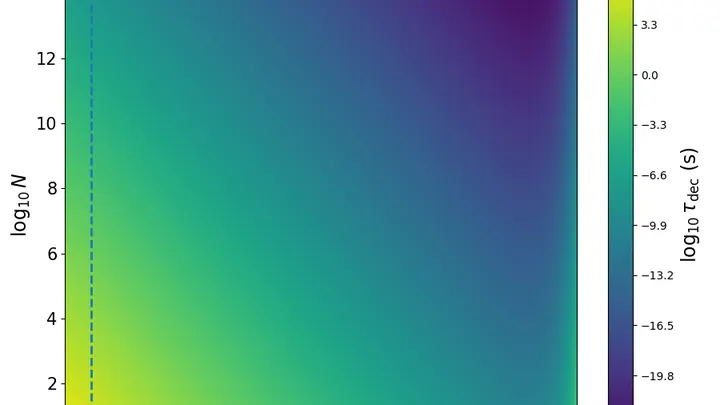
The antiproton is a mirror twin of the proton: same mass, but negative charge. When it approaches an atomic nucleus, the particles can annihilate, turning into radiation.
A quantum particle, an inhabitant of the elementary particle world, resembles a coin spinning in the air: neither heads nor tails, but a blend of possibilities. Yet when it lands on the table, the outcome becomes definite. What serves as the table in a measurement?
Two great theories describe reality: one — how massive bodies cause curvature of space, the other — the Standard Model — governs elementary particles. Reconciling them remains elusive, like trying to describe an ocean storm in the language of a diamond lattice.