Trapped Light Dances on Command express
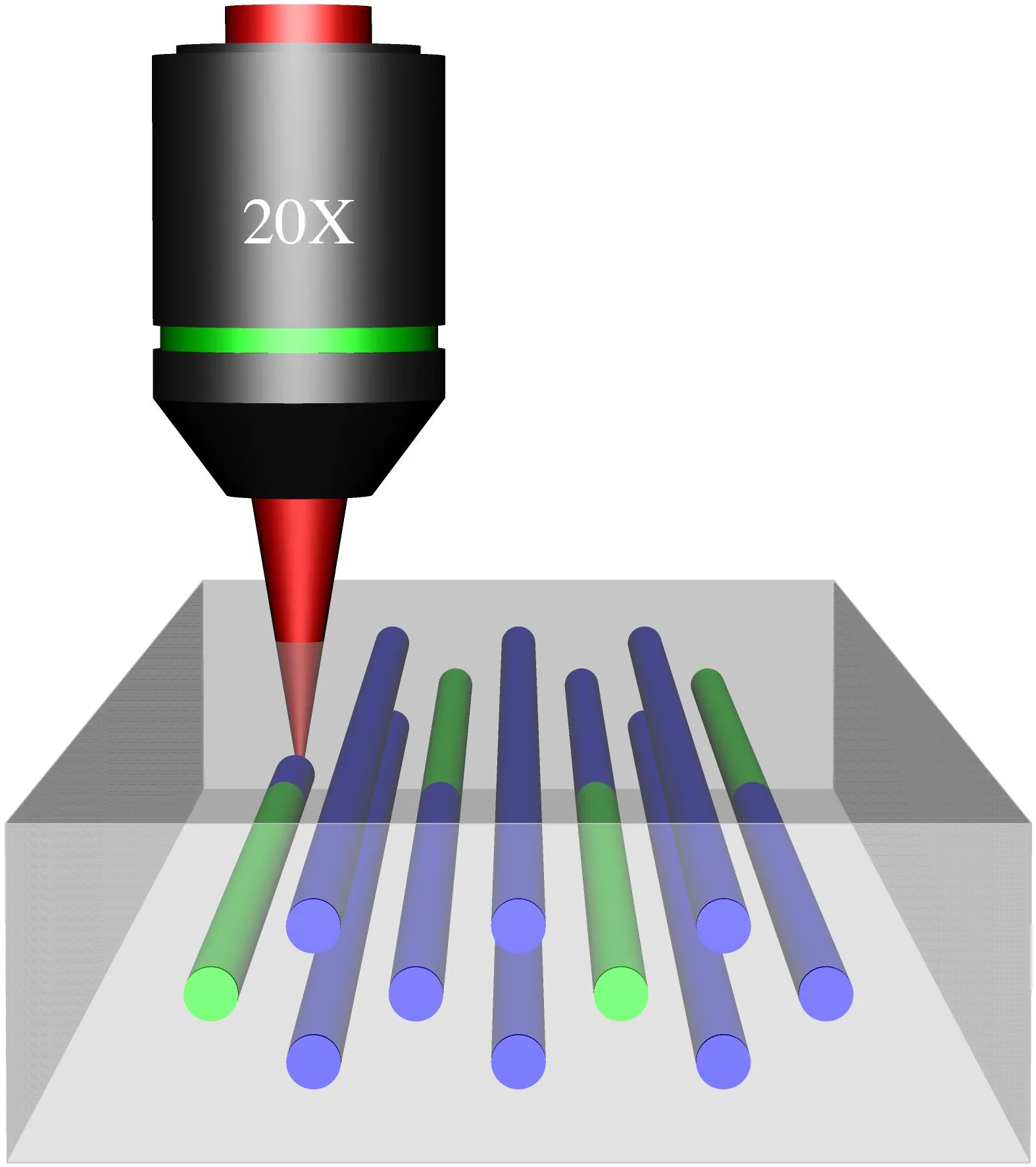
Light running through a waveguide sometimes gets trapped. In special structures, flat bands, it freezes in place: the wave doesn't spread but sits in a few neighboring channels, like a squeezed spring.
The authors took such a lattice made of laser-written waveguides and started 'shaking' it — rapidly changing the medium's properties along the light's path. These periodic kicks, or Floquet engineering, turn a stationary state into a moving one. Light begins hopping between channels — a sort of quantum walk, but strictly left or strictly right. The direction is set by the phase of the input beam: shift the phase one way, and light goes one way; shift it the other, and it goes the other.
The big surprise: the motion turned out to be topologically protected. Each moving pair carries a winding number of +1 or -1, which doesn't get scrambled by small perturbations. The experiment was done on glass waveguides inscribed with a femtosecond laser, and they watched the trapped light obediently step in the desired direction.
Original abstract
as written by the authors arXiv:2607.10415
The Aharonov-Bohm (AB) effect remains a cornerstone of fundamental and applied physics. In this work, we utilize the AB caging effect originated from an effective magnetic field induced by multi-orbital interactions, creating an all flat band (FB) lattice system. Normally, FB states are known for being compact in space and having a zero tail; therefore, their mobility in a linear environment is generally understood as impossible. We propose a Floquet driving protocol in an all-FB photonic system to fully control the dynamics of localized photonic states. The modulation of the Hamiltonian along the propagation coordinate allows the translation of compact states in the direction of constructive interference, resulting in an effective stroboscopic quantum walk-like effect. We find that the traveling states exist in chiral pairs and have a related topological invariant (winding number) equal to +1 or -1, with the sign determining the propagation direction. We experimentally implement the Floquet driven protocol using femtosecond laser written photonic waveguides and demonstrate directional control of the propagation, determined by the relative phase of the input condition.
Flat bands, where light gets stuck, were first noticed in crystals half a century ago, but only now have we learned to control motion within them.