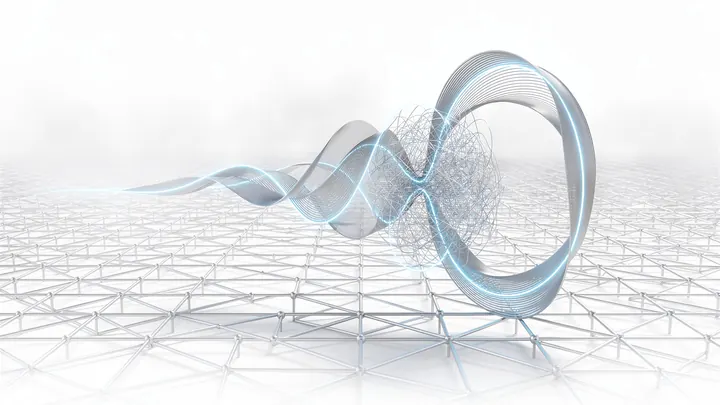
A quantum walk is the quantum mechanical counterpart of a classical random walk, where a particle (or a quantum system) moves through a graph or lattice in a superposition of multiple paths simultaneously. Unlike a classical walker who takes one step at a time with probabilities, a quantum walker evolves coherently, with amplitudes for different paths interfering constructively or destructively. This interference can lead to dramatically different behavior, such as ballistic spreading (where the variance grows quadratically with time) instead of the classical diffusive spreading (linear growth).
History
The concept of quantum walks was introduced independently by Y. Aharonov, L. Davidovich, and N. Zagury in 1993, and later formalized by J. Kempe in 2003. They were inspired by the classical random walk but adapted to the principles of quantum mechanics.
How it works
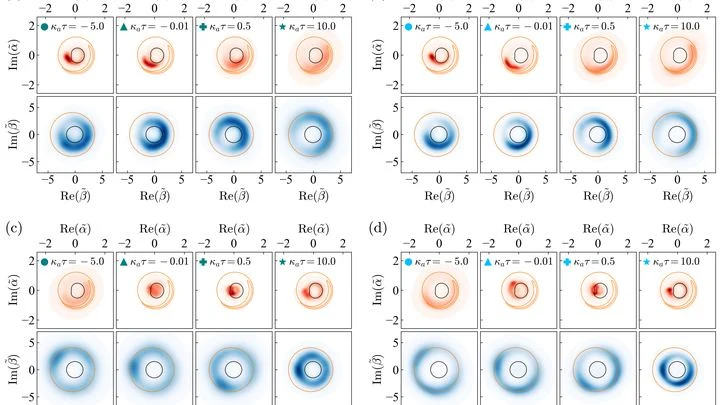
The quantum walk is typically implemented using a 'coin' degree of freedom (like a spin) that determines the direction of movement, and a position degree of freedom. At each step, the coin is rotated (via a unitary operation) and then the particle moves conditionally on the coin state. Because the particle is in a superposition of coin states, it effectively explores all paths at once. The interference between these paths can enhance or suppress probabilities at certain positions, leading to faster spreading and unique patterns like the 'quantum boomerang' effect mentioned in the titles.
In practice
Quantum walks are used as a computational primitive in quantum algorithms, such as the search algorithm by Shenvi, Kempe, and Whaley, and for simulating quantum transport in complex networks, including photosynthesis and quantum biology.
Fun fact
In a quantum walk on a line, the probability distribution can exhibit a 'double-peak' structure, with the walker spreading much faster than any classical random walk, a phenomenon that has been observed experimentally with photons and atoms.
It is commonly believed that a black hole is a merciless cosmic vacuum cleaner, sucking in everything indiscriminately. But new research flips the picture: right at the horizon, curvature transforms from a trap into a trampoline.
The classical Mpemba paradox — hot water freezes faster than cold — has teased scientists for centuries. Only recently has nonequilibrium statistical mechanics explained it: it’s all about boundary conditions; the system seems to seek an excuse to “hit the wall” and speed up cooling.
A swing can rock strongly or barely move. Usually, if left alone, it stays in its chosen mode. But in the microworld, things are different: a tiny membrane, oscillating under the action of a laser beam, can spontaneously jump from one amplitude to another.
The deepest equations of physics, like the Wheeler–DeWitt equation, contain no time. Past and future are scrambled within them, like frames on a film reel with no arrow indicating which way to play it. This symmetry is not a flaw but a feature.
In the first moments of the universe's existence, space was filled with hot plasma, where particles emerged and disappeared like bubbles in a boiling pot. The traces of these processes, stretched to gigantic sizes by expansion, are preserved in the cosmic microwave background — ancient light that has reached us across billions of years.
The quantum world doesn't like being glanced at sideways. To extract all available information from an atom or photon, you need a whole fan of 'needles'—different ways to ask a question. Physicists call such a fan a complete set of measurements. But among complete sets, there are special ones: their needles are arranged so evenly that each responds with equal strength.
A quantum walk is like a drunk person who turns randomly at every intersection. Except instead of streets, there are graph nodes, and instead of steps, there are quantum transitions. Scientists have discovered that such a walk has a hidden measure — Krylov complexity.
Toss a handful of peas into a pot of semolina porridge — the peas quickly sink, pushing the grains aside. But if you make the porridge very thick and sticky, the peas get stuck. That's roughly how light lithium atoms behaved in a cloud of heavy potassium atoms at temperatures just a few millionths of a degree above absolute zero.
Two seemingly incompatible mathematical languages describe a single quantum reality. The first is the language of quantum walks: here, a particle (such as an electron or even a quasiparticle in a condensed medium) takes a stroll on a graph, simultaneously exploring all possible paths — much like a pedestrian in an unfamiliar city instantly finding…
In 1961, Stanislaw Ulam proposed a simple model: a particle bounces between a fixed wall and a wall that oscillates according to a piecewise-linear law. It seemed like just another billiard. But behind this simplicity lay a question that troubled physicists for decades: can the particle accelerate to infinity?
The answer turned out to be paradoxical. In the classical version, almost never.
Quantum walking is not a series of random steps, but a musical score where the piano of space sounds under the conductor's baton of the internal state. The coin sets the tone. Until now, it was believed that detuned keys (phase disorder) mute any melody, leading to Anderson localization — a ringing silence.