Topological protection is a principle in physics that explains why certain quantum states remain robust against disturbances, such as material impurities or geometric deformations. The key idea is that some properties are not determined by the local details of a system but by global, 'topological' features—like the number of holes in a doughnut—which cannot be changed by smooth, continuous transformations. This makes these states incredibly stable, as small perturbations cannot alter their fundamental nature.
History
The concept gained prominence in the 1980s with the discovery of the quantum Hall effect, where the quantization of conductance was explained by topological invariants. The theoretical framework was developed by David Thouless and others, leading to the 2016 Nobel Prize in Physics.
How it works
In a topologically protected system, the quantum state is characterized by a topological invariant, a kind of integer 'quantum number' that remains constant as long as the system evolves smoothly. To change this invariant, the system would have to undergo a drastic, discontinuous change, such as passing through a phase transition. This is why, for example, the conductance in the quantum Hall effect is quantized with extreme precision: it is tied to a topological invariant that is immune to the presence of impurities or defects.
In practice
Topological protection is a key principle in the development of topological quantum computers, where qubits are encoded in topologically protected states to prevent decoherence and errors.
Fun fact
Topological protection is so robust that the quantum Hall effect's conductance is measured to an accuracy of one part in a billion, making it a standard for electrical resistance.
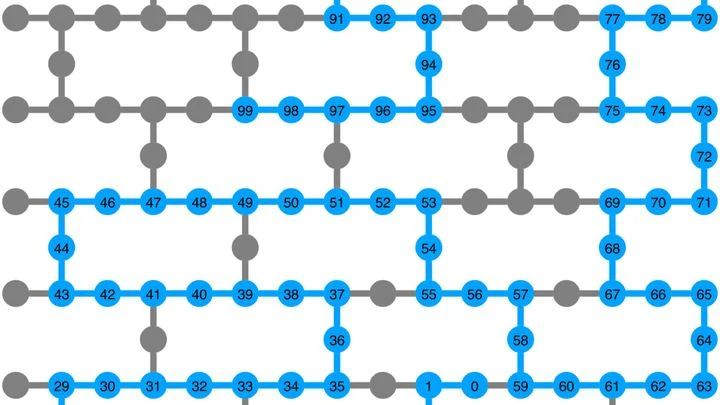
Picture a vast hall where thousands of janitors are sweeping the floor at the same time. Each one knows only their own patch and sweeps debris toward the nearest wall, without asking a manager. It used to be thought that such an approach was impossible for a quantum computer: too many errors, and you need a central brain that sees the whole picture.
A driver on a slippery road doesn't know exactly how the car will respond to the steering wheel, and learns on the go, leaving room for error. A smart control algorithm behaves in a similar way.
Quantum chromodynamics is the theory that describes how quarks and gluons assemble into protons and neutrons. In its equations, there is a strange angle, the parameter θ (theta).
The classical Mpemba paradox — hot water freezes faster than cold — has teased scientists for centuries. Only recently has nonequilibrium statistical mechanics explained it: it’s all about boundary conditions; the system seems to seek an excuse to “hit the wall” and speed up cooling.
Light or sound can be confined in a tiny region of a crystal, like a pearl in a shell. Usually, two methods are used. The first is like a heavy ball in a pit: a particle with large mass simply cannot roll out. The second is a perfect cage of mirrors, where waves cancel each other everywhere except in the trap itself.
Imagine a perfectly tuned orchestra, where every instrument is adjusted with flawless precision, trying to play in a noisy hall. That noise is quantum gravity — the microscopic ripples of spacetime. It constantly threatens to throw the musicians off.
A quantum computer is like an orchestra: each musician plays their own part, but the slightest noise from the audience can throw off the whole ensemble. The particles that store information easily lose their coherence from thermal jolts or stray magnetic fields.
A person hunting for keys mentally runs through places where they might be. A bird that tucked hundreds of seeds into crevices in autumn retrieves them flawlessly in winter. How can a brain hold so many addresses when all birds have roughly the same number of neurons? The answer lies in geometry.
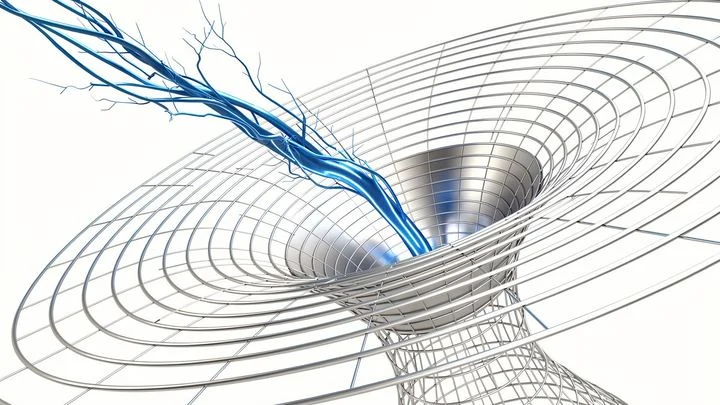
Since time immemorial, physicists have dreamed of tunnels piercing the cosmos — wormholes, capable of connecting far-flung corners of the Universe in an instant.
Throw a stone into a pond, and ripples spread across the water. Throw two stones nearby, and the ripples intersect, creating a pattern of reinforced and canceled waves. That's interference.
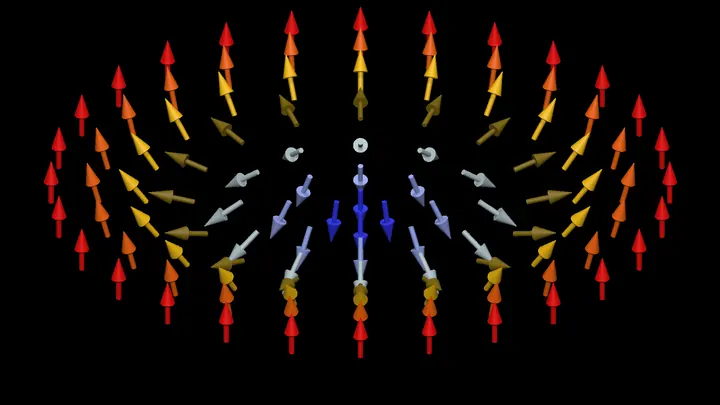
A candle flame flickers in a draft but doesn't go out — the tongue of fire briefly changes shape and then returns. Optical skyrmions behave much the same way — tiny vortices in a light beam, reminiscent of swirling eddies. Until recently, they were created only in the perfect, smooth light of a laser.
In a field trap, scientists assembled a crystal — 150 ions at ultra-low temperature. Each ion behaves like a tiny magnet, capable of rotating in any direction. By controlling forces that depend on this rotation, physicists made all the magnets swirl into a common vortex called a skyrmion.
In a strong magnetic field, electrons in a thin metal film move along circular orbits. When the film thickness is comparable to the size of such an orbit, the resistance starts to oscillate: these are Sondheimer oscillations, known since the mid-20th century as a purely geometric effect.
A quantum computer is like an orchestra where each musician plays their own part. If the conductor slips up, the music falls apart. In digital quantum simulations, the conductor's role is played by a sequence of simple operations, and errors accumulate like wrong notes.
A gold particle a few nanometers across looks like a tiny faceted diamond, but with five faces instead of the usual ones. Inside it hides a defect, like a crack in glass that can either heal or shatter the whole object. Scientists set out to discover what makes this defect move and disappear.
The quantum world loves order, but reality often brings disorder. In this work, physicists study one-dimensional chains of spins — tiny magnetic arrows that can point up or down. Usually, topological phases (stable states protected by symmetry) are defined for pure states, where each arrow is precisely known.
In the quantum world, you cannot create a copy of an unknown particle's state – this was established by William Wootters and Wojciech Zurek in 1982, and Charles Bennett turned this prohibition into a data protection tool.
A rope braided from a hundred short strands can be twisted to the right or to the left. Each strand individually doesn't know which way the whole rope is twisted, but try to unravel it, and the difference immediately shows. That's roughly how the states physicists call symmetry-protected are arranged: locally they are indistinguishable, but globally they are different.
Each qubit has its own little ring, freely sliding on the doughnut. All quantum logic boils down to smooth movements: shift, flip, connect. Entanglement, for example, is when two doughnuts stick together, and the rings on them begin to spin synchronously, like figure skaters in pairs skating.
The key insight: the geometry of the surface dictates the rules of the game.
In a tokamak, plasma is like a crowd on a narrow street: once someone starts running, everyone takes off at once. In a stellarator with a non-circular cross-section, the street is winding, with dead ends and pockets. The crowd can't gather into a single wave — people get stuck in different corners.
The quantum world is full of surprises: even simply observing a particle changes its behavior. In a new study, physicists showed that continuously measuring energy can make quantum chaos more pronounced. They used a quantity that indicates how long a quantum state remains similar to itself under repeated measurements.
An ordinary laser amplifies light into a bright beam. Run the process in reverse, and you get an anti-laser — a device that sucks in light without a trace. But such a machine is finicky: even a slight disorder can ruin the absorption.
Physicists have found a way to make the anti-laser invulnerable.
Pour a handful of dry sand: it will spread into a neat cone. Now grab a box of star-shaped pasta: the pile will stand almost vertical. Why? It's all about particle shape.
Physicists built cylindrical piles from particles of different geometries — from smooth spheres to 'polypods' with several arms, like a sea star.
Quantum computers use GKP states, dreamed up by Alexei Kitaev, John Preskill, and Daniel Gottesman. Their hallmark is built-in stabilizer checks that catch errors. For a long time, it was believed that a successful check guaranteed a nearly perfect state. Alas, it's an illusion.
The law discovered by Wolfgang Pauli forbids identical particles from occupying the same spot. Hence, in cold matter, a Fermi sea is born: particles, like water, fill energy levels from bottom to top. The shape of the sea's surface — including 'islands' of emptiness — dictates the properties of the whole system.
Quantum entanglement is a fragile resource. Heat a system, and thermal fluctuations will tear the delicate threads of correlations: at a sufficiently high but finite temperature, the Gibbs state of a local Hamiltonian becomes separable, that is, representable as a probabilistic mixture of products of local states.
A black hole in anti-de Sitter space is not a void but rather a pot of boiling liquid. This liquid has two phases: small and large black holes, like steam and water. At a certain pressure, they merge at a critical point, just as water at 374 °C and 218 atmospheres loses the distinction between liquid and gas.