A femtosecond is a unit of time equal to one quadrillionth of a second (10^-15 s). To grasp this scale: light travels about 300 nanometers in a femtosecond, roughly the size of a small molecule. This timescale is where the fastest processes in nature unfold—the vibrations of atoms in a crystal, the breaking and forming of chemical bonds, and the initial quantum events in photosynthesis.
History
The first femtosecond laser pulses were achieved in the 1980s, building on earlier work in picosecond pulse generation. The technique of pump-probe spectroscopy was developed in the late 20th century, enabling the study of chemical reactions in real time.
How it works
Femtosecond physics became possible with the development of mode-locked lasers, which produce pulses of light lasting only a few femtoseconds. By splitting such a pulse into a 'pump' (to trigger a process) and a 'probe' (to observe it at a precise delay), scientists can take snapshots of ultrafast events. Varying the delay between pump and probe reconstructs a movie of the process with femtosecond time resolution.
In practice
Femtosecond lasers are used in eye surgery (LASIK), precision micromachining, and as the basis for optical frequency combs that measure time with extraordinary accuracy.
Fun fact
In one femtosecond, light travels only about the width of a single water molecule.
Systems:SICGSOne quadrillionth of a second (10^-15 s), defined as a submultiple of the SI base unit second.
The ticking of atomic clocks is like the beat of a metronome, but instead of a pendulum, it's the oscillation of electrons in an atom. Two such clocks — one using an ytterbium ion, the other using strontium atoms — were made to tick side by side, and their rhythms were compared.
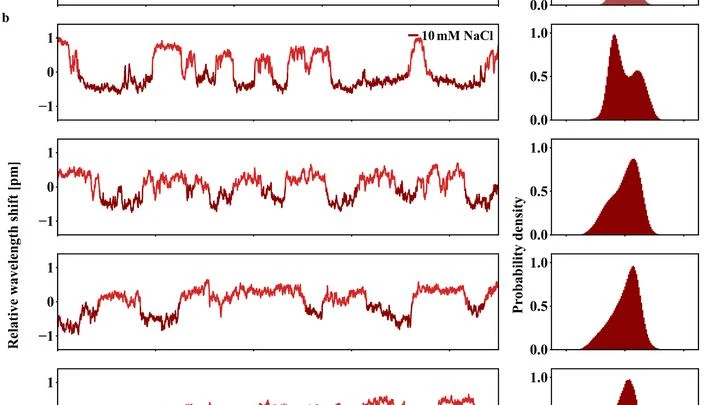
A protein in a cell is not a frozen sculpture but a restless mechanism. Its parts are constantly vibrating, and these movements determine how it grabs molecules, transmits signals, or builds the cellular scaffold. But filming the life of a single protein was hampered by two nuisances at once. First, the movements last millionths of a second — ordinary cameras simply cannot catch them.
Light waves are never perfectly smooth — they are constantly jittered by quantum ripples. These almost invisible nudges were studied by Nobel laureate Roy Glauber, who laid the foundations of quantum optics. Now physicists have learned to freeze these ripples.
In giant accelerators, particles zip through detectors in billionths of a second, and telling one from another requires a stopwatch of incredible precision. The new µRWELL-PICOSEC detector acts as such a stopwatch: it captures the moment a particle passes with a precision of 48 picoseconds: that's 48 trillionths of a second.
A regular camera captures the world as a series of frames: twenty-four, sixty, or even a hundred images per second. That's enough for filming a falling drop, but inside a living cell, events unfold a thousand times faster. Protein molecules carry cargo, membranes bubble, ions slip through channels — all in fractions of a millisecond.
Ordinary window glass may seem frozen forever, but inside, atoms never stay still. In amorphous germanium telluride (GeTe)—a material used in rewritable discs and non-volatile memory — physicists have for the first time directly tracked how atomic bonds stretch and bend in trillionths of a second.
Short, powerful bursts of radio static from deep space have long puzzled scientists. Their source is believed to be the ultra-dense cores of dead stars, where magnetic fields are unimaginably strong.