Quantum Error Correction Learns on the Fly express
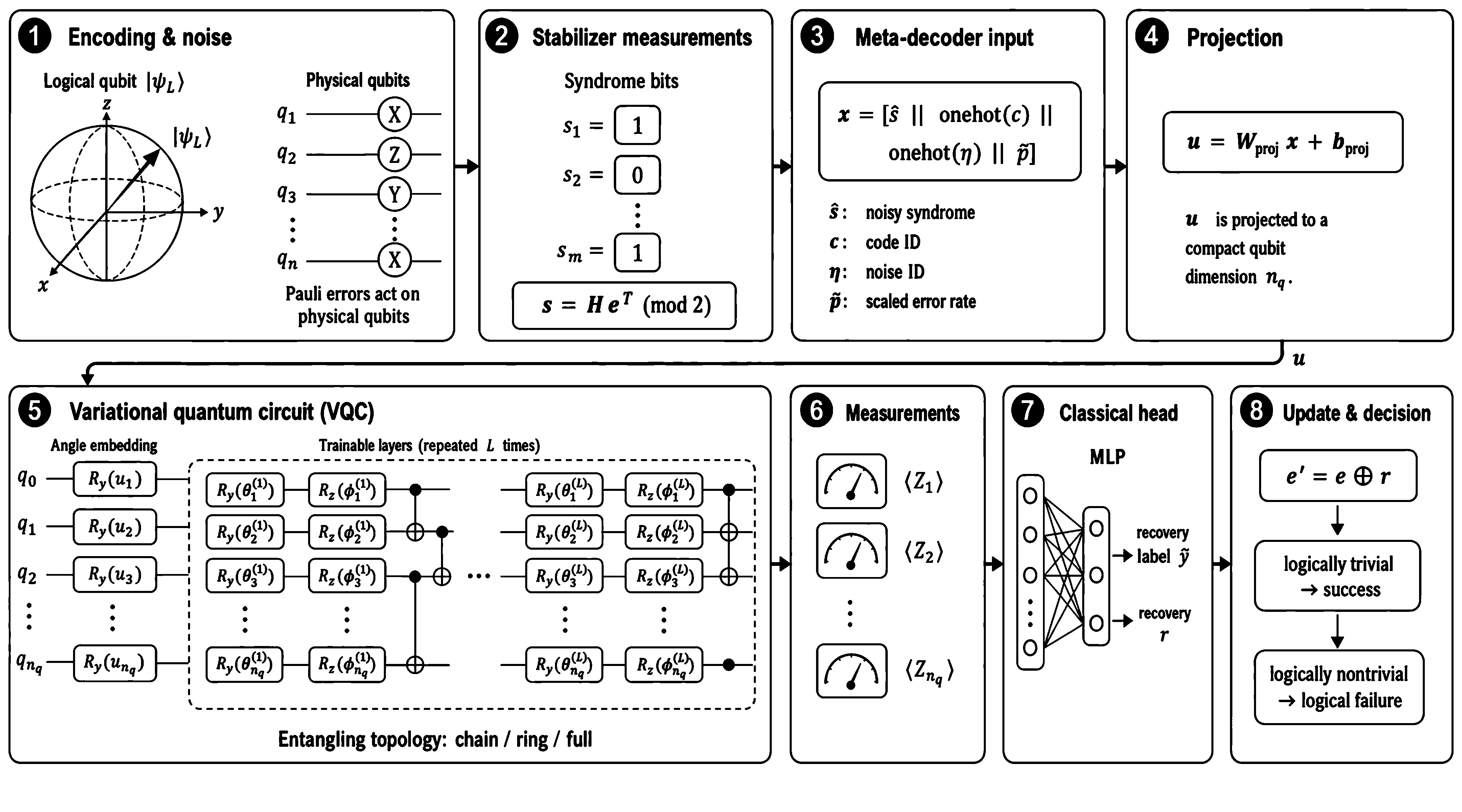
A quantum computer is like an orchestra where each musician is a fragile qubit. The slightest noise, and the melody falls out of tune. To keep the harmony, you need a conductor who instantly hears the false notes and brings the instruments back into line. In the quantum world, such a conductor is called a decoder.
Usually, each score (correction code) and each type of interference (noise) gets its own conductor. But what if the hall changes and the notes get lost? The researchers proposed a meta-decoder — a system that learns to conduct different ensembles under different conditions. Like an experienced maestro, it grasps the essence on the fly: after seeing a couple of examples, it adapts to a new code or unfamiliar noise.
So the authors added a safety net: if the meta-decoder's confidence is low, it hands over control to a proven conductor. With this backup, the logical error rate dropped almost to the reference level: 1.71 times higher for the classical version and 1.11 for the quantum one. The orchestra keeps playing even when the usual supports disappear.
This is how a universal ear for quantum computing is born. Instead of building a new conductor for every concert, you can train one — flexible, fast, and cautious. When in doubt, it does not improvise but trusts a senior colleague. It is this combination of learning and caution that promises to make quantum computers truly reliable.
Original abstract
as written by the authors arXiv:2607.10707
We propose a unified meta-decoding framework for quantum error correction that learns syndrome-to-recovery mappings across multiple stabilizer codes and noise settings, without requiring separate decoders for each configuration. The benchmark includes FiveQubit, Steane, Planar3x3, and Planar5x5 codes, four noise families, and five evaluation regimes: interpolation, unseen-p transfer, unseen-noise transfer, few-shot unseen-code adaptation, and few-shot held-out-size adaptation. We compare a classical Meta-MLP teacher-trained baseline with variational quantum circuit (VQC) meta-decoders selected through hardware-aware quantum architecture search over qubit count, circuit depth, and entangling topology. The Meta-MLP achieves teacher-label accuracies of 0.9993, 0.9118, 0.9342, 0.6304, and 0.7548 across the five regimes, while the hardware-aware VQC achieves 0.9400, 0.8495, 0.8415, 0.5678, and 0.7143. However, logical-level evaluation shows that high teacher-label accuracy alone is insufficient in the most challenging Planar5x5 setting. During interpolation, the raw logical-failure ratios relative to the teacher are 12.08 and 25.91 for the Meta-MLP and VQC, respectively, whereas confidence-gated fallback reduces them to 1.71 and 1.11. These results support confidence-aware selective recovery rather than unconditional teacher replacement.
The quantum meta-decoder was tuned using architectural search — the algorithm varied the number of qubits, circuit depth, and entanglement topology, like a LEGO set for quantum circuits.