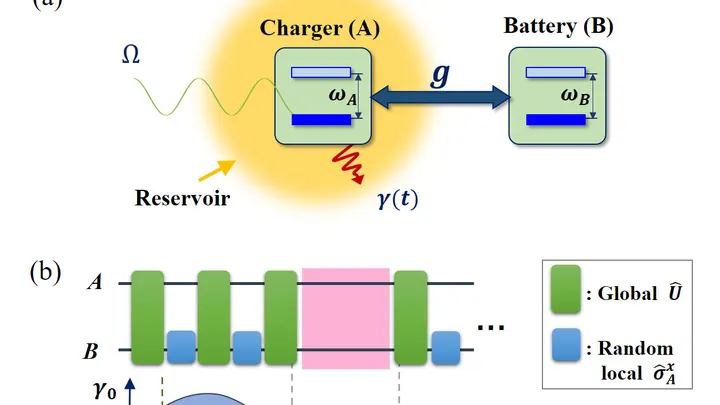
Quantum batteries are microscopic energy storage devices that exploit quantum effects to charge faster or store more energy than classical batteries. However, they are fragile: interactions with the environment cause decoherence and energy leakage, quickly draining the stored energy. Quantum battery protection involves using quantum error correction techniques — originally developed for quantum computers — to shield the battery from these harmful effects. The goal is to maintain the battery's quantum state long enough to extract useful work.
History
The concept of quantum batteries was introduced in 2013 by Alicki and Fannes. The application of quantum error correction to protect them emerged in the late 2010s, with theoretical proposals for autonomous error correction using engineered dissipation.
How it works
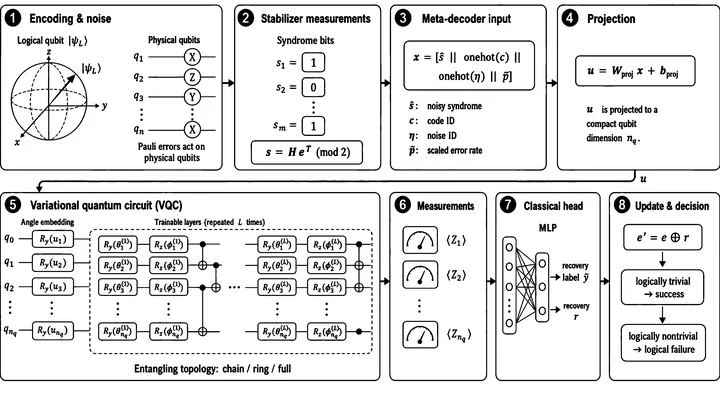
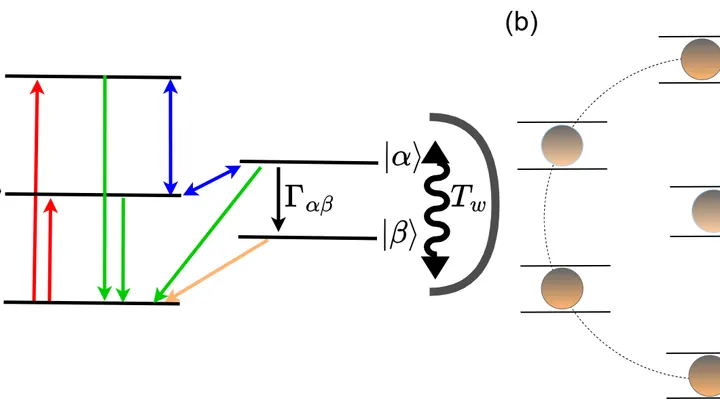
A quantum battery typically consists of a set of qubits (two-level quantum systems) that can be charged collectively. The protection scheme encodes the battery's state in a larger Hilbert space using redundant qubits, so that errors (like energy loss or phase flips) can be detected and corrected without measuring the battery itself. For example, using a stabilizer code, one can continuously monitor error syndromes and apply corrective operations to restore the ideal state. Alternatively, topological protection — such as braiding of Rydberg atoms — can make the battery's state inherently robust against local perturbations, as the information is stored non-locally.
In practice
Quantum batteries are still experimental, but protection schemes are essential for any practical implementation. They are being explored for ultra-fast charging in quantum devices and for energy storage in quantum thermodynamic cycles.
Fun fact
In 2022, a theoretical study showed that a quantum battery protected by a topological code could be charged infinitely fast in the ideal limit, though practical constraints still apply.
Any battery, from a AA to a quantum one, is simple in principle: there's a store of energy, and there's a way to get it out. In the quantum world, this 'way' looks like a careful switching between particle states, akin to moving a ball from a high shelf to a low one.
A quantum computer is like an orchestra where each musician is a fragile qubit. The slightest noise, and the melody falls out of tune. To keep the harmony, you need a conductor who instantly hears the false notes and brings the instruments back into line.
A lithium battery is like a tiny city: lithium ions are the residents who move between electrode neighborhoods, generating current. But to understand how much energy the city can deliver, you need to know not only the street layout (the material's structure) but also how residents interact with neighbors, transportation, and even the weather.
The atomic nucleus is a natural spring of colossal power. When the protons and neutrons inside it rearrange, it enters a special long-lived state — a nuclear isomer. It stores energy like a spring compressed to its limit.
Quantum batteries harness quantum effects to circumvent the limitations of ordinary devices imposed by entropy — a measure of disorder and energy losses. Imagine a bucket under a powerful jet: filling is lightning-fast. But the bucket has holes: the environment constantly drains the energy.
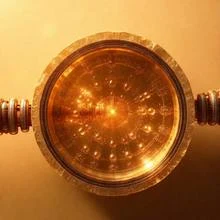
Ordinary batteries lose charge like tea cools down. A quantum battery works differently: its heart is a tiny cavity with darting photons. If you illuminate it with special photon pairs, energy flows into a chain of qubit cells instantaneously — much like a swing gets a boost from strong pushes.
An ordinary battery in a phone stores energy in chemical bonds — slowly, with heat and wear. A quantum capacitor works differently: it charges not with matter but with rhythm. A swing that is pushed in time with its motion accumulates energy in the motion itself, without friction.
A quantum battery is not a box of chemicals but a chain of tiny magnets (spins) capable of storing energy. Its main trick: charge many particles at once, using their quantum entanglement. But there's a catch — not all entanglement works.
An optical tweezer is a laser beam that holds an atom in place, much like fingers holding a pea. Arrays of these tweezers form the basis of future quantum computers. But there's a catch: not every tweezer catches an atom. Typically, only half of the traps get filled, and for molecules, even fewer. Empty spots break the whole setup.
Steam rising from hot metal is a familiar sight in the kitchen. But if you use rubidium instead of water, that cloud becomes a battery. It doesn't run on chemical reactions but on the quantum coordination of atoms.
In quantum batteries, charging can be accelerated by shuffling the steps in time, like a deck of cards. Instead of a smooth energy climb, you get abrupt efficiency explosions, like microscopic supernovae inside atoms.
The quantum battery works like a sponge that absorbs light but won't release it without a forced squeeze. The inspiration came from bacteria's natural solar traps: capturing solar photons, they transfer energy almost losslessly, as proven by spectroscopy.
A quantum dot is a box so small that an electron inside cannot have just any energy, but only strictly defined values, like the steps of a staircase. Each step can accommodate several electrons, but exactly how many is the question. If a step is double, two electrons can stand on it; if single, only one.
A quantum battery is a device that stores energy in the quantum states of particles. In the new work, the battery was modeled as a pair of qubits — the tiniest carriers of information that can be in a "zero" state, a "one" state, or a mixture of both.
A quantum computer is like an orchestra where every musician plays their part, but the slightest thing throws them off. Errors in qubits happen constantly: an instrument goes out of tune, a musician misses a note. Usually, the conductor has to guess who made the mistake, and that's really hard.
Inside a battery, like a layered cake, different solid layers sit side by side. The meeting point, the interface, behaves capriciously: stresses concentrate there, and over time the battery ages. To understand these processes, we need computer models that see every atom. But accurate calculations are too expensive, and fast ones are too crude.
For two atomic nuclei to fuse, they must overcome their fierce electric repulsion — like trying to bring two angry bulls together. Normally, only monstrous energy does the trick, as in stellar cores, where Hans Bethe explained fusion back in the 1930s.
Quantum batteries lose energy due to entropy — the tendency toward disorder. Just as parallel wires pick up interference, the battery's contacts with the environment create leakage channels. The solution: braid the giant atoms, which act as both charger and storage, into a braid.
An orchestra without a conductor, where each musician hears only the hall's echo, can create a powerful melody. That's how a quantum battery works: many particles, immersed in a warm environment, don't dissipate heat but exchange it synchronously. Instead of chaos, an orderly charge emerges.
A pendulum receives a kick but returns to its starting position not after one period, but after two. That is how a discrete time crystal behaves: a phase of matter that spontaneously breaks discrete time-translation symmetry and oscillates with a period that is a multiple of the driving period.
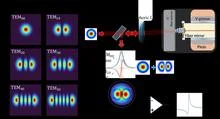
Tuning a string: higher harmonics help hold the pitch without drowning out the fundamental note. In an optical microcavity, a tiny resonator made of two mirrors, light bounces between the reflective surfaces, and any jitter in the spacing knocks it off resonance.
A quantum battery is not a box of electrolyte but a handful of atoms or superconducting loops, with energy stored in excited states. It can be charged in fractions of a second using collective quantum effects.