Interpolation is a mathematical technique for estimating values that lie between known data points. When you have a set of measurements or observations, interpolation lets you fill in the gaps by assuming a smooth or predictable relationship between the points. It is distinct from extrapolation, which tries to guess values outside the observed range — interpolation stays within the known boundaries, making it a safer and more reliable operation.
History
The concept dates back to ancient astronomers and mathematicians, but a formal treatment emerged with Newton's forward difference formula in the 17th century and later with Lagrange's polynomial method in the 18th century.
How it works
The simplest form is linear interpolation, which draws a straight line between two adjacent points and reads off the value at any position along that line. More sophisticated methods, such as polynomial or spline interpolation, fit higher-order curves through multiple points to capture curvature and produce smoother results. The choice of method depends on the nature of the data and the required accuracy.
In practice
Interpolation is used everywhere from image resizing in digital photography to reconstructing continuous signals from discrete samples in audio processing, and in scientific computing to approximate functions that are expensive to evaluate directly.
Fun fact
The term comes from the Latin 'interpolare', meaning 'to refurbish' or 'to alter', which originally referred to touching up old manuscripts.
The orchestra plays without a conductor. Each instrument follows its own schedule: the violin on Monday, the flute on Wednesday, the timpani on Saturday. Astronomers hear not music but isolated notes scattered across the calendar. A telescope sees a star only when it is above the horizon and when the schedule has allotted time for it.
A black hole devours everything, even light. Yet it obeys the laws of physics: it possesses entropy — a measure of the hidden information an object 'remembers.' In the 1970s, Jacob Bekenstein and Stephen Hawking discovered a strange pattern: a black hole's entropy grows not with its volume, but…
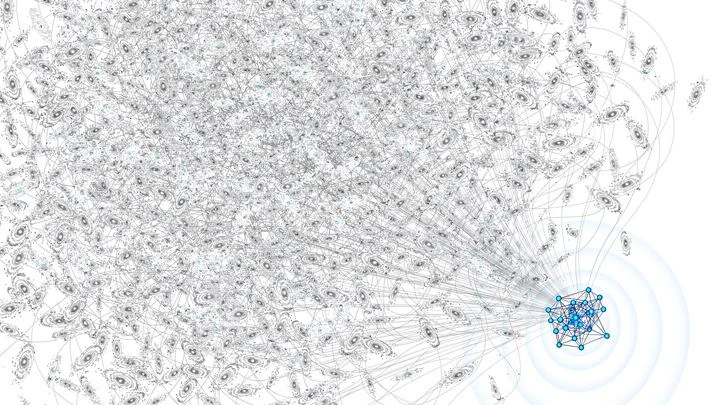
Look into the night sky — before you is not a scattering of lights, but a multi-layered manuscript. Under the bright ink of stars and galaxies appears a faded, almost erased text.
The early universe expanded at a breakneck pace: this phase is called inflation. But how exactly did it do it? Some models describe the expansion as a steep exponential surge, others as a more gentle power-law motion.
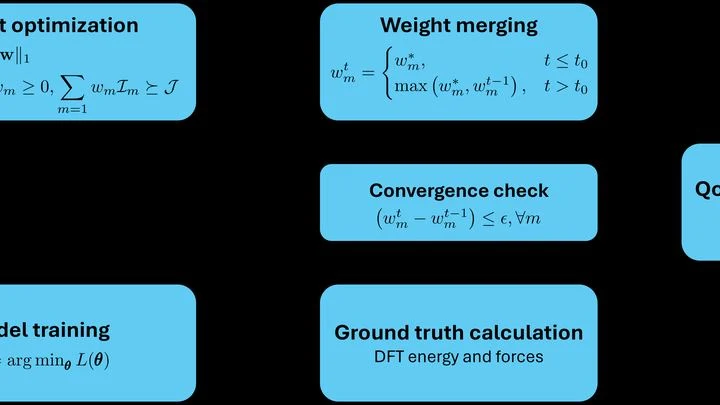
A chef doesn't waste ingredients cooking the whole dish to check the taste: they just taste a drop of sauce. The same logic underlies the "information matching" method for predicting metal strength. Instead of expensive calculations of every atom's behavior, scientists "taste" only simple indicators linked to plasticity — a metal's ability to bend without breaking.
Earth's magnetic field is like an invisible river that meanders beneath our feet. Navigators and geologists rely on maps of this river, but instruments only take readings at scattered points, leaving blank spots in between. Filling those gaps is like trying to sketch the river's course from a few pebbles found on the bank.
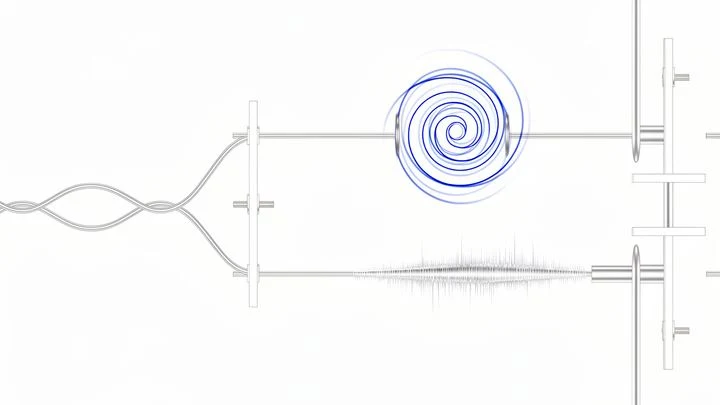
Niels Bohr insisted: you cannot simultaneously know which path a photon took and see interference. For a long time, this was considered a limitation of knowledge — we simply cannot obtain both types of information at once.