Quantum Error Correction Learns on the Fly express
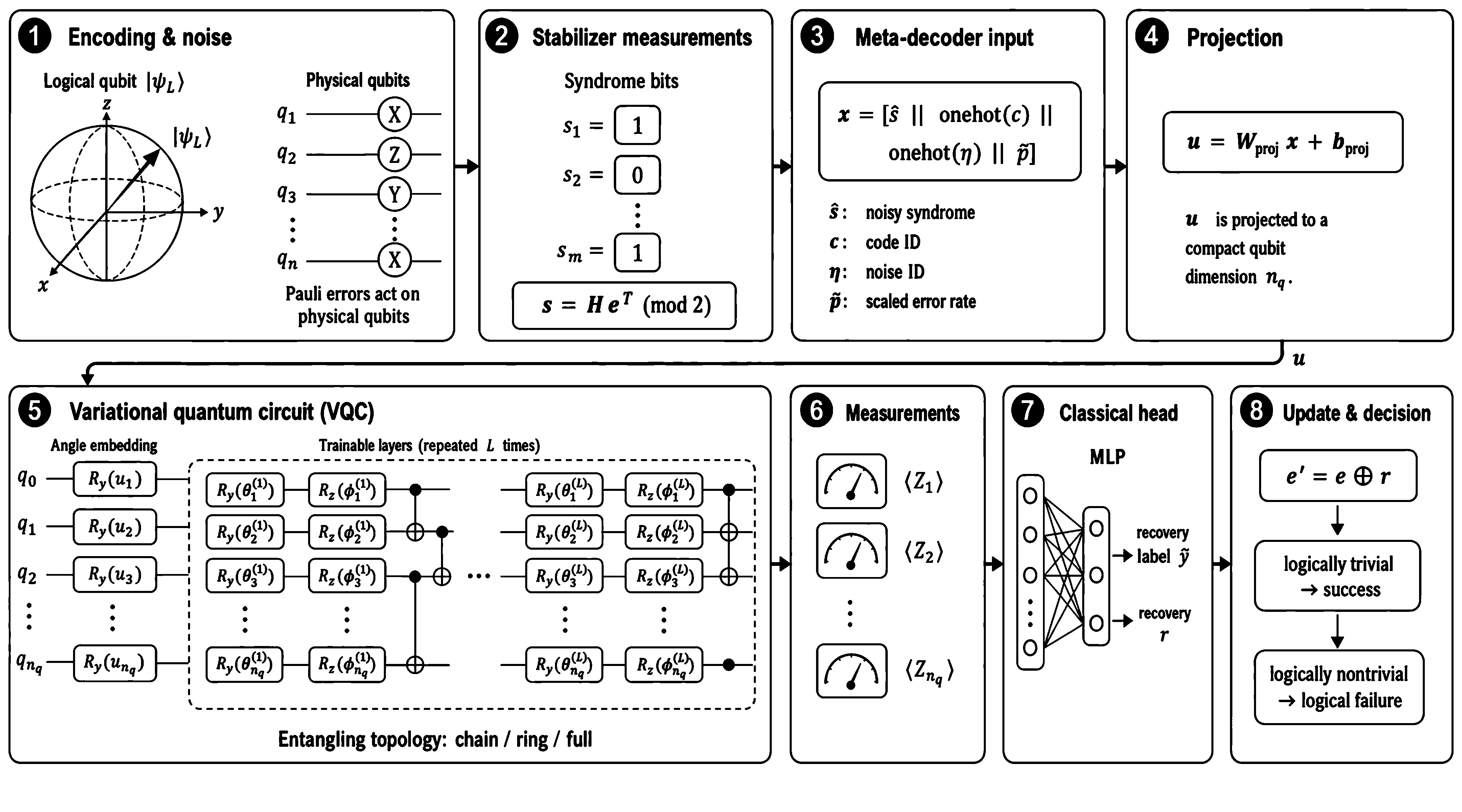
A quantum computer is like an orchestra where each musician is a fragile qubit. The slightest noise, and the melody falls out of tune. To keep the harmony, you need a conductor who instantly hears the false notes and brings the instruments back into line. In the quantum world, such a conductor is called a decoder.
Usually, each score (correction code) and each type of interference (noise) gets its own conductor. But what if the hall changes and the notes get lost? The researchers proposed a meta-decoder — a system that learns to conduct different ensembles under different conditions. Like an experienced maestro, it grasps the essence on the fly: after seeing a couple of examples, it adapts to a new code or unfamiliar noise.
So the authors added a safety net: if the meta-decoder's confidence is low, it hands over control to a proven conductor. With this backup, the logical error rate dropped almost to the reference level: 1.71 times higher for the classical version and 1.11 for the quantum one. The orchestra keeps playing even when the usual supports disappear.
This is how a universal ear for quantum computing is born. Instead of building a new conductor for every concert, you can train one — flexible, fast, and cautious. When in doubt, it does not improvise but trusts a senior colleague. It is this combination of learning and caution that promises to make quantum computers truly reliable.
The quantum meta-decoder was tuned using architectural search — the algorithm varied the number of qubits, circuit depth, and entanglement topology, like a LEGO set for quantum circuits.