A Magnetic Staircase of Crystals express
A magnetic field of 42 tesla — about a million times stronger than Earth's field. In such a field, the crystal SrCu₂(BO₃)₂ behaves unusually: its magnetization doesn't increase smoothly but in jumps, pausing at specific values. Previously, it was thought that these plateaus arise when electron spins (their tiny magnetic arrows) align in a strict geometric pattern, like soldiers in formation.
But tensor network calculations suggested a different picture. On the plateaus at 1/8 and 2/15 of full saturation, electrons don't stand alone but pair up with spin 2. These pairs behave as independent particles and freeze into a regular lattice — resulting in a crystal made of pairs. Physicists call this a Wigner crystal of bound states.
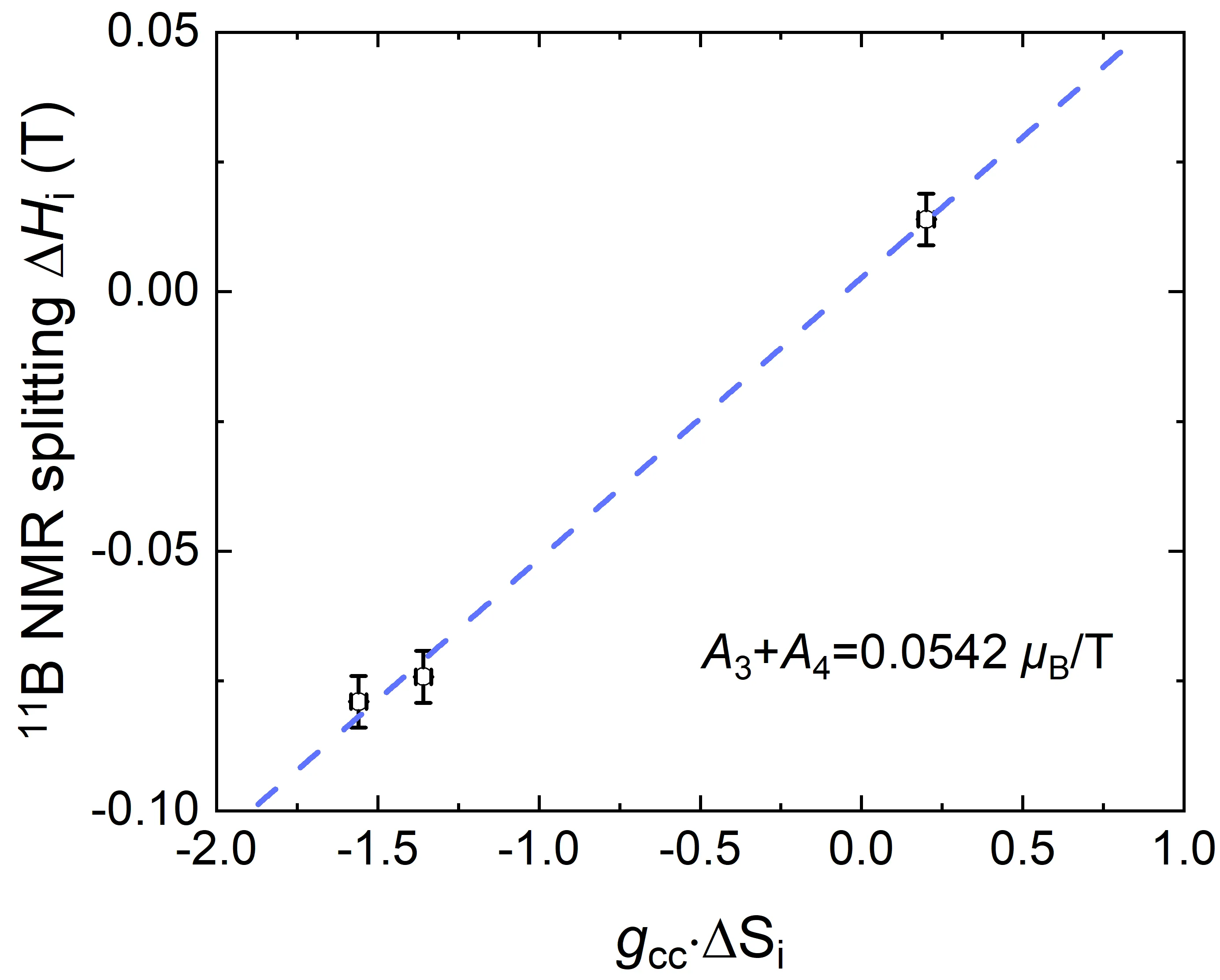
To test the hypothesis, the authors used nuclear magnetic resonance on copper-63 and copper-65 nuclei in fields up to 41.9 tesla. Spectra at the 1/3 plateau helped calibrate the model, then data for 1/8 and 2/15 were compared with predictions. The result matched the paired scenario exactly. The version with a crystal of single triplets (bound electron-hole pairs) did not fit.
This mechanism, a Wigner crystal of bound states, had not been considered before as a basis for magnetic plateaus. Now it is a new fundamental scenario that could also work in other quantum magnets.
The 42-tesla field used in the experiment is strong enough to lift a small car: that's how powerful the magnet is.
The idea of a crystal made of paired particles evokes the 'ice-nine' from Kurt Vonnegut's novel Cat's Cradle, where water froze into an unusual form upon contact with a special substance.