Landau levels are the discrete, quantized energy states that a charged particle (like an electron) can occupy when moving in a uniform magnetic field. In classical physics, an electron in a magnetic field spirals in circles with a continuous range of energies. Quantum mechanics, however, restricts these orbits to a set of evenly spaced energy levels, named after Lev Landau who derived them in 1930. The spacing between these levels is proportional to the magnetic field strength, so stronger fields push the levels further apart.
History
Lev Landau first derived these quantized energy levels in 1930 while working on the theory of diamagnetism. The concept became central to understanding the quantum Hall effect discovered by Klaus von Klitzing in 1980, which earned him the Nobel Prize in 1985.
How it works
The quantization arises because the electron's wavefunction must be single-valued around its circular orbit, just like a standing wave on a ring. This imposes a condition that the magnetic flux through the orbit is an integer multiple of the flux quantum. The resulting energy levels are given by E_n = ħω_c(n + 1/2), where ω_c is the cyclotron frequency and n is a non-negative integer. In two-dimensional systems, each Landau level can hold a fixed number of electrons per unit area, leading to the integer quantum Hall effect when levels are partially filled.
In practice
Landau levels are essential for understanding the quantum Hall effect, which is used to define the standard of electrical resistance. They also play a role in the design of quantum dots and in studying the electronic properties of graphene under strong magnetic fields.
Fun fact
In graphene, the Landau levels are not evenly spaced but follow a square-root dependence on the magnetic field, a signature of its unique relativistic-like electron behavior.
In some crystals, electrons are not spread uniformly but arrange themselves into a strict checkerboard: one cell has more electrons, the neighboring cell has fewer. Such a pattern is called charge order, and for a long time it was considered something frozen, like a pattern on frosty glass.
A laser pulse slams into a gas cloud and knocks electrons out of it, leaving behind a bubble: a cavity almost devoid of particles. This bubble races through the plasma at nearly the speed of light, and its walls drag along the electrons trapped inside, much like a speedboat tows a water skier.
A laser hits an atom, and tears out an electron. The brighter the light, the stronger the kick, and the faster the electron flies away. That's how the familiar picture works, where light is a smooth wave. But what if the light isn't smooth but 'squeezed,' with quantum fluctuations, like the trembling of a string?
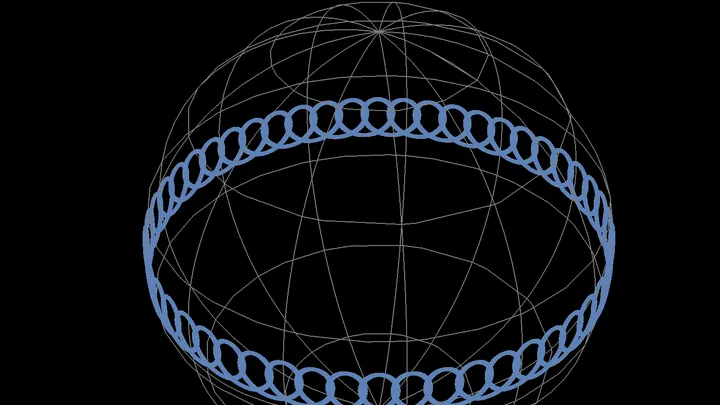
In a ring accelerator, a beam of electrons circles millions of times. If the electrons are twisted like strands in a rope, their vortex motion should persist. But along the way, random jolts from imperfect magnets can disturb them.
Scientists have described how vortex motion changes under such perturbations.
10¹⁵ Gauss — that's the magnetic field found on some white dwarfs. It is billions of times stronger than what a compass shows on Earth. A white dwarf is not a star in the usual sense, but a cooled core the size of a planet. Inside, gravity opposes the pressure of degenerate electrons.
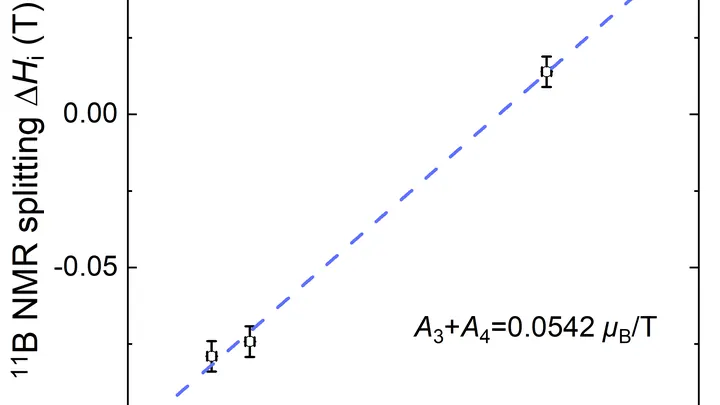
A pale green crystal was placed in a magnetic field and cooled below one kelvin — almost to absolute zero. Inside it hide chains of copper atoms that behave like tiny magnetic needles. Usually their orientation is chaotic, but the strong field and cold make the needles align in a unified impulse, like soldiers on a parade ground.
A tiny magnetized sphere floats in a vacuum, held by invisible fields. It starts to spin around the axis of the magnetic field, just like a top that's been given a gentle nudge. That's precession. But when the sphere becomes really small, quantum laws come into play.
A magnetic field of 42 tesla — about a million times stronger than Earth's field. In such a field, the crystal SrCu₂(BO₃)₂ behaves unusually: its magnetization doesn't increase smoothly but in jumps, pausing at specific values.
Imagine a slide with three dips: the deepest one is a stable position for a ball, the middle one is precarious. A slight push and the ball rolls down. Yet, constant vibration of the right strength can hold it in the middle hollow for a long time.
In the 1950s, physicists Lee and Yang discovered that all states of matter are separated by invisible points in the world of imaginary numbers.
A long chain of atoms, each a tiny magnet. They talk to each other and to a common field, like musicians in an orchestra who hear both the conductor and their neighbors. When the external field changes, the orchestra either plays out of sync or all instruments come in together: that's a quantum phase transition.
Gravity is a cosmic net: massive bodies stretch it, and lighter objects roll along its curves. But in the world of atoms, this net begins to tremble chaotically, producing infinite values in the equations. Spacetime curvature ceases to be smooth.
Usually, quantum corrections to gravity explode into infinities.
The magnetic field increases, but the magnetization stays put. It's like a scale where you add weight, yet the needle doesn't move until enough has accumulated to jump to the next mark. That's exactly how rare-earth tetraboride crystals behave, and physicists have been puzzled for decades.
A magnetic field in plasma resembles a stretched soap film: pressure from inside pushes it out, while surface tension pulls it in, giving it shape. Here too, magnetic pressure and tension forces balance each other.
A palm hovering over a hot stove feels the heat even when the surrounding air seems cool. Something similar happens to electrons in the Aharonov–Bohm effect: the particle senses an electric voltage even though it enters a region where the field has already been switched off.
A drop of water stretches in a strong electric field. The deuterium nucleus, a bound pair of a proton and a neutron, behaves the same way, except here the field comes from a passing gamma ray, and instead of just stretching, the nucleus can simply fall apart.
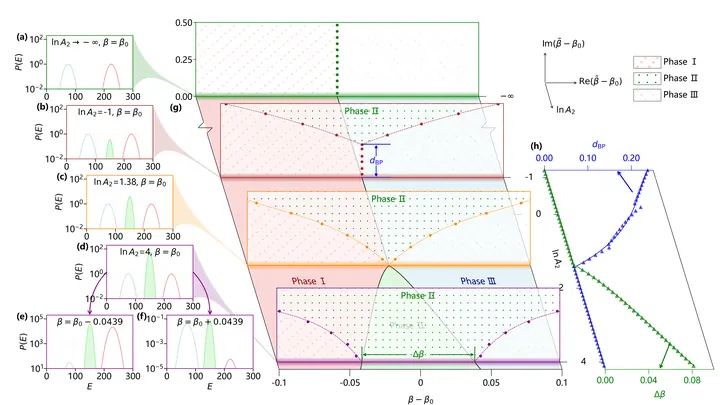
If you drop an ice cube into a glass of water, it will float until it melts. But if you cool the water slowly, at some point it all freezes at once: that's a first-order phase transition: abrupt, with a clear boundary.
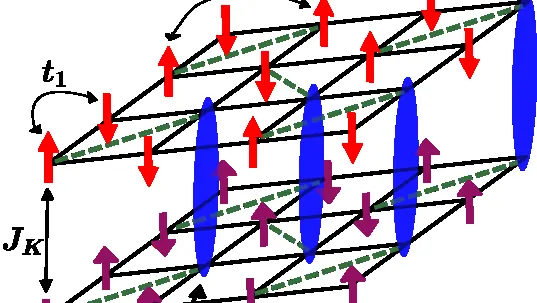
Imagine a triangular grid with tiny magnetic arrows at each node. Electrons, the charge carriers, run across this grid. Usually, the arrows align simply: all pointing the same way (ferromagnet) or alternating in the plane.
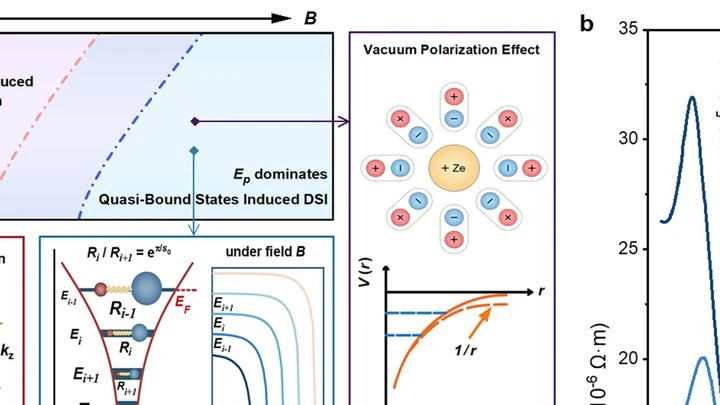
In the crystal HfTe5, electrons behave almost like light: their mass is so small that they obey the laws of relativity. If you place such a crystal in a strong magnetic field, the electrons start to circle in tiny orbits. Their energy then changes not smoothly but in steps, like floors in a building.
A magnetar is a neutron star with a magnetic field hundreds of millions of times stronger than Earth's. If you brought an ordinary magnet near such a field, it would instantly lose its magnetism, and atoms would stretch into thin filaments.
The quantum world loves order, but reality often brings disorder. In this work, physicists study one-dimensional chains of spins — tiny magnetic arrows that can point up or down. Usually, topological phases (stable states protected by symmetry) are defined for pure states, where each arrow is precisely known.
A sheet of carbon just one atom thick is placed in a strong magnetic field and cooled to thousandths of a degree above absolute zero. A microwave microscope slides along the sheet's edge, measuring how well that edge conducts electricity.
A sheet of graphene is a lattice of carbon atoms arranged like a honeycomb. Electrons in it zip around so fast they seem to have no mass, just like light. When a powerful laser pulse hits such a sheet, the electrons get a kick and start accelerating. Their path can be compared to a road with occasional barriers — the forbidden zones.