A bound state is a quantum system where particles are held together by forces, resulting in a total energy lower than that of the same particles when separated. This energy deficit is what makes the state stable—it takes energy to break it apart. Bound states appear everywhere in physics: atoms are bound states of electrons and nuclei, nuclei are bound states of protons and neutrons, and even protons themselves are bound states of quarks. The concept is fundamental to understanding why matter is stable and why chemical reactions release or absorb energy.
History
The concept of bound states emerged with the development of quantum mechanics in the 1920s, particularly through the work of Erwin Schrödinger and Max Born, who explained the discrete energy levels of the hydrogen atom as bound states of the electron-proton system.
How it works
In quantum mechanics, a bound state corresponds to a solution of the Schrödinger equation with a discrete energy eigenvalue that lies below the potential energy at infinity. The wavefunction of a bound state is localized in space, decaying exponentially outside the potential well. The binding energy is the difference between the bound state energy and the free-particle energy, and it determines how much energy is needed to ionize or dissociate the system.
In practice
Bound states are exploited in technologies like lasers (where electrons are bound in atoms and transition between levels), in nuclear reactors (where neutrons are bound in nuclei), and in quantum computing (where qubits are often implemented as bound states in quantum dots).
Fun fact
The existence of bound states is what makes chemistry possible—without them, electrons would not stay attached to nuclei, and atoms would never form molecules.
A layered cake of molybdenum disulfide MoS2 sits on the lab bench. It is prepared in the usual way: adhesive tape peels off the top layers to obtain a thin sample. But beneath the tape remains an invisible cavity where the atomic floors are no longer pressed together. It is there that electrons begin to behave differently than in the crystal bulk.
In nature's workshop, there is a strange lathe: it cuts threads on screws but forbids left-handed ones. You can tighten a screw as much as you like, in any clockwise direction, but counterclockwise is not allowed. This lathe is not a fantasy but an exact quantum rule that physicists have just built for magnetic materials.
Dancers on a stage with moving walls: particles in a finite quantum system collide with each other and reflect off the edges, but the walls can move according to a prescribed scenario. Physicists have long been able to describe such dances only with fixed walls or in an infinite hall. Now there is a way to account for both the motion of the walls and the reflections from them.
A thin silver thread nearly as long as a hair's width, and inside it, pristine quantum laws hold sway. Physicists built a conductor where electrons can only move forward or backward, like on a perfectly straight single-lane road with no shoulders. On such a road, any pothole or pebble would normally destroy the fragile quantum state.
The proton is not a solid ball but a tiny prison. Inside it, three quarks are locked up, and the gluon field keeps them from escaping — something like invisible threads that only grow stronger if the quarks try to move apart.
Boiling water in a pot is a good place to start. Bubbles of steam rise, pop, and the surface settles down. Something similar might have happened in the first moments of the universe's life with a special field filling space: bubbles of a new phase inflated and collided, like islands of steam in liquid.
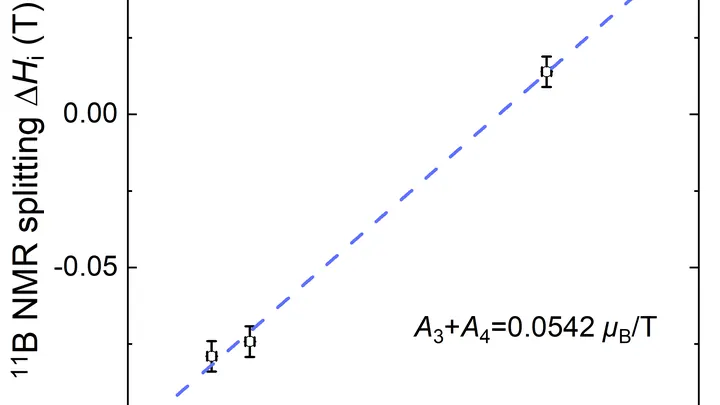
A magnetic field of 42 tesla — about a million times stronger than Earth's field. In such a field, the crystal SrCu₂(BO₃)₂ behaves unusually: its magnetization doesn't increase smoothly but in jumps, pausing at specific values.
Quantum entanglement — a phenomenon where the states of two or more particles become interconnected regardless of the distance between them — usually links intrinsic properties such as spin or polarization. However, a new experiment has for the first time realized entanglement of the positions of two atoms in space.
Light or sound can be confined in a tiny region of a crystal, like a pearl in a shell. Usually, two methods are used. The first is like a heavy ball in a pit: a particle with large mass simply cannot roll out. The second is a perfect cage of mirrors, where waves cancel each other everywhere except in the trap itself.
A lone fold runs across a taut sheet — a sharp drop in height that doesn't spread out but moves as a whole. Physicists call such a fold a 'kink'. If you give the sheet a sharp tug in one spot, ripples will travel across it. But in some media, these ripples don't disperse; instead, they gather into a clump and tremble in place for dozens or hundreds of cycles. Such a clump is an oscillon.
In the mountains, there is a saddle — a point where the trail from one valley crosses over into another. Standing exactly on it, you take a step and are already descending the new slope. In chemistry, such a place is called the transition state: a brief moment when atoms are frozen on the threshold of transformation.
Inside a neutron star, matter is squeezed so hard that atomic nuclei stop being separate clumps. Neutrons and protons get closer together, and their innards, quarks, begin to feel their neighbors through the walls of their 'bags'.
A neutron star is a sphere about the size of a small city but with a mass of one and a half Suns.
A child on a swing: too strong a push and they fly off. Roughly this is how powerful light tears electrons out of an atom. It would seem that the stronger the push, the more certain the destruction. But in the quantum world it is different: when the field strength crosses a certain threshold, the atom suddenly freezes.
An ordinary magnet always carries two poles — north and south. Split it in half, and each piece immediately grows its own pair. But deep in particle theory lives a strange notion: the monopole — a particle carrying just one magnetic charge, a lone pole without a partner.
Sometimes an unwelcome guest sneaks into the equations, like a creaky floorboard that unsettles the whole house. In gravity theories, if you add curvature-squared terms to the equations (which you need to describe very strong fields), a ghost particle appears — heavy but with negative energy.
The atomic nucleus is not a solid ball but a dense swarm of tiny particles called quarks, glued together by a special glue (the strong force). In light nuclei, such as calcium, this swarm is simply arranged: the numbers of the two quark types, up and down, are almost equal, like the white and black keys in an octave.
If you try to break a proton apart and pull out a quark, you're in for a surprise. Ordinary forces, like the electric force, weaken as particles fly apart. Here, it's the opposite. The farther a quark gets from its neighbors, the harder it's pulled back.
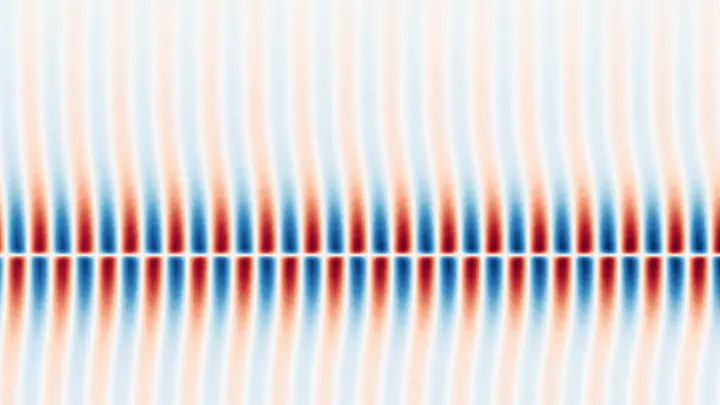
A struck tuning fork fades: its vibrations leak into the air. But there are systems where the oscillation does not decay, even though there are plenty of free waves around, ready to carry energy away. Physicists call such 'captured' states bound states in the continuum (BIC).
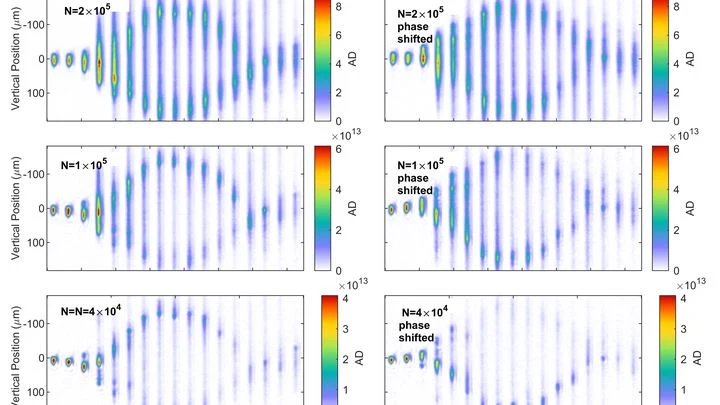
Atoms settled along a chain of traps, like a line of coastal forts. Nearby, a quantum sea: a Bose-Einstein condensate (a substance with zero resistance, where particles move as a single wave).
An ordinary proton consists of three quarks, like a three-legged stool. But nature does not forbid assembling a 'chair' from four quarks, if two of them are heavy beauty quarks and two are light. Such particles are called tetraquarks, and until now they have been studied mainly at large accelerators, by colliding particles and sifting through the debris.
A rubber band is stretched, and suddenly snaps. In the atomic world, a similar picture emerges: the string binding particles can break. In a new study, physicists took a chain of Rydberg atoms and tracked how such a string breaks.
Under weak tension, the string breaks completely, and the system splits into several independent pieces, as if a rubber band shattered into segments.
A superconducting qubit is a tiny electrical circuit that behaves like an artificial atom. In its normal state, current flows through it without resistance, and the energy levels are evenly spaced, like steps on a staircase. But if a single electron gets stuck in the circuit, everything changes.
In the quantum world, a collision between particles doesn't destroy their individuality but ties them into an inseparable knot: internal states and motions become intertwined like threads in an intricate tapestry.
When an extra neutron is added to an atomic nucleus, it starts behaving like an overfilled cup: one more drop and it spills over. Physicists at the French facility GANIL orchestrated such a 'pass' of a neutron from a deuteron (the nucleus of heavy hydrogen) to an oxygen-19 nucleus.
An ultracold atomic cloud, resembling fog, hints that gravity might not work as Newton said. On the outskirts of galaxies stars move faster than expected, and MOND theory tweaks the law of gravitation over large distances, removing the need for dark matter.