The proton spin puzzle is a long-standing mystery in particle physics. Protons are composite particles made of quarks and gluons, and they possess an intrinsic angular momentum called spin. Naively, one might expect that the spin of the proton is simply the sum of the spins of its three constituent quarks. However, experiments in the 1980s revealed that the quarks' spins contribute only about 30% of the proton's total spin, leaving the remaining 70% unaccounted for. This discrepancy between theoretical expectation and experimental measurement is the puzzle.
History
The puzzle was discovered in 1987 by the European Muon Collaboration (EMC) at CERN, which found that the quark spin contribution was much smaller than expected. This result was so surprising that it was initially met with skepticism, but it was later confirmed by experiments at SLAC and DESY. The puzzle remains an active area of research, with experiments at RHIC, JLab, and the LHC continuing to probe the gluon and orbital contributions.
How it works
The proton's spin is a quantum mechanical property that arises from the combined contributions of its constituents: the intrinsic spin of quarks and gluons, as well as their orbital angular momentum. The puzzle arises because the quark spin contribution, measured through deep inelastic scattering experiments, is much smaller than predicted by simple quark models. The missing spin must be carried by gluon spin and the orbital angular momentum of both quarks and gluons. Measuring these components requires sophisticated experiments involving polarized beams and targets, as well as complex theoretical calculations in quantum chromodynamics (QCD), the theory of strong interactions.
In practice
While the proton spin puzzle has no direct technological applications, it drives the development of advanced particle accelerators, polarized targets, and detection technologies, and it deepens our fundamental understanding of the strong force that binds matter.
Fun fact
The proton spin puzzle is sometimes called the 'spin crisis' because it challenged the naive quark model, leading to a fundamental rethinking of how composite particles acquire their quantum numbers.
The proton is not a solid ball but a tiny prison. Inside it, three quarks are locked up, and the gluon field keeps them from escaping — something like invisible threads that only grow stronger if the quarks try to move apart.
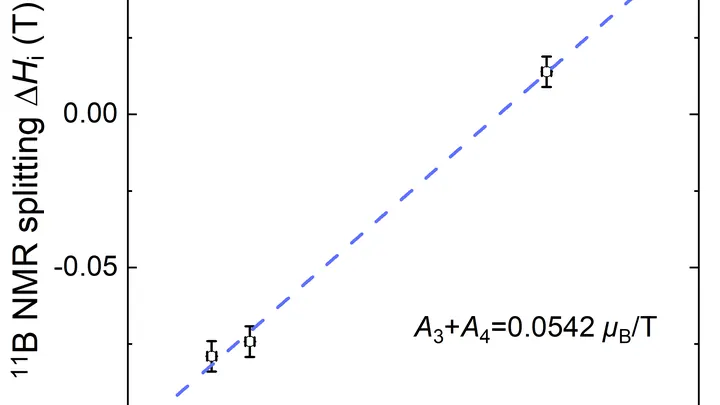
A magnetic field of 42 tesla — about a million times stronger than Earth's field. In such a field, the crystal SrCu₂(BO₃)₂ behaves unusually: its magnetization doesn't increase smoothly but in jumps, pausing at specific values.
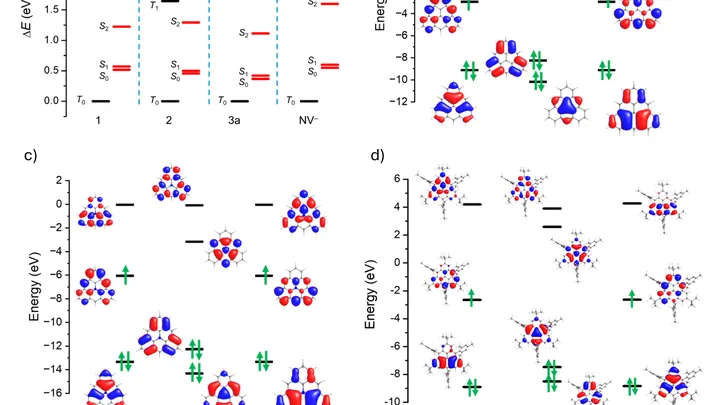
At the heart of a future quantum computer might lie a tiny organic molecule shaped like a triangle. It has two 'extra' electrons that don't pair up. Such molecules are called diradicals, and their electrons can store information in a special, quantum way.
Imagine an orchestra where every musician plays their own part without listening to the others. Suddenly, without any visible command, neighboring musicians begin to sync perfectly, yet there is still no overall melody.
Every quantum particle has spin — an intrinsic magnetic property, like a tiny arrow. In an experiment, a beam of such particles passing through a magnet splits in two, like a coin that lands either heads or tails. That’s exactly how particles like a hydrogen atom behave.
Imagine a spinning top the size of a city, weighing more than the Sun and making hundreds of revolutions per second. That's a neutron star — the remnant of an exploded star. Occasionally, its rotation suddenly speeds up, as if something inside has switched. Astronomers call these jumps glitches and suspect that invisible vortices in the star's superfluid interior are to blame.
A drop of cream in a glass of milk. Shake it, and the fat doesn't spread evenly: it clumps into denser blobs that move differently from the rest of the liquid. Quarks inside mesons, tiny particles that live for mere fractions of a second, behave in much the same way.
A meson consists of a quark and an antiquark, and they are rarely equals.
A single graviton, a quantum of spacetime, is incredibly weak. For detectors like LIGO, built by Rainer Weiss and colleagues, quantum effects are suppressed by a factor of 10⁻³⁸: it's like trying to hear a grain of sand changing the wind's direction in a hurricane.
A quantum computer is like an orchestra where each musician is an electron spin: its tiny magnetic moment. For the orchestra to play in harmony, the conductor must hear each musician individually.
According to the Standard Model, the vacuum is not emptiness but an ocean of virtual ghost particles. An ultra-strong electromagnetic field, like a storm, yanks electron-positron pairs into reality.
To uncover the proton's true size, physicists swapped the electron in a hydrogen atom for its heavy copy — the muon. Acting like a magnifying glass with thousandfold power, the muon gets right up against the nucleus and 'probes' the proton with unprecedented precision.
When particles collide at enormous speeds, they produce a shower of new particles. Among them are antiprotons — twins of ordinary protons but with the opposite charge. Each of these particles has its own spin, like a tennis ball sent with a twist. But whether antiprotons are actually spun up at birth has never been checked.
Two particles flying apart in opposite directions behave as a single whole: measuring one instantly determines the state of the other. Such quantum entanglement has long been known for light particles, but now it has been observed for the first time in heavy Z bosons — the carriers of the weak force.
The proton is not a solid ball but a seething cloud of quarks and gluons. Each particle carries its own bit of rotation, but if you add up all the bits, you don't get the full proton spin. Part of the rotation seems to hide in the cloud's slowest inhabitants: those carrying only a tiny share of the total motion.
A crystal the size of half a matchbox was grown in a furnace, where a molten zone slowly crept along a rod, leaving perfectly ordered layers behind. Inside this crystal, copper ions sit at the nodes of a triangular lattice, but the triangles are slightly skewed, as if someone pressed on one corner. Each copper ion behaves like a tiny magnetic needle that can point up or down.
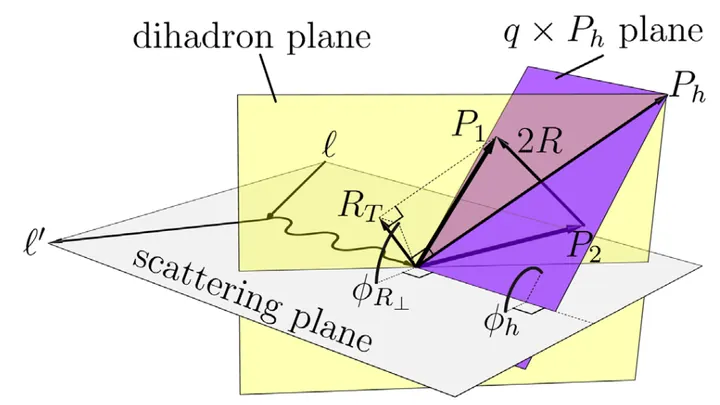
A beam of electrons, twisted like a corkscrew, slams into a proton. From the collision point, pairs of particles, a positive and a neutral pion, fly out. For the first time, physicists measured how often such pairs scatter at different angles when the electron's spin points left or right.
The pulsar in the Crab Nebula blinks like a lighthouse: every 33 milliseconds it sends out a radio pulse, and it does so with the precision of atomic clocks. But sometimes its rotation stumbles: the star suddenly speeds up slightly, as if something inside it is shifting.
Two spinning tops are set off simultaneously in opposite directions. If one spins left, the other always spins right — no matter how far apart they fly. That's roughly how quantum entanglement works, except instead of tops, we have top quarks, the heaviest known particles.
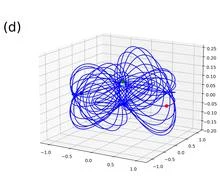
Three bodies attracting each other by universal gravitation: a problem that has stumped mathematics for three centuries. After Poincaré, it became clear that no general solution exists and trajectories are chaotic. But within this chaos there are islands of order: periodic orbits where motion repeats.