A Battery with Character: The Geometry of Energy Delivery express
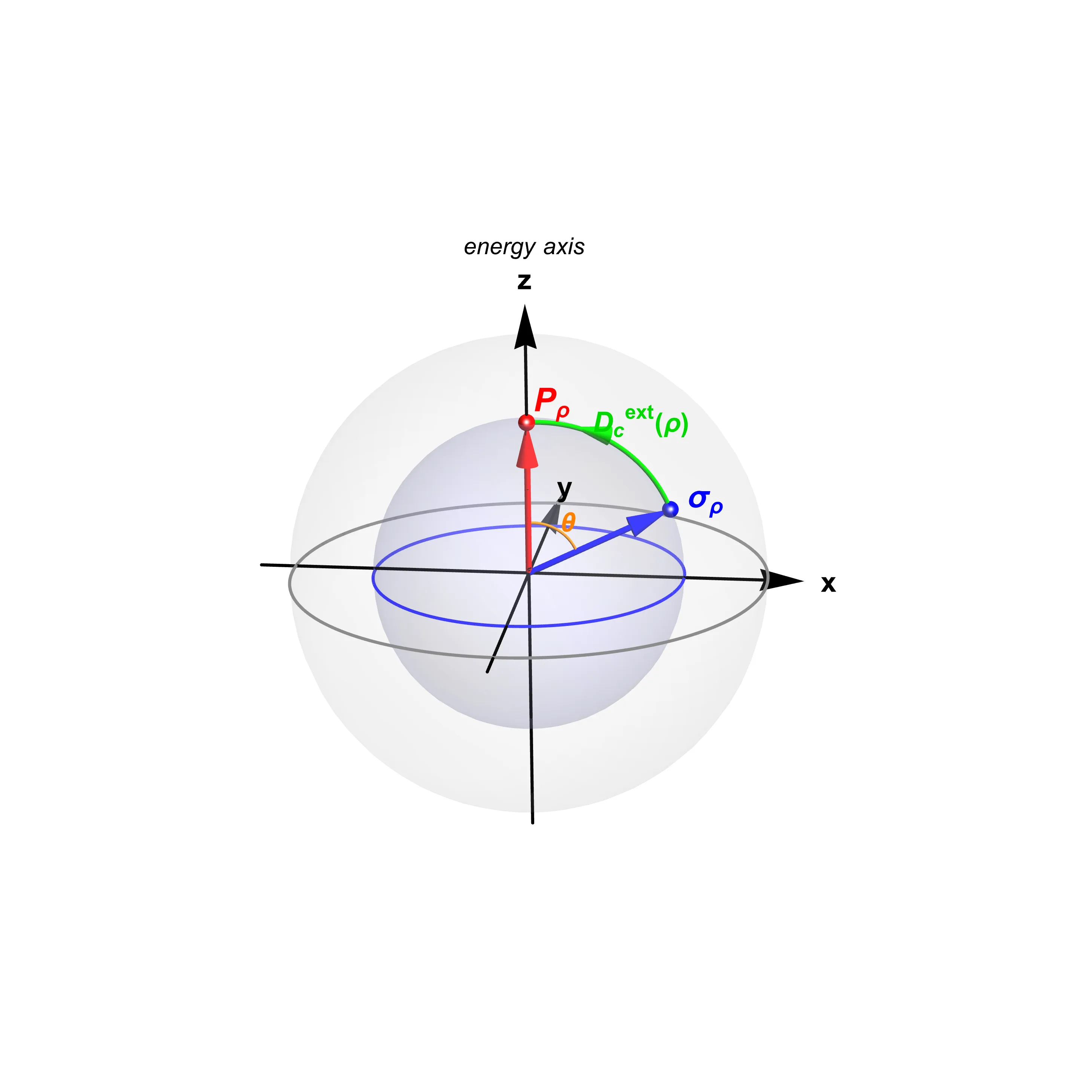
Any battery, from a AA to a quantum one, is simple in principle: there's a store of energy, and there's a way to get it out. In the quantum world, this 'way' looks like a careful switching between particle states, akin to moving a ball from a high shelf to a low one. But if there are many shelves arranged in a tricky pattern, some energy may remain trapped — much like water in a bent tube that can't be fully drained without tilting the whole structure.
The authors of the new study proposed looking at this problem from a geometric perspective. They introduced two key measures. The first, 'coherent energy', is the fraction of charge that can be extracted without destroying quantum order (similar to the synchronized motion of many pendulums). The second, 'extraction distance,' shows how far apart the initial and final states are on the abstract map of all possible states. Their ratio gives a new quantity: 'geometric power capacity.'
The physicists rigorously proved that the actual rate of energy delivery of any quantum battery cannot exceed the product of this capacity and the maximum 'strength' of the control signal (i.e., the fastest rate at which we can change states). In other words, power capacity is an intrinsic property of the charged state itself: its 'talent' for releasing energy quickly. It does not depend on the specific charging-discharging protocol but is determined solely by how the initial state is structured.
This approach is like measuring a pipe's throughput rather than just the tank's volume. It allows one to estimate in advance how quickly energy can be extracted from a quantum storage device without delving into technical details of the process. In the future, this could help design more efficient microscopic power sources — for instance, for quantum computers or ultra-sensitive sensors.
An ordinary AA battery loses a noticeable portion of its energy just sitting on the shelf — due to slow chemical reactions. In an ideal quantum battery, such 'self-discharge' is impossible: energy is locked in a pure quantum state and does not leak out on its own.